How Hard Is the CCRN Exam? What AACN's Test Plan Says
"How hard is the CCRN exam" is one of the most common questions ICU nurses type into a search bar before they schedule a test date. The honest answer is: it depends less on general nursing knowledge and more on whether you can apply that knowledge fast, under pressure, to the specific body systems AACN's own test plan says it will ask about. Here's what that test plan actually says — not a guess, not a forum post, but the categories and weights AACN publishes.
CertPath Publishing's Adult CCRN Exam Prep guide is built directly around this test plan, with practice questions organized by the same body-system categories AACN uses to write the real exam. You can try a piece of that question style right now with 25 free Adult CCRN practice questions at certpathpublishing.store/sample?book=ccrn — no email or signup required, with a full explanation after every answer.
The basic format: 150 questions, 3 hours
The Adult CCRN exam is administered by the American Association of Critical-Care Nurses (AACN). CertPath Publishing is an independent publisher and is not affiliated with or endorsed by AACN.
- 150 multiple-choice questions total — 125 are scored and 25 are unscored pretest items AACN uses to evaluate future questions. You won't know which 25 those are, so every question deserves your full attention.
- 3-hour time limit — that works out to about 72 seconds per question on average, though the exam isn't timed section by section, so you can move faster through questions you're sure of and spend more time on the ones that need it.
- Computer-based delivery at an approved testing center, with results available shortly after you finish.
What the exam is actually testing: the 80/20 split
This is the part most candidates skip past, and it's the part that matters most. AACN's official Adult CCRN test plan splits the 125 scored questions into two categories:
Clinical Judgment — 80% of the exam
This is the bulk of the test, and it's organized by body system rather than by nursing task. The two heaviest categories are Cardiovascular and a combined Endocrine/Hematology/Gastrointestinal/Renal/Integumentary category, which AACN weights as the single largest content area on the exam. The rest of Clinical Judgment covers additional body-system categories, all asking you to apply assessment findings, recognize a deteriorating patient, and choose the right intervention — not just recall a fact.
Professional Caring and Ethical Practice — 20% of the exam
The remaining fifth of the exam covers the non-physiological side of critical care nursing: advocacy, ethical decision-making, communication with patients and families, and end-of-life care. It's built on the AACN Synergy Model for Patient Care, which frames nursing competencies around matching a nurse's characteristics to a patient's needs — a framework worth understanding on its own terms, not just memorizing as exam trivia.
Worked example: turning percentages into a question count
Because AACN publishes the split as percentages of the 125 scored questions, you can estimate how many questions you'll actually see in each category:
- Clinical Judgment: 125 × 0.80 = about 100 questions
- Professional Caring and Ethical Practice: 125 × 0.20 = about 25 questions
That's the single most useful planning number in this article. If your study time is split evenly between physiology-heavy content and professional-practice content, you're under-preparing for the 80% of the exam that's actually about clinical judgment across body systems.
Try 25 tough CCRN questions free
No email, no signup. Full explanations after every answer.
Who's eligible to sit the exam
Before you can even schedule the CCRN exam, AACN requires a current RN or APRN license plus clinical hours caring for critically ill adult patients, under one of two paths:
- 1,750 hours in direct care of critically ill adult patients within the last 2 years, or
- 2,000 hours in direct care of critically ill adult patients within the last 5 years
If you're early in your ICU career and doing the hour math, it's worth checking AACN's eligibility page directly, since the exact accrual rules and any additional recency requirements are confirmed there rather than on third-party sites.
Fees and the retake policy
The exam fee is $260 for AACN members and $375 for non-members. If you don't pass on your first attempt, AACN offers a discounted retest fee of $185 for members and $290 for non-members. You're allowed up to four attempts within a 12-month period, and there's no mandatory waiting period before you can reapply for a retest — you can schedule again as soon as your new application is approved.
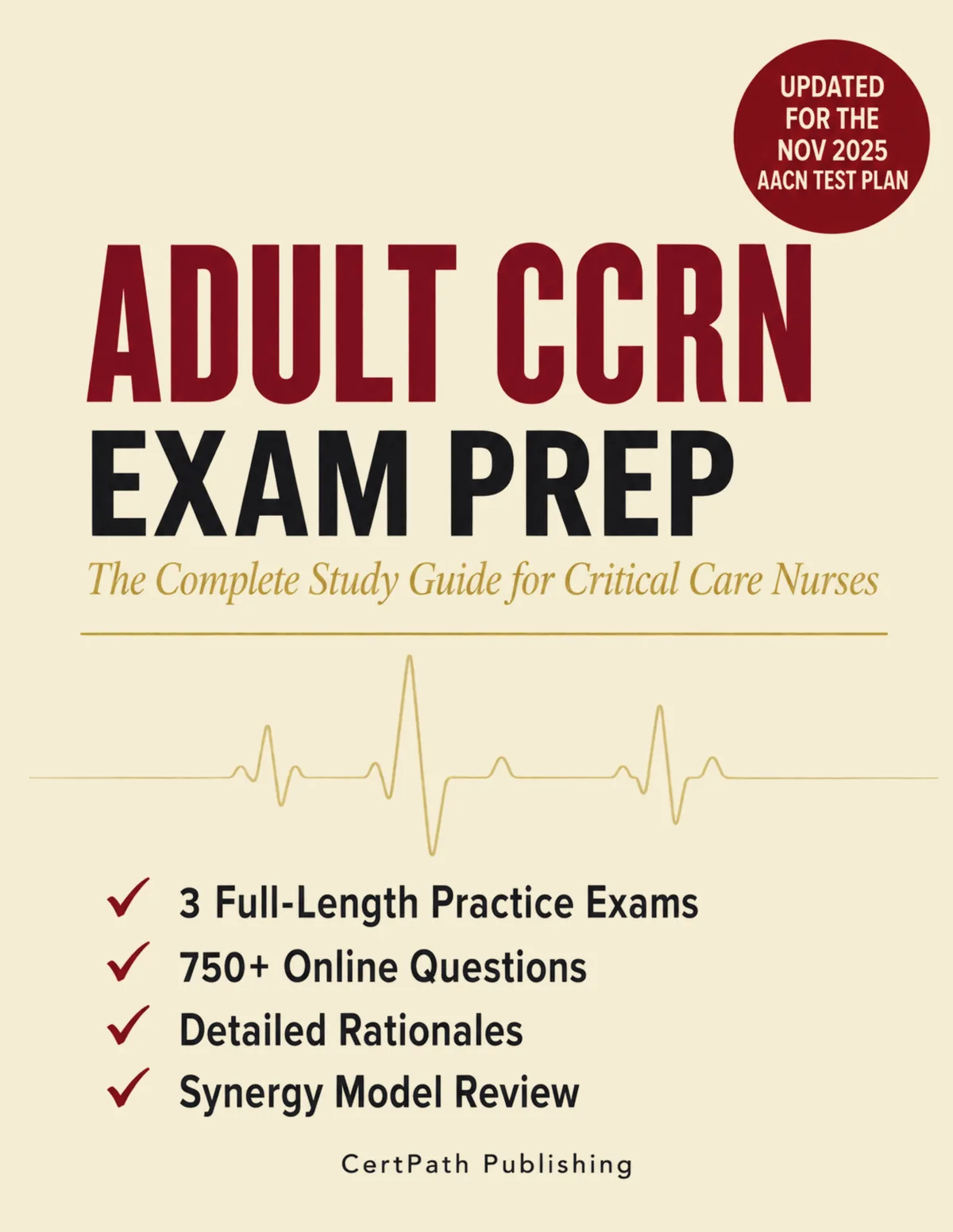
Featured book: Adult CCRN Exam Prep
CertPath Publishing's Adult CCRN Exam Prep guide is organized around AACN's own test plan categories, with full-length timed practice tests and a step-by-step explanation for every question.
Buy on Amazon →A study checklist based on the actual weighting
Rather than studying every topic equally, use the test plan's own weights to prioritize:
- Start with cardiovascular and the endocrine/hematology/GI/renal/integumentary cluster. These are the heaviest-weighted categories inside Clinical Judgment, so a weak spot here costs you more than a weak spot in a lighter category.
- Review every other body-system category at least once before test day — Clinical Judgment spans multiple systems, and skipping one to over-study another leaves a gap the exam is likely to find.
- Don't skip Professional Caring and Ethical Practice. It's a smaller slice at 20%, but it's a distinct skill — recognizing the ethically correct or most patient-centered action — that clinical experience alone doesn't always sharpen.
- Practice under real time pressure. At roughly 72 seconds a question across a 3-hour block, the exam rewards candidates who've rehearsed pacing, not just content.
- Work full-length timed sets, not just isolated questions. Endurance over 150 questions is its own skill separate from knowing the material.
What "hard" actually means for this exam
The CCRN exam isn't hard because the nursing content is obscure — most of it reflects situations experienced ICU nurses see regularly. It's hard because it asks you to apply that knowledge quickly, across a wide range of body systems, in a format where two answer choices often look correct until you check them against the specific scenario details. That's a different skill than bedside competence, and it's the skill that structured practice questions are built to train.
For the full study guide with timed practice tests organized around this same test plan, see the CCRN exam page or buy the Adult CCRN Exam Prep guide on Amazon. And if CCRN isn't the exam you're studying for, CertPath has free practice for other exams here.
FAQ
Where can I find free CCRN practice questions?
CertPath Publishing has 25 free Adult CCRN practice questions at certpathpublishing.store/sample?book=ccrn. No email or signup is required, and you get a full explanation after every answer.
How many questions are on the CCRN exam and how long is it?
The Adult CCRN exam has 150 multiple-choice questions — 125 scored and 25 unscored pretest items — with a 3-hour time limit.
What does the CCRN exam actually test?
According to AACN's official test plan, 80% of scored questions fall under Clinical Judgment, organized by body system, with Cardiovascular and the combined Endocrine/Hematology/Gastrointestinal/Renal/Integumentary category weighted heaviest. The remaining 20% falls under Professional Caring and Ethical Practice, built on the AACN Synergy Model for Patient Care.
What are the eligibility requirements for the CCRN exam?
You need a current RN or APRN license plus either 1,750 hours of direct care to critically ill adult patients within the last two years, or 2,000 hours within the last five years.
How many times can you retake the CCRN exam?
AACN allows up to four attempts within a 12-month period, and there's no mandatory waiting period before reapplying for a retest.
— The CertPath Publishing Team