Free CSP Practice Test: 4 Real Questions Explained
The CSP exam — the Certified Safety Professional credential from the Board of Certified Safety Professionals (BCSP) — doesn't ask you to recall safety trivia. It asks you to work a calculation, weigh a control decision, or read an audit finding the way a practicing safety professional would. Here are four real practice questions, worked step by step, so you can see exactly what that looks like before test day.
These questions are drawn from the same style tested in CertPath Publishing's CSP Exam Study Guide, which also unlocks a free set of 25 tough CSP practice questions online at certpathpublishing.store/sample?book=csp — no email or signup required, with a full explanation after every answer. Below, we'll walk through four of them across four different exam domains, then cover what the real exam actually looks like.
What the CSP exam actually covers
The CSP is administered by the Board of Certified Safety Professionals (BCSP). CertPath Publishing is an independent publisher and is not affiliated with or endorsed by BCSP.
The exam has 200 multiple-choice questions — 176 scored and 24 unscored pretest items you won't be able to identify — with a 5.5-hour time limit. It's a computer-based, closed-book exam, and BCSP's current CSP11 examination blueprint, in effect since August 1, 2025, organizes the content into seven weighted domains:
- Advanced Application of Safety Principles — 25%
- Program Management — 25%
- Risk Management — 15%
- Occupational Health and Applied Science — 10%
- Training — 10%
- Emergency Management — 9%
- Environmental Management — 6%
Advanced Application of Safety Principles and Program Management together make up half the exam, so the four questions below are drawn from a mix of these domains — deliberately, since that's roughly how the real test is weighted.
Question 1: Occupational Health — hearing conservation dose math
A maintenance mechanic's dosimetry for a hearing conservation programme shows 92 dBA for 3 hours, 97 dBA for 2 hours and 85 dBA for 3 hours. The dose is computed on the OSHA hearing conservation basis: a 5 dB exchange rate, a 90 dBA criterion level for an 8-hour reference duration, and an 80 dBA threshold, so every measured level at or above 80 dBA is included. What is the 8-hour time-weighted average?
- A. 92.1 dBA
- B. 90.6 dBA
- C. 91.0 dBA
- D. 92.9 dBA
Correct answer: A — 92.1 dBA.
Explanation: Reference durations are 6.06 h at 92 dBA, 3.03 h at 97 dBA and 16 h at 85 dBA, so the dose is 100 × (3/6.06 + 2/3.03 + 3/16) = 134.2 percent, and the time-weighted average is 16.61 × log(134.2/100) + 90 = 92.1 dBA.
Skill tested: converting sound-level readings into reference durations and combining them into a single dose, then into a time-weighted average — a calculation the exam expects you to do from the exchange-rate formula, not from memory.
The trap: answer C (91.0 dBA) drops the 85 dBA period entirely by applying a 90 dBA threshold. That threshold belongs to permissible-exposure-limit compliance, not to the hearing conservation dose this question specifies, which starts including levels at 80 dBA.
Question 2: Program Management — combining probabilities in a fault tree
A fault tree shows the top event occurring if either subsystem fails. The first subsystem fails only when both of its redundant components fail, each with a failure probability of 0.2. The second subsystem fails if either of its two components fails, with probabilities of 0.1 and 0.05. All four component failures are independent of one another. What is the probability of the top event?
- A. 0.145
- B. 0.179
- C. 0.190
- D. 0.040
Correct answer: B — 0.179.
Explanation: The redundant pair is an AND gate: 0.2 × 0.2 = 0.04. The second subsystem is an OR gate: 1 − (0.9 × 0.95) = 0.145. The two feed another OR gate: 1 − (0.96 × 0.855) = 0.179.
Skill tested: reading a fault tree's logic gates correctly — knowing when component failures multiply (AND) versus when they combine through the complement rule (OR) — a core system-safety-analysis skill inside Program Management.
The trap: answer C (0.190) comes from adding 0.04, 0.10 and 0.05 straight down the tree, which double-counts overlapping failure paths and gets worse the higher the individual probabilities are. Answer A (0.145) stops one gate too early, at the second subsystem alone.
Question 3: Risk Management — choosing a control under the hierarchy
Solvent vapour at a degreasing line runs at twice the exposure limit. Reformulating to an aqueous cleaner would require customer requalification of the finished part, which engineering says will take at least eighteen months. Enclosing the line with local exhaust is feasible in about four months. What is the most defensible plan?
- A. Provide respirators and restrict access now, start the enclosure and exhaust design immediately, and keep the substitution study open as the longer-term goal.
- B. Rotate operators through the line so that no individual's time-weighted average exceeds the limit while the substitution study proceeds.
- C. Suspend the substitution study because the requalification delay makes it infeasible, and direct the full budget to enclosure and exhaust.
- D. Implement the respirator programme with fit testing and medical evaluation as the control, and revisit engineering controls only if sampling worsens.
Correct answer: A.
Explanation: Use respirators and access restrictions immediately as interim protection, implement the feasible enclosure and local exhaust as soon as practicable, and continue evaluating substitution as the higher-order long-term control.
Skill tested: applying the hierarchy of controls to a real timeline with competing constraints, instead of picking a single control and stopping there.
The trap: answer B (rotation) is an administrative control that may lower one worker's individual exposure reading, but it doesn't reduce the source concentration and can spread the exposure to more people — it's inferior to a feasible engineering control that's already on the table. Answer D treats respirators as the permanent fix instead of an interim measure, which runs against the hierarchy's basic ordering.
Try 25 tough CSP questions free
No email, no signup. Full explanations after every answer.
Question 4: Emergency Management — hydraulic design for a sprinkler system
A storage area is protected by a dry-pipe sprinkler system. The hydraulic design calls for a density of 0.20 gpm per sq ft over a 2,500 sq ft area of operation. Given that a dry-pipe system's area of operation must be increased by 30 percent without changing the density, and that a hose stream allowance of 250 gpm must be added at the base of the riser, what total water supply must be available?
- A. 650 gpm
- B. 750 gpm
- C. 975 gpm
- D. 900 gpm
Correct answer: D — 900 gpm.
Explanation: The dry-pipe adjustment enlarges the area to 2,500 × 1.30 = 3,250 sq ft, the sprinkler demand is 3,250 × 0.20 = 650 gpm, and adding the hose stream allowance gives 900 gpm.
Skill tested: applying a dry-pipe system's area-of-operation adjustment before adding the hose stream allowance, in the correct order — a fire protection system design calculation inside Emergency Management.
The trap: answer B (750 gpm) uses the unadjusted 2,500 sq ft area and misses the 30 percent increase that compensates for the delay while air is exhausted from dry piping. Answer A (650 gpm) omits the hose stream allowance entirely, and answer C (975 gpm) applies the 30 percent increase to the combined figure instead of to the area alone.
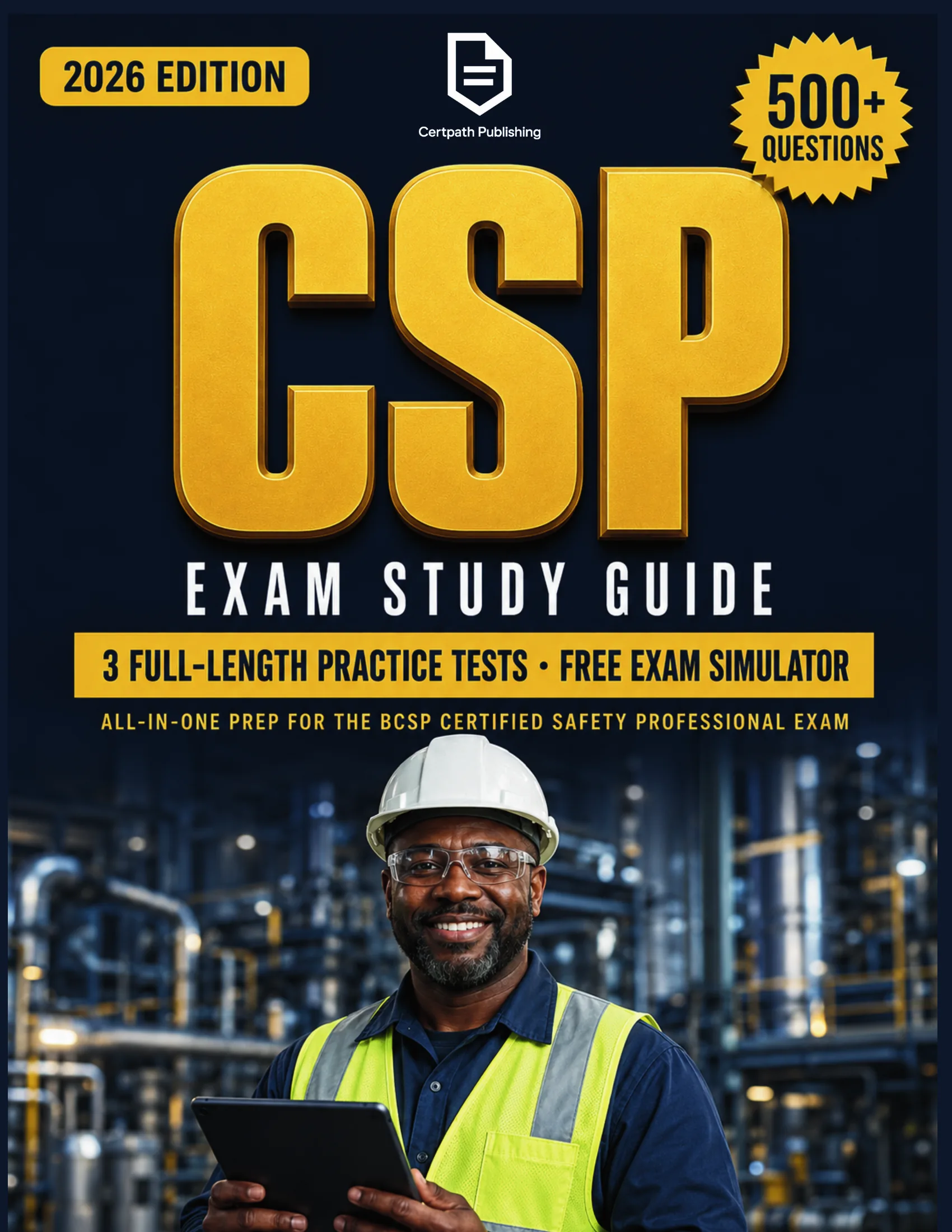
Featured book: CSP Exam Study Guide
CertPath Publishing's CSP Exam Study Guide is organized around the current CSP11 blueprint domains, with 3 full-length timed practice tests (180 questions total) and a step-by-step explanation for every question.
Buy on Amazon →Who's eligible to sit the CSP exam
The CSP isn't an entry-level credential — BCSP requires candidates to already hold an approved prerequisite credential before they can apply:
- A minimum of a bachelor's degree in any field.
- At least 4 years of safety, health and environment (SH&E) experience, at least half of which is preventative, professional-level work with breadth and depth of safety duties.
- A BCSP-approved credential, such as the Associate Safety Professional (ASP), Graduate Safety Practitioner, or an equivalent BCSP-qualified credential.
If you're weighing whether your degree and experience qualify, BCSP's eligibility page is the place to confirm the exact requirements, since the accepted prerequisite credentials and experience rules are detailed there rather than on third-party sites.
Fees and the retake policy
The application fee is $160 and the exam fee is $350; BCSP also offers a bundle around $600 that includes two exam attempts and one self-assessment. Once you're approved, you have a one-year eligibility window to take and pass the exam. If you fail with less than six weeks remaining in that window, BCSP requires a paid one-year extension before you can retest. If the window closes without a pass, you'll need to reapply and pay the application fee again.
What these four questions tell you about the real test
Notice that in all four questions, the wrong answers aren't random — each one is the direct result of one specific, predictable mistake (applying the wrong threshold, stopping the calculation one step early, treating an interim control as permanent, skipping a required adjustment). That's how CSP question writers build distractors across every domain, not just these four. The fastest way to raise your score isn't memorizing formulas in isolation; it's training yourself to notice which trap each wrong answer represents before you pick.
The other pattern worth noticing: several of these questions combine two steps into one problem — a unit conversion followed by a design rule, or a probability calculation followed by a logic-gate combination. The CSP exam rewards candidates who can hold two steps in mind at once rather than stopping after the first one feels complete.
The remaining 21 questions in the free set cover the rest of the CSP11 domains, worked the same way with a full explanation after each one. Head to the free CSP sample to try them.
FAQ
Where can I find free CSP practice questions?
CertPath Publishing has 25 free CSP practice questions at certpathpublishing.store/sample?book=csp. No email or signup is required, and you get a full explanation after every answer.
How many questions are on the real CSP exam, and how long is it?
The CSP exam has 200 multiple-choice questions — 176 scored and 24 unscored pretest items — with a 5.5-hour time limit.
What are the eligibility requirements for the CSP exam?
You need a minimum of a bachelor's degree in any field, at least 4 years of safety, health and environment experience (at least half of it preventative, professional-level work), and a BCSP-approved credential such as the Associate Safety Professional (ASP).
What does the CSP exam actually cover?
The current CSP11 blueprint splits the exam into 7 domains: Advanced Application of Safety Principles (25%), Program Management (25%), Risk Management (15%), Occupational Health and Applied Science (10%), Training (10%), Emergency Management (9%) and Environmental Management (6%).
Can I retake the CSP exam if I don't pass?
Yes. You have a one-year eligibility window to take and pass the exam. Failing with less than six weeks left in that window requires a paid one-year extension before you can retest, and if the window closes without a pass, you must reapply and pay the application fee again.
For the full study guide with all three timed practice tests, see the CSP exam page or buy the CSP Exam Study Guide on Amazon. And if CSP isn't the exam you're studying for, CertPath has free practice for other exams here.
— The CertPath Publishing Team