Free CHST Practice Test: 4 Exam-Style Questions Explained
The CHST exam — the Construction Health and Safety Technician credential from the Board of Certified Safety Professionals (BCSP) — doesn't test safety slogans. It tests whether you can look at a specific jobsite condition (a trench, a scaffold, a rigging setup) and apply the exact rule that governs it, including the numbers. Here are four exam-style practice questions, worked step by step, so you can see exactly what that looks like before test day.
These questions are drawn from the same style tested in CertPath Publishing's CHST Exam Study Guide, which also unlocks a free set of 25 tough CHST practice questions online at certpathpublishing.store/sample?book=chst — no email or signup required, with a full explanation after every answer. Below, we'll walk through four of them across four different exam domains, then cover what the real exam actually looks like.
What the CHST exam actually covers
The CHST is administered by the Board of Certified Safety Professionals (BCSP). CertPath Publishing is an independent publisher and is not affiliated with or endorsed by BCSP.
The exam has 200 multiple-choice questions with a 4-hour time limit. It's a computer-based, closed-book exam, and BCSP's current CHST5 examination blueprint organizes the content into four weighted domains:
- Hazard and Risk Identification and Control — 36.6%
- Safety Program Development, Implementation and Sustainment — 22.5%
- Leadership, Communication and Training — 21%
- Emergency Preparedness, Incident Investigation and Response — 19.9%
Hazard and Risk Identification and Control alone accounts for more than a third of the exam, which is why three of the four questions below come from that domain — deliberately, since that's roughly how the real test is weighted.
Question 1: Hazard Identification and Control — fall protection at 7 feet
Crews are installing roof sheathing on a 7 ft high equipment platform inside a building under construction. The platform has an open edge along one side, work will last two shifts, and the general contractor proposes a controlled access zone with a monitor because anchor points are difficult to install. What does the construction standard require here?
- A. Guardrails, safety nets or personal fall arrest are required, because difficulty installing anchors does not by itself establish infeasibility or a greater hazard.
- B. A warning line set 6 ft back from the open edge is acceptable, because it keeps workers outside the zone where a fall could occur.
- C. No fall protection is required, because the 6 ft trigger applies only to exposures at the perimeter of a structure's outermost frame.
- D. A controlled access zone with a competent monitor is acceptable, because the exposure is below 10 ft and of short duration.
Correct answer: A.
Explanation: The open edge is 7 ft above the lower level, so guardrails, safety nets or personal fall arrest are required. A controlled access zone with a safety monitor may be used for qualifying work only under a compliant site-specific fall-protection plan, and only after the employer demonstrates that conventional systems are infeasible or create a greater hazard. The tempting answer accepts the monitor on the strength of a short exposure and awkward anchors, neither of which establishes that exception.
Skill tested: recognizing that a controlled access zone and safety monitor is a narrow exception, not a default option, and that it requires a documented infeasibility finding, not just an inconvenient anchor point.
The trap: treating short job duration or difficult anchor installation as good enough reasons to skip conventional fall protection — that's exactly the reasoning answer D offers, and it's the one BCSP question writers expect candidates to reach for first.
Question 2: Hazard Identification and Control — trench sloping math
An 8 ft deep trench with a 4 ft wide bottom must be opened in soil the competent person has classified as Type C, using the maximum allowable slope of 1.5 horizontal to 1 vertical for that class. The only working space runs 26 ft between an existing curb and a building face. What should the competent person conclude?
- A. Sloping alone needs 20 ft across the top and fits the available space, so no support or shield system is required.
- B. Sloping alone needs 16 ft across the top and fits the available space, so no support or shield system is required.
- C. Sloping alone needs 28 ft across the top, which exceeds the 26 ft available, so a support or shield system must be used instead.
- D. Benching the walls fits the available space and is the appropriate alternative where sloping cannot be completed.
Correct answer: C.
Explanation: Each side needs 1.5 × 8 = 12 ft of run, so the top width is 4 + 12 + 12 = 28 ft, which the 26 ft of working space cannot accommodate; a trench shield or shoring is then required. The most tempting answer, 20 ft, comes from applying the 1 to 1 slope that belongs to Type B soil. The 16 ft figure counts the run on one side only, and benching is not permitted in Type C soil at all.
Skill tested: calculating the horizontal run per side for a given slope ratio and soil type, then comparing the total top width against the actual site constraint before deciding whether sloping alone is enough.
The trap: mixing up the slope ratio for the wrong soil classification — swapping in Type B's steeper 1:1 slope is the single most common error on this style of question, and it's exactly what makes answer A tempting.
Question 3: Hazard Identification and Control — rigging sling angles
A 4,000 lb precast panel will be lifted with a two-leg bridle sling whose legs share the load equally. Each leg is rated 2,600 lb. The rigging crew can set the legs at 30, 45, 60 or 75 degrees from the horizontal. What is the smallest of those angles that keeps each leg within its rating?
- A. 75 degrees
- B. 30 degrees
- C. 45 degrees
- D. 60 degrees
Correct answer: D.
Explanation: Leg tension is half the load divided by the sine of the angle from horizontal. At 60 degrees it is 2,000 ÷ 0.866 = 2,310 lb, within the 2,600 lb rating, and it is the smallest listed angle that qualifies. The most tempting answer is 45 degrees, a common default that many riggers assume is safe; there the tension is 2,000 ÷ 0.707 = 2,830 lb, which overloads the leg. At 30 degrees each leg carries the full 4,000 lb.
Skill tested: computing sling leg tension from the load and the angle from horizontal, and recognizing how sharply that tension climbs as the angle gets shallower.
The trap: assuming 45 degrees is a safe rule-of-thumb rigging angle. It isn't automatically safe — it depends entirely on how much margin the sling's rated capacity leaves above half the load, and here it doesn't leave enough.
Try 25 tough CHST questions free
No email, no signup. Full explanations after every answer.
Question 4: Safety Program Development — recordable and DART rate math
A specialty contractor worked 92,000 hours on a project and recorded five OSHA recordable cases, three of which involved days away from work or job restriction. An owner's prequalification form sets limits of 8.0 for the total recordable case rate and 7.0 for the DART rate. How does the contractor stand?
- A. The total recordable rate of 6.5 is within its limit and the DART rate of 3.3 is within its limit, so the contractor meets both criteria.
- B. The total recordable rate of 10.9 exceeds its limit while the DART rate of 6.5 is within its limit, so the contractor fails on the recordable criterion.
- C. The total recordable rate of 10.9 and the DART rate of 7.6 both exceed their limits, so the contractor fails on both criteria.
- D. The total recordable rate of 5.4 and the DART rate of 3.3 are both within their limits, so the contractor meets both criteria.
Correct answer: B.
Explanation: Both rates use a 200,000 hour base: (5 × 200,000) ÷ 92,000 = 10.9 and (3 × 200,000) ÷ 92,000 = 6.5, so the recordable rate fails and the DART rate passes. The most tempting error uses a 100,000 hour base and reports 5.4 and 3.3, which would clear both limits and misrepresent the contractor's record. Counting only the three DART cases as the recordable rate gives 6.5 and also clears the screen wrongly.
Skill tested: applying OSHA's standard 200,000-hour base correctly in a recordable-rate and DART-rate calculation, and keeping the two counts (all recordables vs. days-away/restricted cases) separate.
The trap: using a 100,000-hour base instead of 200,000 — a mix-up with a different injury-rate convention that quietly cuts every rate in half and can make a contractor look like it passes a prequalification screen it actually fails.
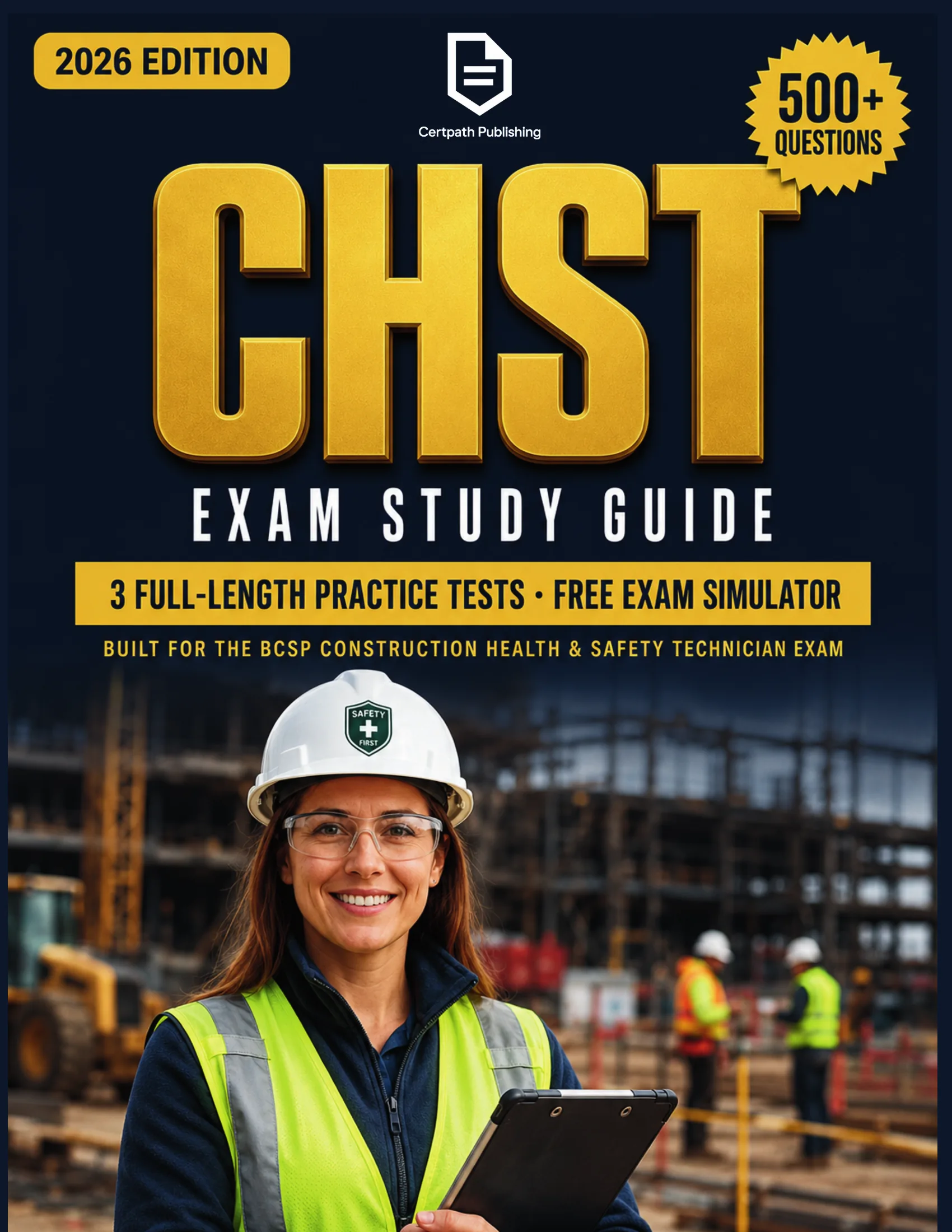
Featured book: CHST Exam Study Guide
CertPath Publishing's CHST Exam Study Guide is organized around the current CHST5 blueprint domains, with 3 full-length timed practice tests (180 questions total) and a step-by-step explanation for every question.
Buy on Amazon →Who's eligible to sit the CHST exam
The CHST is a mid-career credential aimed at people who already spend most of their time on construction safety, not an entry-level test. BCSP's current eligibility requirements are:
- At least 3 years of construction safety, health and environmental experience, with construction safety making up a defined minimum share of your job duties.
- No specific degree requirement — BCSP does not publish an academic-credit or degree prerequisite for CHST eligibility, unlike some of its other credentials.
- Passing the CHST exam itself once your application and experience are approved.
If you're weighing whether your job duties and experience qualify, BCSP's own CHST eligibility page is the place to confirm the exact current requirements, since the accepted duty categories and their minimum share are detailed there.
Fees and the retake policy
Under BCSP's published fee schedule, the CHST application and a separate exam authorization are billed individually (BCSP also offers combined application-plus-exam pricing). Once you're approved, you have a one-year eligibility window to take and pass the exam. If you don't pass, you must wait six weeks before retesting and purchase another exam authorization. If fewer than six weeks remain in your one-year eligibility window when you fail, BCSP requires a one-time, paid extension before you can retest. Confirm the current dollar amounts directly on BCSP's CHST page before you apply, since fee schedules change.
What these four questions tell you about the real test
Notice that in all four questions, the wrong answers aren't random guesses — each one is the direct result of one specific, predictable mistake (accepting a narrow exception too easily, applying the wrong soil class's slope ratio, trusting a "safe" rule of thumb that doesn't hold here, using the wrong hour base in a rate calculation). That's how CHST question writers build distractors across every domain, not just these four. The fastest way to raise your score isn't memorizing rules in isolation; it's training yourself to spot which specific number or condition each wrong answer got wrong.
The other pattern worth noticing: three of these four questions expect you to do a calculation — a slope run, a sling tension, an incident rate — rather than just recall a fact. The CHST exam rewards candidates who can carry a number through two or three steps correctly, not just candidates who know the underlying rule exists.
The remaining 21 questions in the free set cover the rest of the CHST5 domains, worked the same way with a full explanation after each one. Head to the free CHST sample to try them.
FAQ
Where can I find free CHST practice questions?
CertPath Publishing has 25 free CHST practice questions at certpathpublishing.store/sample?book=chst. No email or signup is required, and you get a full explanation after every answer.
How many questions are on the real CHST exam, and how long is it?
The CHST exam has 200 multiple-choice questions with a 4-hour time limit, administered as a closed-book, computer-based test.
What are the eligibility requirements for the CHST exam?
You need at least 3 years of construction safety, health and environmental experience, with construction safety duties making up a defined minimum share of your work, and you must pass the CHST exam.
What does the CHST exam actually cover?
The current CHST5 blueprint splits the exam into four domains: Hazard and Risk Identification and Control (36.6%), Safety Program Development, Implementation and Sustainment (22.5%), Leadership, Communication and Training (21%), and Emergency Preparedness, Incident Investigation and Response (19.9%).
Can I retake the CHST exam if I don't pass?
Yes. You must wait six weeks before retesting and pay for another exam authorization. You have a one-year eligibility window from your application's approval to pass the exam, and BCSP offers a one-time extension if you're close to that deadline.
For the full study guide with all three timed practice tests, see the CHST exam page or buy the CHST Exam Study Guide on Amazon. And if CHST isn't the exam you're studying for, CertPath has free practice for other exams here.
— The CertPath Publishing Team