CNOR Certification: Eligibility, Exam Format and Prep
CNOR — Certified Perioperative Nurse — is the credential that tells an OR director you can manage a patient safely through every phase of surgery, not just follow a checklist. It's administered by the Competency & Credentialing Institute (CCI), and it isn't a formality: it's a 200-question exam built from a real job-task analysis of practicing OR nurses. Here's what you actually need to qualify, what the exam covers, and a realistic way to prepare while still working full shifts.
CertPath Publishing's CNOR Exam Study Guide is built around this same content outline. Before you buy anything, though, try 25 free CNOR practice questions — no email or signup required, with a full explanation after every answer, so you can see where your knowledge actually stands. CertPath Publishing is an independent publisher and is not affiliated with or endorsed by CCI.
Who's eligible to sit the CNOR exam
CNOR isn't an entry-level credential — it's built for nurses who are already working in the OR. Per CCI's published eligibility criteria, you need:
- A current, unrestricted RN license.
- At least 2 years and 2,400 hours of perioperative nursing experience, with at least half of those hours (1,200) spent specifically in the intraoperative setting — actually circulating or scrubbing cases, not just working somewhere in the surgical department.
- Current, active practice in perioperative nursing, full-time or part-time, at the time you apply.
If you're not sure your specific role or hour mix qualifies, CCI's own CNOR certification page is the authoritative source — confirm the exact current wording there before you submit an application, since eligibility language can be refined between handbook updates.
What's actually on the CNOR exam
The exam is 200 multiple-choice questions with a 3-hour, 45-minute time limit, delivered as a computer-based test. Not all 200 items count toward your score — a portion are unscored pretest questions CCI is trying out for future exam forms, which is standard practice across most large certification exams and why domain weights below are reported as a share of the scored items. To pass, you need a scaled score of at least 620; a scaled score isn't the same thing as "620 out of 1,000 raw points," so don't try to reverse-engineer how many questions you can miss.
CCI's current content outline organizes the exam into seven subject areas:
- Management of Intraoperative Activities — roughly 34% (the single largest area by far)
- Infection Prevention and Control of the Environment, Instrumentation and Supplies — roughly 16%
- Pre/Postoperative Patient Assessment and Diagnosis — roughly 15%
- Communication and Documentation — roughly 11%
- Emergency Situations — roughly 10%
- Individualized Plan of Care Development and Expected Outcome Identification — roughly 8%
- Professional Accountability — roughly 6%
Worth flagging: CCI has adopted the results of its 2024 job-task analysis, and has announced that starting in 2027 the CNOR (and CFPN) content outline will consolidate from seven subject areas into six. If your test date lands in or after 2027, verify the current blueprint on CCI's site before you build a study plan around the breakdown above.
A worked example: allocating study time by domain weight
A simple, defensible way to plan your study hours is to split them roughly in proportion to how much of the scored exam each domain represents — rather than spending equal time on all seven areas, which under-prepares you for the domain that actually decides most of your score.
Say you have 40 total hours to study before your test date. Applying the weights above:
- Management of Intraoperative Activities: 34% × 40 = 13.6 hours (round to 14)
- Infection Prevention and Control: 16% × 40 = 6.4 hours (round to 6)
- Pre/Postoperative Assessment and Diagnosis: 15% × 40 = 6 hours
- Communication and Documentation: 11% × 40 = 4.4 hours (round to 4)
- Emergency Situations: 10% × 40 = 4 hours
- Plan of Care Development: 8% × 40 = 3.2 hours (round to 3)
- Professional Accountability: 6% × 40 = 2.4 hours (round to 3, to keep the total close to 40)
That's roughly a third of your entire study budget on intraoperative management alone — sterile technique, positioning, counts, specimen handling, electrosurgery safety, and the dozens of intraoperative judgment calls CNOR is really testing. If you only have time to over-prepare one area, this is the one.
A 4-week study plan while working full-time OR shifts
You don't need to quit picking up shifts to prepare well. A focused, four-week plan built around the domain weights above looks like this:
- Week 1: Take a full practice set cold to find your weak domains. Then work through Management of Intraoperative Activities and Infection Prevention — the two largest domains — using your study guide's chapter reviews.
- Week 2: Cover Pre/Postoperative Assessment and Communication/Documentation. Start mixing in timed practice questions daily, even just 10-15 minutes, rather than saving all practice for the end.
- Week 3: Cover Emergency Situations, Plan of Care Development, and Professional Accountability. Take a second full-length timed practice test under real exam conditions (3 hours, 45 minutes, no notes).
- Week 4: Review every question you missed on both practice tests, focusing on why the wrong answer was tempting, not just what the right answer was. Take a final practice test 3-4 days before your scheduled exam, then taper off — don't cram new material the night before.
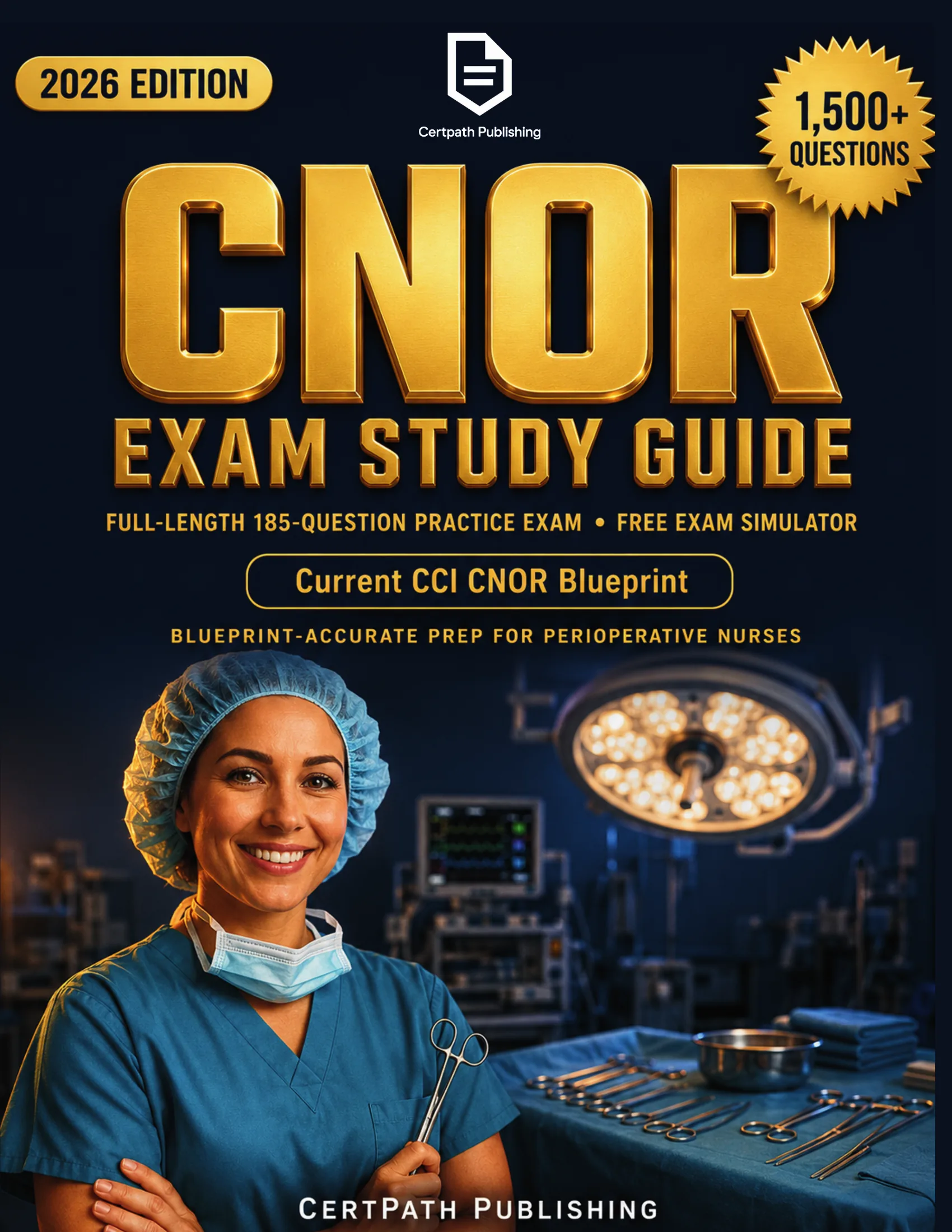
Featured book: CNOR Exam Study Guide
CertPath Publishing's CNOR Exam Study Guide is organized around CCI's content outline, with full-length timed practice tests and a step-by-step explanation for every question.
Buy on Amazon →Registration, fees and retakes
You apply for CNOR directly through CCI, submitting proof of your RN license and documenting your qualifying perioperative hours. Once approved, you're issued an eligibility window in which to schedule and sit the exam at a testing center. If you don't pass, CCI allows you to retake the exam — retakes are purchased separately from your original application fee and can only be scheduled after a required waiting period, within your overall eligibility window.
Application fees, retake fees and eligibility-window lengths do change, and different sources currently quote different numbers, so rather than repeat a figure that might be out of date by the time you read this, confirm the current fee schedule and retake rules directly in CCI's official CNOR candidate handbook before you apply.
Recertification: CNOR isn't a one-time credential
Passing the exam is the start, not the end. CNOR certification runs on a multi-year cycle, and you maintain it by earning continuing education and professional-development points rather than retaking the full exam each time — as long as you keep meeting the recertification criteria. CCI made a notable change here: effective January 1, 2026, it removed the mandatory standalone recertification year from all certification cycles, so CNORs now work within a single continuous validity window and have more flexibility in when they earn points and submit their renewal application, rather than being boxed into a separate final year. If you're already certified or planning ahead, check CCI's recertification page for the current point totals, accepted activity categories, and deadlines that apply to your specific certification cycle.
Try 25 tough CNOR questions free
No email, no signup. Full explanations after every answer.
FAQ
Where can I find free CNOR practice questions?
CertPath Publishing has 25 free CNOR practice questions at certpathpublishing.store/sample?book=cnor. No email or signup is required, and you get a full explanation after every answer.
How many questions are on the CNOR exam and how long do I have?
The CNOR exam has 200 multiple-choice questions with a 3-hour, 45-minute time limit. Some of the 200 items are unscored pretest questions being tried out for future exams, which is why CCI's content outline reports domain weights as a share of the scored items rather than all 200.
What are the eligibility requirements for the CNOR exam?
You need a current, unrestricted RN license and at least 2 years and 2,400 hours of perioperative nursing experience, with at least half of those hours in the intraoperative setting.
What score do I need to pass the CNOR exam?
CNOR uses scaled scoring, and candidates need a scaled score of at least 620 to pass. The scaled score is not the same as a raw percentage of questions answered correctly.
Can I retake the CNOR exam if I don't pass?
Yes. CCI allows retakes within your eligibility period, purchased separately and scheduled after a required waiting period. Because fee amounts and waiting periods can change, confirm the current retake policy and pricing on CCI's official CNOR candidate handbook before you apply.
For the full study guide with timed practice tests, see the CNOR exam page or buy the CNOR Exam Study Guide on Amazon. And if CNOR isn't the exam you're studying for, CertPath has free practice for other exams here.
— The CertPath Publishing Team