Digital PSAT vs. Digital SAT Math: What's Different
Line them up side by side and the Digital PSAT/NMSQT Math section and Digital SAT Math section look almost identical — same number of questions, same two-module adaptive design, same built-in calculator. Most study guides treat the PSAT as simply "an easier SAT" and leave it there. That misses the parts that actually matter: the two tests weight their math topics differently, score on entirely different scales, and exist for different purposes. Here's exactly what changes and what doesn't, checked against College Board's own SAT Suite pages.
CertPath Publishing keeps a separate, exam-specific guide for each test — Digital SAT Math Prep and Digital PSAT/NMSQT Math Prep — built around each exam's own content weighting rather than one being a reskin of the other. Before comparing formats, see how the questions actually feel: try 25 free Digital SAT Math practice questions or 25 free PSAT/NMSQT Math practice questions, no email or signup required for either, with a full explanation after every answer.
The math section format is nearly a mirror image
Structurally, these two sections are built from the same blueprint. Both are 44 questions across two 35-minute modules (70 minutes total), and both are adaptive: how you do on the first module decides whether the second module skews easier or harder, which is how each test narrows in on your actual level. Both allow a calculator — a built-in graphing calculator (or your own approved model) — for the entire section, with no calculator-free portion on either test. And both math sections sit inside a full test that runs 2 hours and 14 minutes, preceded by a 64-minute, 54-question Reading and Writing section (also two modules) and a 10-minute break before Math begins.
Sources: the SAT Math section page and PSAT/NMSQT Math section page, both from College Board's SAT Suite. CertPath Publishing is an independent publisher and is not affiliated with or endorsed by College Board.
Where they actually diverge: content weighting
Both tests draw questions from the same four content domains — Algebra, Advanced Math, Problem-Solving and Data Analysis, and Geometry and Trigonometry — but they don't weight those domains identically. According to College Board's published content domain breakdowns:
- SAT Math: Algebra ~35%, Advanced Math ~35%, Problem-Solving and Data Analysis ~15%, Geometry and Trigonometry ~15%.
- PSAT/NMSQT Math: Algebra ~35%, Advanced Math ~32.5%, Problem-Solving and Data Analysis ~20%, Geometry and Trigonometry ~12.5%.
The shift is small but consistent: the PSAT/NMSQT trims a little weight from Advanced Math and from Geometry and Trigonometry, and adds it to Problem-Solving and Data Analysis — the domain built around rates, ratios, percentages and reading data from tables and graphs.
Worked example: turning those percentages into an actual question count
Applying each set of percentages to the 44 scored questions on a single math section (rounding to whole questions):
- SAT Math (44 questions): about 15 Algebra, 15 Advanced Math, 7 Problem-Solving and Data Analysis, 7 Geometry and Trigonometry.
- PSAT/NMSQT Math (44 questions): about 15 Algebra, 14 Advanced Math, 9 Problem-Solving and Data Analysis, 6 Geometry and Trigonometry.
That's only a two-question swing between the two tests — one fewer Advanced Math question, one fewer Geometry and Trigonometry question, two more Problem-Solving and Data Analysis questions on the PSAT/NMSQT. It won't change how you study overall, but if you're deciding where to spend a last-minute review hour, the PSAT/NMSQT rewards data-and-rates practice fractionally more, while the SAT rewards a bit more depth in nonlinear equations and trig.
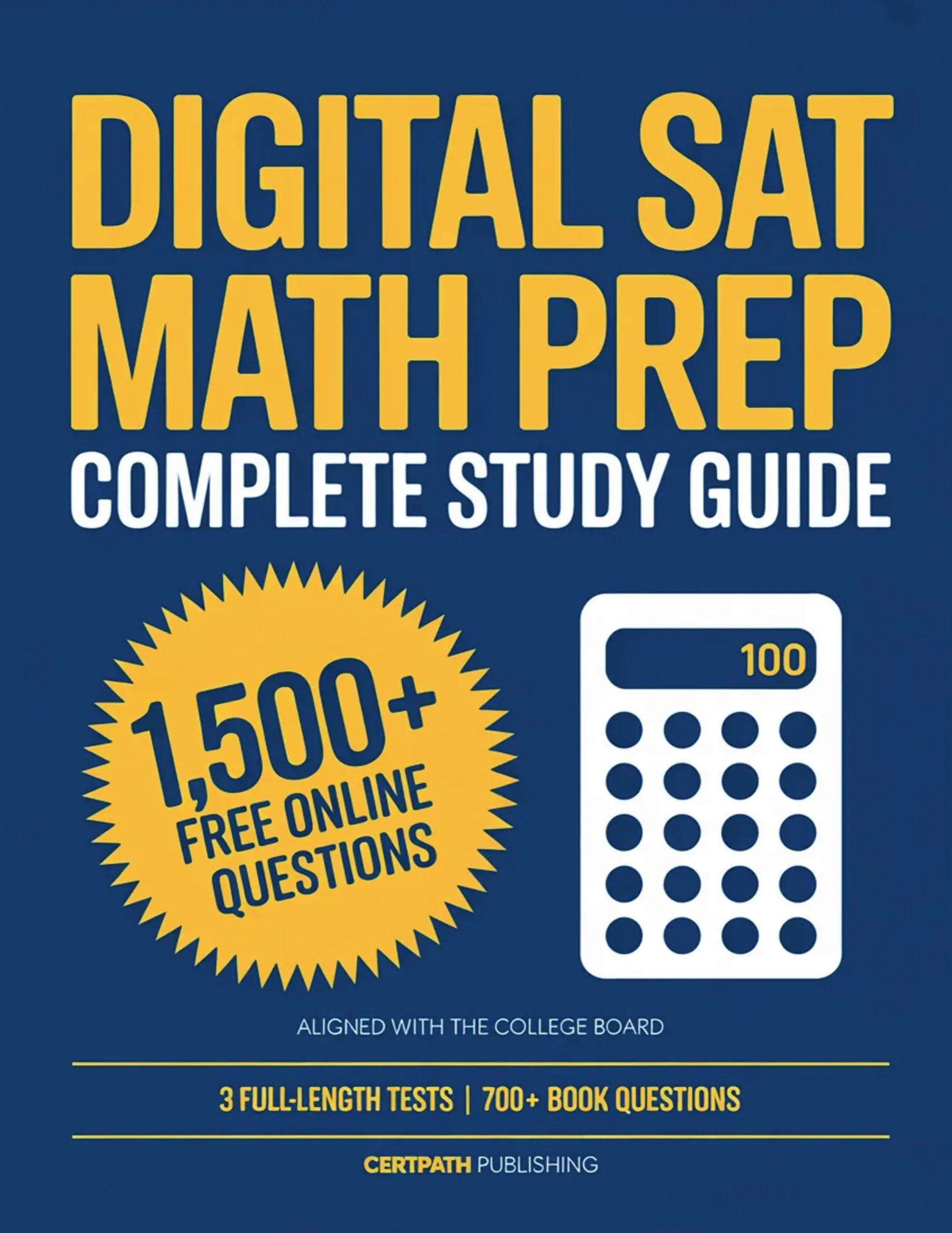

Featured books: SAT & PSAT/NMSQT Math Prep
Each guide is organized around its own exam's content domains and includes full-length practice tests with instant feedback and a worked explanation for every question — no cross-exam guesswork.
Scoring: same idea, deliberately different scale
Neither test wants its score confused with the other's, so the scales don't overlap. SAT Math scores from 200–800, combining with a 200–800 Reading and Writing score for a total of 400–1600. PSAT/NMSQT Math scores from 160–760, combining with a 160–760 Reading and Writing score for a total of 320–1520 — per College Board's scoring pages. The lower PSAT/NMSQT ceiling isn't a harder curve; it reflects that PSAT/NMSQT test-takers are typically a year or more away from the content depth the full SAT scale is built to spread out.
The PSAT/NMSQT adds one more number the SAT doesn't have: a Selection Index, calculated as (2 × Reading and Writing score + Math score) ÷ 10, giving a range of 48–228. This is the number the National Merit Scholarship Corporation actually uses for recognition — and only a score from the PSAT/NMSQT taken in 11th grade counts toward it, regardless of how well a student scores in 10th grade or on the SAT itself.
Purpose and cost: why the two tests exist side by side
The SAT is a college-admissions test: any student can register for it, at any grade, and take it more than once, with fee-paying registration set by College Board at $68 for U.S. test-takers. Most students take it in 11th or 12th grade, often more than once, to submit scores directly to colleges.
The PSAT/NMSQT is administered through schools, usually to 10th and 11th graders on a single October date each school sets, at a much lower per-student fee (College Board's base fee is $18 for the 2026–27 school year, and many schools cover or subsidize it so students rarely pay that amount directly). For most students it functions as a practice run and diagnostic; for juniors, it's also the only route to National Merit recognition.
So which one should you actually prepare for?
- You're a junior taking the PSAT/NMSQT this fall. Prioritize it. This is your one shot at a Selection Index that counts for National Merit, and every math skill you sharpen for it carries straight into the SAT later.
- You're a sophomore taking the PSAT/NMSQT. Treat it as a low-stakes diagnostic. It doesn't count toward National Merit yet, so use the score report to see which of the four content domains needs the most work before junior year.
- You've already taken the PSAT/NMSQT, or you're a senior focused on applications. Shift your remaining time to SAT-specific practice — the content overlaps heavily, but the slightly higher Advanced Math and Geometry/Trigonometry weight, plus the 200–800 scale colleges actually see, is what you're being measured on now.
Try 25 tough SAT or PSAT math questions free
No email, no signup. Full explanations after every answer.
Start the free SAT Math sample → Start the free PSAT Math sample →
FAQ
Where can I find free Digital SAT and PSAT/NMSQT math practice questions?
CertPath Publishing has 25 free Digital SAT Math practice questions at certpathpublishing.store/sample?book=sat-math and 25 free PSAT/NMSQT Math practice questions at certpathpublishing.store/sample?book=psat-math. Neither requires an email or signup, and both give a full explanation after every answer.
Is the PSAT/NMSQT math section easier than the SAT's?
Not by design — both use the same 44-question, two-module adaptive structure and the same four content domains. The PSAT/NMSQT puts slightly less weight on Advanced Math and Geometry and Trigonometry and slightly more on Problem-Solving and Data Analysis than the SAT does, but the two are built to measure the same underlying math skills at a comparable difficulty level for their respective grade levels.
Does a good PSAT/NMSQT math score mean I'll get the same SAT score?
It's a strong predictor, not a guarantee. The two tests use different score scales (160–760 for PSAT/NMSQT Math versus 200–800 for SAT Math) and are taken at different points in a student's preparation, so scores tend to rise between a junior-year PSAT/NMSQT and a later SAT sitting as students study more content and gain testing experience.
Which one should I actually prioritize studying for?
If you're a junior taking the PSAT/NMSQT this fall, prepare for that first — it's your only shot at National Merit recognition this year, and everything you learn carries directly into the SAT. If you've already taken the PSAT/NMSQT or are a senior focused on college applications, put your remaining time into SAT-specific practice instead.
See the Digital SAT Math exam page or the Digital PSAT/NMSQT Math exam page for the full study guides, or buy SAT Math Prep and PSAT Math Prep on Amazon. If you're prepping for a different exam, CertPath has free practice for other exams here.
— The CertPath Publishing Team