ASVAB Math: Arithmetic Reasoning vs. Mathematics Knowledge
Two of the ASVAB's nine subtests are math, and recruits routinely mix them up until test day. Arithmetic Reasoning and Mathematics Knowledge test different things, in different formats, on different clocks — and both feed directly into your AFQT score, the number that decides whether you can enlist at all. Here's what actually separates them, how they're timed, and how to study each one differently instead of treating "ASVAB math" as one subject.
CertPath Publishing's ASVAB Math Prep guide covers both subtests across 35 timed practice tests. Before you decide whether you need it, you can try 25 free ASVAB Math practice questions online — no email or signup required, with a full explanation after every answer.
Arithmetic Reasoning: math wrapped in a story
Arithmetic Reasoning (AR) never just asks you to compute something. It hands you two or three sentences describing a situation — a shipment, a work crew, a fuel tank, a paycheck — and the real task is translating that situation into the right equation before you touch a calculator (which you don't get; the ASVAB is done by hand). Common AR territory includes:
- Rate, time and distance problems, including combined-rate "two workers/two pipes/two pumps" setups
- Ratios, proportions and unit conversions
- Percentages, including percent change and percent-of-a-percent
- Simple interest, unit pricing and basic profit/loss word problems
The difficulty in AR rarely lives in the arithmetic itself — it lives in figuring out what operation the words are actually describing, and in rounding correctly (up or down) when a question asks how many trips, boxes or crews are needed for a job.
Mathematics Knowledge: the same math, without the story
Mathematics Knowledge (MK) asks the underlying math directly, with no word problem to decode. It draws from:
- Algebra: solving linear equations, exponents, factoring, basic inequalities
- Geometry: area, perimeter, volume, angle relationships
- Order of operations, fractions, decimals and basic number properties
Where AR tests whether you can figure out what to calculate, MK tests whether you can calculate it correctly and quickly once the problem is already in symbols. Test-takers who are strong at "story problems" but rusty on formal algebra often find MK is the harder of the two, and vice versa — which is exactly why treating them as one subject to study is a mistake.
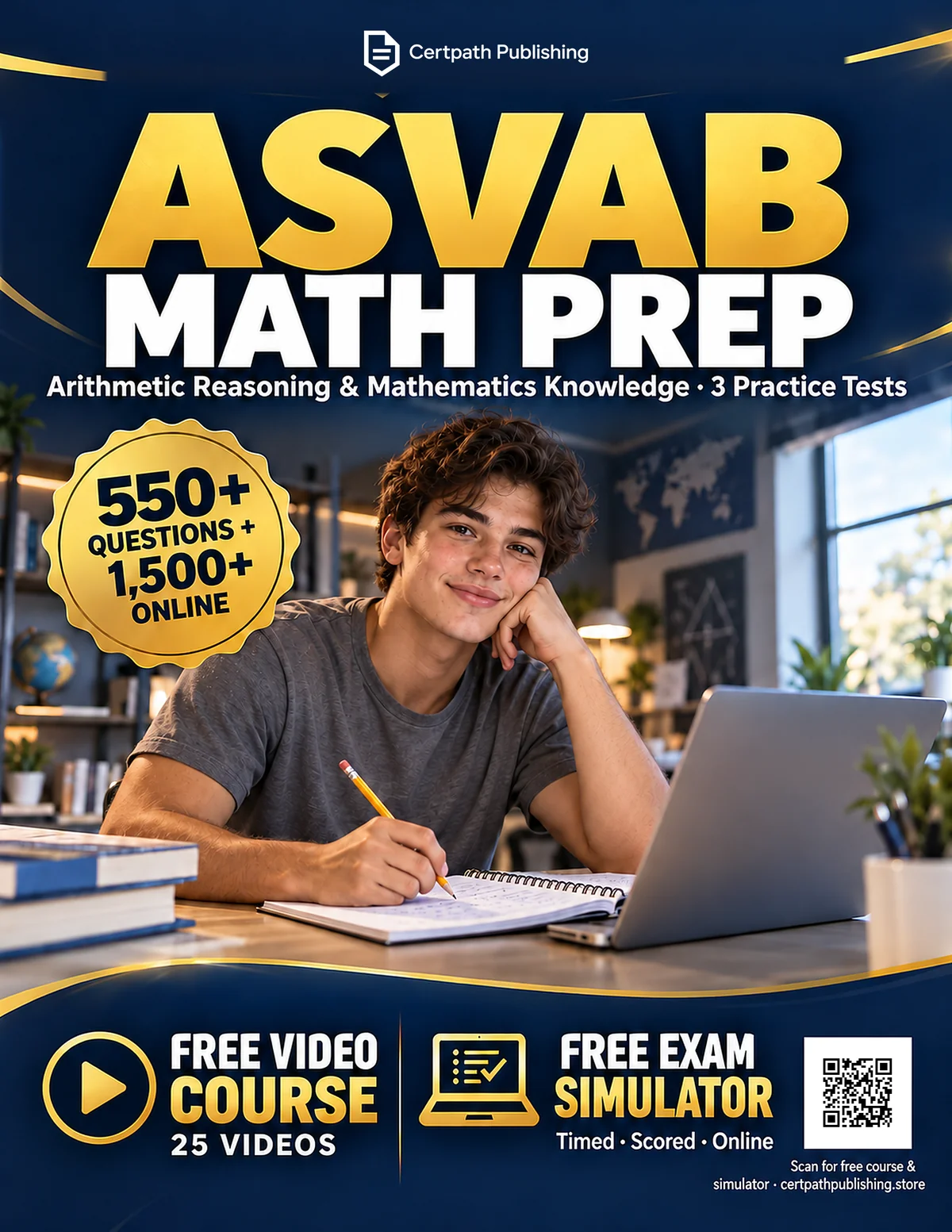
Featured book: ASVAB Math Prep
CertPath Publishing's ASVAB Math Prep separates Arithmetic Reasoning and Mathematics Knowledge practice across 35 timed tests, so you can drill each subtest's specific skills instead of studying "math" as one blur.
Buy on Amazon →Format: two very different clocks
Most applicants today take the computer-adaptive CAT-ASVAB at a MEPS (Military Entrance Processing Station); some take the paper-and-pencil P&P-ASVAB at a satellite testing site. The two versions don't just differ in delivery — the question counts and time limits are different too, per the official ASVAB program:
- CAT-ASVAB — Arithmetic Reasoning: 15 questions in 55 minutes (about 3 minutes 40 seconds per question)
- CAT-ASVAB — Mathematics Knowledge: 15 questions in 31 minutes (about 2 minutes per question)
- P&P-ASVAB — Arithmetic Reasoning: 30 questions in 36 minutes (about 1 minute 10 seconds per question)
- P&P-ASVAB — Mathematics Knowledge: 25 questions in 24 minutes (about 1 minute per question)
Notice that AR gets more time per question than MK on both versions. That's not an accident of test design so much as a reflection of what AR asks you to do: read a scenario, decide what it's really asking, set up the equation, and only then compute. MK skips straight to computing. If you consistently run out of time on AR, the fix usually isn't "get faster at arithmetic" — it's practicing how quickly you can recognize a problem type from its wording.
Worked example: Arithmetic Reasoning
A supply truck can carry 2,400 pounds per trip. A shipment consists of 54 crates weighing 50 pounds each. How many trips does the truck need to move the entire shipment?
First find the total weight: 54 × 50 = 2,700 pounds. Divide by the truck's capacity: 2,700 ÷ 2,400 = 1.125 trips. Since a truck can't make a partial trip, round up: 2 trips. The first trip carries the full 2,400-pound capacity, and the second carries the remaining 300 pounds. This is the pattern AR tests over and over — the last step (rounding a decimal answer up to a whole number of trips, boxes or crews) is where careless test-takers lose points even after doing the math correctly.
Worked example: Mathematics Knowledge
Solve for x: 3(x − 4) = 2x + 5
Distribute the 3: 3x − 12 = 2x + 5. Subtract 2x from both sides: x − 12 = 5. Add 12 to both sides: x = 17. Check it: 3(17 − 4) = 3(13) = 39, and 2(17) + 5 = 39 — both sides match, confirming x = 17. MK questions like this reward a consistent, careful order of operations far more than cleverness; most errors come from a sign mistake in the distribution step, not from not knowing algebra.
How AR and MK decide your AFQT score
The Armed Forces Qualification Test (AFQT) score is the gatekeeper score — it's what determines whether you're eligible to enlist at all, separate from the line scores used to qualify for specific jobs. Per the official ASVAB program, the AFQT raw score is calculated as:
AFQT raw score = 2 × VE + AR + MK
VE ("Verbal Expression") is a scaled combination of your Word Knowledge and Paragraph Comprehension scores, and AR and MK are added in directly. Because VE is doubled, the two verbal subtests together carry as much weight in your AFQT as the two math subtests combined — a detail that surprises people who assume AFQT is mostly a math score. That raw score is then converted into a percentile from 1 to 99, comparing you against a reference group of other test-takers. AR and MK also contribute, alongside other subtests, to several service-specific line scores (such as the Army's GT or the Navy's various composites) that determine which jobs you qualify for — but the exact composites and required minimums are set by each branch and change over time, so confirm current requirements with your recruiter or branch-specific materials rather than a blog post.
A simple two-subtest study plan
- For Mathematics Knowledge: Rebuild the fundamentals first — fraction and decimal operations, exponent rules, solving linear equations, and basic geometry formulas (area, perimeter, volume). Drill these until they're automatic, since MK gives you roughly one minute per question with no reading buffer.
- For Arithmetic Reasoning: Once the underlying math is solid, shift to translation practice — reading a word problem and identifying, within a few seconds, which formula or setup it's describing (a rate problem, a percent-change problem, a ratio problem). Time yourself on full sets, not single questions, since the CAT-ASVAB's per-question time budget only matters in aggregate.
- Review your misses by category, not just by right/wrong. An AR miss caused by misreading the question needs different practice than an AR miss caused by a shaky ratio setup, even though both count the same on the score report.
Try 25 tough ASVAB Math questions free
No email, no signup. Full explanations after every answer.
FAQ
Where can I find free ASVAB Math practice questions?
CertPath Publishing has 25 free ASVAB Math practice questions at certpathpublishing.store/sample?book=asvab-math. No email or signup is required, and you get a full explanation after every answer.
What's the real difference between Arithmetic Reasoning and Mathematics Knowledge?
Arithmetic Reasoning (AR) presents math inside a short word problem you first have to translate into an equation, covering things like rates, ratios, percentages and unit conversions. Mathematics Knowledge (MK) asks the underlying math directly, without a story, covering algebra, geometry, exponents and order of operations.
How many questions are on the ASVAB math sections and how much time do I get?
On the computer-adaptive CAT-ASVAB, Arithmetic Reasoning is 15 questions in 55 minutes and Mathematics Knowledge is 15 questions in 31 minutes. On the paper-and-pencil P&P-ASVAB, Arithmetic Reasoning is 30 questions in 36 minutes and Mathematics Knowledge is 25 questions in 24 minutes.
How is the AFQT score calculated from ASVAB math and verbal scores?
The AFQT raw score is 2 times your Verbal Expression (VE) score plus your Arithmetic Reasoning (AR) score plus your Mathematics Knowledge (MK) score. VE itself comes from combining Word Knowledge and Paragraph Comprehension. Because VE is doubled, the two verbal subtests together carry as much weight as both math subtests combined, and that raw score is then converted to a 1-99 percentile.
How soon can I retake the ASVAB if I don't like my score?
You must wait one month between your initial ASVAB and a first retest, and another one month before a second retest, per the official ASVAB retest policy. Any retest after that requires a six-month wait. An exception applies if your score jumps unusually high: a confirmation test can be given immediately, without the standard wait.
CertPath Publishing is an independent publisher and is not affiliated with or endorsed by the Department of Defense or the official ASVAB program. For the full study guide with 35 timed practice tests covering both subtests, see the ASVAB Math Prep page or buy it on Amazon. And if ASVAB isn't the exam you're studying for, CertPath has free practice for other exams here.
— The CertPath Publishing Team