Free Journeyman Electrician Practice Test: 4 Questions Explained
A "journeyman electrician exam" isn't one test — it's whatever your state (or in some cities, your local board) requires before you can pull permits and work unsupervised, and nearly all of them draw their questions straight from the National Electrical Code (NFPA 70). Try 25 free journeyman electrician practice questions — no email required — then come back here for four of them worked all the way through, in the same mix of calculation and code-reading questions you'll see on a real state exam.
CertPath Publishing's Journeyman Electrician Exam Study Guide is written in this same style — calculation questions paired with the kind of "which answer is the tempting trap" explanations you'll find below — across three full-length practice tests. Before you buy anything, try the free sample and see how it feels under a clock.
Who actually writes and grades your exam?
There is no single national journeyman electrician exam. Each state licensing board sets its own eligibility rules, content outline and passing score, then usually contracts the actual testing to a third-party vendor such as PSI or Prometric. What almost all of them share is the same source material: the National Electrical Code (NFPA 70), the model code that state and local jurisdictions adopt — sometimes with local amendments — as their electrical law.
Two real examples show how much the details vary even though the underlying code is the same. In Texas, the Department of Licensing and Regulation's exam is split into two scored portions — a knowledge portion on NEC rules and a separate calculations portion — each of which you must pass independently, per the TDLR Candidate Information Bulletin. In Massachusetts, the Board of State Examiners of Electricians runs an open-book exam where you may highlight and underline your NEC codebook but may not add handwritten notes, per the official exam bulletin. Most states land somewhere between these two in format, but the open-book, NEC-based core holds across nearly all of them.
The NEC itself is republished on a three-year cycle, most recently as the 2026 edition. State boards typically take a year or more to formally adopt a new edition into their exam, so don't assume your test already covers the newest code — your own board's candidate bulletin will say which edition applies and what you're allowed to bring into the room.
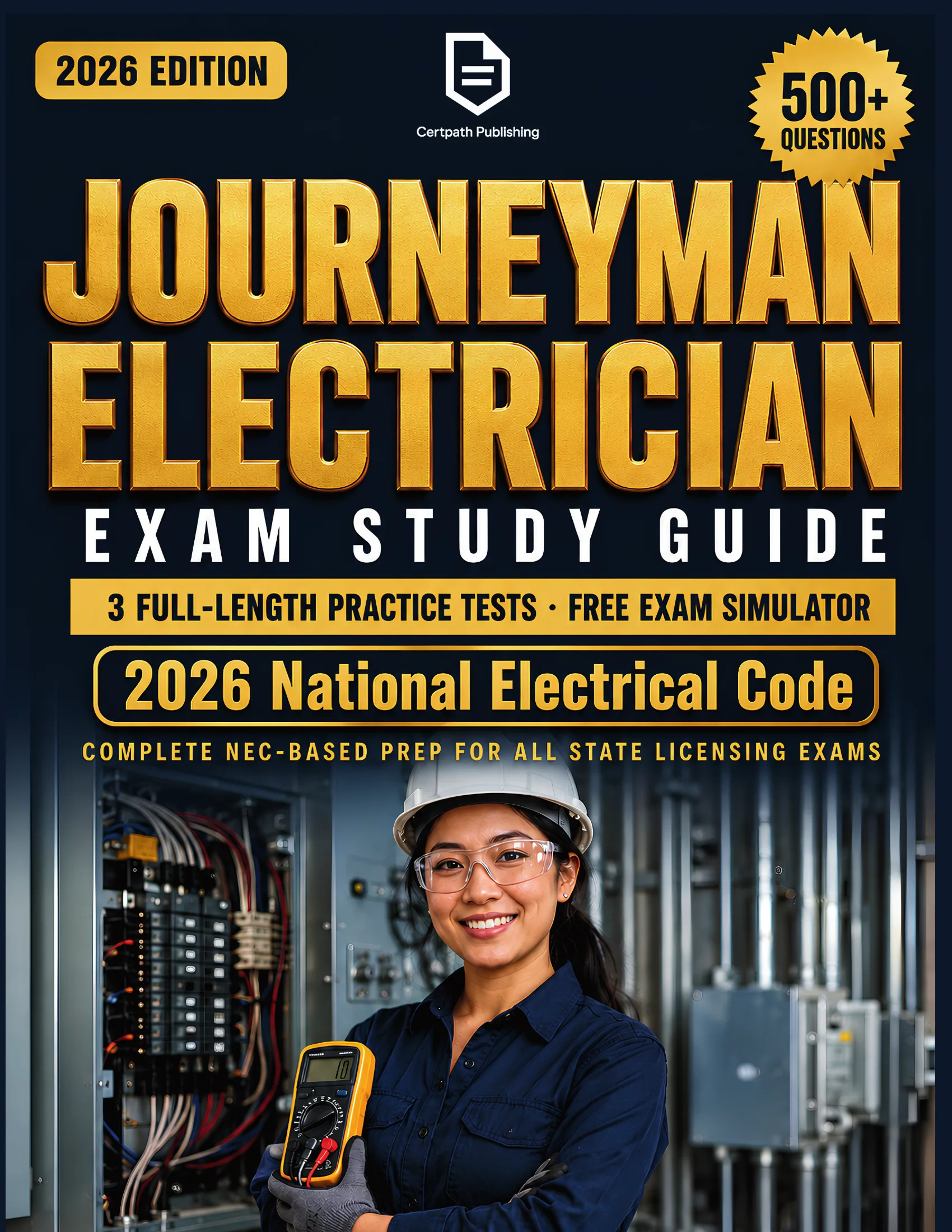
Featured book: Journeyman Electrician Exam Study Guide
CertPath Publishing's Journeyman Electrician Exam Study Guide covers electrical theory, voltage drop, transformers, motor circuits, box and raceway fill, grounding and bonding, and overcurrent protection across 180 practice questions in three full-length tests.
Buy on Amazon →4 practice questions, worked step by step
These four come from CertPath's free 25-question journeyman electrician sample set and are quoted exactly as written there.
Question 1 — Voltage drop: picking the right conductor size
A 120 V single-phase branch circuit supplies a 20 A load 150 ft from the panel in 10 AWG copper, and the project specification limits branch-circuit voltage drop to 3 percent. Given K = 12.9 for copper and circular-mil areas of 10,380 for 10 AWG, 16,510 for 8 AWG and 26,240 for 6 AWG, which single change brings the circuit within the specification?
- A. Rewire the run in 8 AWG copper, keeping the load and the 150 ft length unchanged.
- B. Split the load onto two 10 A circuits in 10 AWG, keeping the 150 ft length unchanged.
- C. Rewire the run in 6 AWG copper, keeping the load and the 150 ft length unchanged.
- D. Relocate the panel so the run is 100 ft, keeping 10 AWG and the 20 A load unchanged.
Answer: C. The allowable drop is 0.03 × 120 = 3.6 V, and the existing run drops 2 × 12.9 × 20 × 150 ÷ 10,380 = 7.46 V. Only 6 AWG meets it, at 2.95 V. The most tempting change is 8 AWG, the next size up, which still drops 4.69 V; shortening the run to 100 ft leaves 4.97 V, and splitting the load into two 10 A circuits halves the drop to 3.73 V, which still misses 3.6 V.
Skill tested and common trap: this is a straight voltage-drop sizing problem, but the real test is treating the 3 percent limit as a hard voltage number (3.6 V) and checking each candidate change against it, rather than assuming the "obvious" next wire size up is automatically enough.
Question 2 — Motor circuits: sizing a feeder for three motors
One feeder supplies three continuous-duty three-phase motors whose table full-load currents are 40 A, 28 A and 16 A. What is the minimum ampacity required for the feeder conductors?
- A. 94 A
- B. 84 A
- C. 105 A
- D. 100 A
Answer: A — 94 A. A motor feeder carries 125 percent of the largest motor plus the full-load currents of the remaining motors: (40 × 1.25) + 28 + 16 = 50 + 44 = 94 A. The strongest distractor is 105 A, which applies 125 percent to all three motors; 84 A simply totals the three currents and omits the largest-motor allowance entirely. The 100 A value is the next standard overcurrent device rating, which answers a protection question rather than the required conductor ampacity.
Skill tested and common trap: feeder sizing for multiple motors isn't a simple sum — only the largest motor gets the 125 percent continuous-duty allowance. The trap is applying that allowance to every motor (105 A), which looks appropriately cautious but actually over-sizes the rule.
Question 3 — Grounding and bonding: what actually clears a fault
A detached garage is being supplied by a new 120/240 V single-phase feeder installation. Only the two ungrounded conductors and the grounded conductor are run in PVC conduit; no equipment grounding conductor is pulled. An electrician proposes driving two ground rods at the garage and bonding them to the panel enclosure, reasoning that the earth will return fault current to the service. What is the correct assessment of that proposal?
- A. The rods are acceptable once the measured resistance to earth is 25 ohms or less, since that value limits touch voltage on the enclosure during a fault.
- B. The rods are acceptable if every garage receptacle is protected by a ground-fault circuit interrupter, since that device will clear the fault current.
- C. The rods are acceptable because two rods spaced at least 6 ft apart satisfy the electrode requirement that applies to a separate structure.
- D. Earth is not an effective ground-fault current path, so this new feeder requires an equipment grounding conductor run with the circuit conductors to let a fault open the device.
Answer: D. Soil impedance is high enough that a fault through two rods might pass only a few amperes, far too little to operate the overcurrent device, leaving the enclosure energised indefinitely. The most tempting wrong choice invokes the 25 ohm figure, which governs when a supplemental electrode is required and says nothing about carrying fault current. Grounding electrodes handle lightning and voltage stabilisation; bonding plus an equipment grounding conductor is what clears faults.
Skill tested and common trap: this question has no math at all — it checks whether you understand what grounding electrodes are for versus what equipment grounding conductors are for. The trap is the 25-ohm figure, a real NEC number that answers a different question entirely (whether a single rod needs a second one), not whether earth alone can clear a fault.
Question 4 — GFCI and AFCI protection: why the drill trips one outlet but not another
A contractor's drill trips a Class A ground-fault circuit interrupter receptacle within a second of starting, yet the same drill runs normally on a non-protected 20 A circuit whose breaker never opens. Which explanation best fits the way the protective device operates?
- A. Inrush current when the drill starts briefly exceeds the 20 A circuit rating, and the protective device responds far faster than a thermal-magnetic breaker.
- B. The low power factor of the drill motor draws more current than the device rating, which its electronic sensing circuit interprets as a fault.
- C. The equipment grounding conductor in the drill cord is open, so the device loses its reference point and opens on the first half cycle of current.
- D. Moisture in the drill is diverting a few milliamperes to a path other than the grounded conductor, and the device opens once that imbalance reaches roughly 5 mA.
Answer: D. A Class A device compares current leaving on the ungrounded conductor with current returning on the grounded conductor and opens at about 4 to 6 mA of difference, which is a shock-protection threshold far below any overcurrent level. That is exactly why the ordinary breaker sees nothing wrong. The inrush answer is the usual trap because starting current does momentarily rise, but the device does not measure magnitude at all, only imbalance, and it works with no equipment grounding conductor present.
Skill tested and common trap: GFCI protection is about current imbalance, not current magnitude, and this question checks whether you can tell the two apart. The trap is reaching for an inrush-current explanation because starting current genuinely does spike — but a GFCI doesn't care how much current flows, only whether what leaves equals what returns.
A short prep checklist before test day
Journeyman exams reward calculation accuracy and fast code navigation about equally. A focused week looks like this:
- Day 1–2: Rebuild the calculation core — Ohm's law, series/parallel circuits, voltage drop, and the 125 percent continuous-duty rule that shows up in motor and lighting-load questions alike.
- Day 3–4: Practice navigating your actual NEC codebook under time pressure — tab the articles you reach for most (grounding and bonding, conductors, motors, overcurrent protection) so you're flipping pages in seconds, not minutes.
- Day 5: Drill box fill, raceway fill and conductor ampacity adjustment/correction together, since all three hinge on the same skill: correctly counting what does and doesn't count toward a limit.
- Day 6–7: Take timed practice sets that match your own state's format, and for every miss, identify which "tempting wrong answer" you picked — that's the pattern to watch for on the real exam.
Try 25 tough journeyman electrician questions free
No email, no signup. Full explanations after every answer.
FAQ
Where can I find free journeyman electrician practice questions?
CertPath Publishing has 25 free journeyman electrician practice questions at certpathpublishing.store/sample?book=journeyman-elec. No email or signup is required, and you get a full explanation after every answer.
Is the journeyman electrician exam open book?
In most states, yes — you can bring the NEC codebook (NFPA 70) into the exam room, though the rules on tabs and markings vary. Texas and Massachusetts, for example, allow factory-printed tabs and highlighting but not handwritten notes; a few states run closed-book exams instead. Always check your own board's candidate bulletin before test day.
Which NEC edition will my exam be based on?
It depends entirely on your state board, not on when you're reading this. The NEC is republished every three years, most recently as the 2026 edition, but state boards typically take a year or more to formally adopt a new edition into their licensing exam, so many states are still testing on the 2023 edition even after a newer one exists. Your board's candidate bulletin will say which edition your exam covers.
How many questions are on the journeyman electrician exam and how long do I get?
It varies by state. Texas currently splits its exam into a knowledge portion and a separate calculations portion, each scored independently, per the TDLR Candidate Information Bulletin; other states give a single combined exam, often with 80 to 100 questions and three to four hours allowed. There is no single national format, so check your own state board's candidate bulletin for the exact count and time limit.
Do I need a calculator for the exam?
Most state boards allow a basic, non-programmable, silent calculator, and some testing centers provide one. A few restrict the calculator type or don't allow one for certain portions. Confirm what's allowed — and whether you need to bring your own — in your board's candidate bulletin.
CertPath Publishing is an independent publisher and is not affiliated with or endorsed by NFPA, any state licensing board, or any exam vendor. See the journeyman electrician exam page for the full study guide, or buy the Journeyman Electrician Exam Study Guide on Amazon. If you're prepping for a different exam, CertPath has free practice for other exams here.
— The CertPath Publishing Team