How Hard Is the PMI-ACP Exam? What the New Outline Tests
In November 2024, PMI quietly rebuilt the PMI Agile Certified Practitioner (PMI-ACP) exam from the ground up — not just new questions, but a new map of what gets tested and how much each part counts. If you're studying from an older guide, the domain names and weights you're reading may no longer match the real exam. Try 25 free PMI-ACP practice questions — no email required — then read on for what actually changed and how hard it really is.
CertPath Publishing's PMI-ACP Exam Prep guide is built around this current four-domain outline, with practice questions written in the same scenario-judgment style PMI now uses throughout the real exam. Before buying anything, try the free sample below and see how that style feels under a clock.
What actually changed: seven domains became four
For years, the PMI-ACP exam was organized around seven fairly specific domains — things like Agile Principles and Mindset, Value-Driven Delivery, Stakeholder Engagement, Team Performance, Adaptive Planning, Problem Detection and Resolution, and Continuous Improvement. PMI retired that structure with a new Examination Content Outline, effective November 2024, that collapses everything into four broader domains:
- Mindset — 28%. Agile values and principles, servant leadership behavior, and recognizing when a team's actual practices don't match its stated agile mindset.
- Leadership — 25%. Coaching, facilitation, conflict handling, and creating the psychological safety a team needs to raise problems early.
- Product — 19%. Backlog refinement, prioritization, defining value, and working with stakeholders to keep the product direction honest.
- Delivery — 28%. Iteration and release planning, tracking progress with real data (velocity, burn charts, cycle time), and adapting the plan when the data says to.
Two domains — Mindset and Delivery — now carry more than half the exam between them, with Leadership close behind and Product the lightest, though still a substantial fifth of the test. That shift matters for study time: a plan built around the old seven-domain breakdown can easily under-invest in Mindset and Delivery questions relative to how often they'll actually show up.
PMI's own official page for the credential is at pmi.org/certifications/agile-acp, and it's worth checking directly before you register — exam requirements and the content outline can be updated, and the page there is always current.
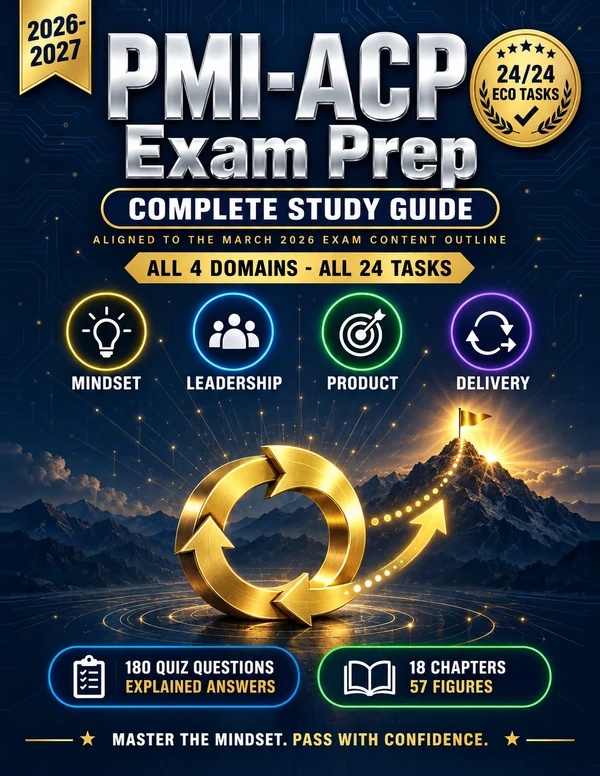
Featured book: PMI-ACP Exam Prep
CertPath Publishing's PMI-ACP Exam Prep covers all four current domains — Mindset, Leadership, Product and Delivery — with 720 scenario-based practice questions across six full-length tests, written to match the judgment-call style of the real exam.
Buy on Amazon →Exam format: what you'll actually sit down to take
The PMI-ACP exam is 120 multiple-choice questions, of which 100 are scored and 20 are unscored pretest questions PMI uses to evaluate future exam items — you won't know which is which, so every question deserves equal attention. You get 180 minutes (3 hours) to finish, with one optional 10-minute break after question 60; once you start the break, you can't go back to review earlier answers. PMI does not publish a fixed passing score or percentage; results are reported as Above Target, Target, Below Target or Needs Improvement for each domain plus an overall pass/fail.
Who can actually sit for it
Unlike some certifications, PMI-ACP does not require a PMP first. The eligibility requirements, per PMI, are:
- A secondary degree (high school diploma or equivalent) or higher.
- 2,000 hours of general project experience earned within the last five years — this requirement is waived if you already hold an active PMP or PgMP certification.
- 1,500 hours of agile project experience earned within the last three years, in addition to the general project experience above.
- 21 contact hours of training in agile practices.
Once your application is approved, you have one year to pass the exam and up to three total attempts within that window. A failed attempt isn't the end of the eligibility period — but it does eat into it, so it's worth being genuinely exam-ready before you schedule the first sitting rather than treating it as a dry run.
A worked example: what a Delivery-domain question is really asking
Delivery questions often hide a simple arithmetic check inside a scenario, so it's worth practicing the math cold. Here's a representative one:
A team's backlog has 192 story points remaining. Over its last four iterations, the team completed 30, 34, 28 and 32 points. At that velocity, roughly how many more two-week iterations will the remaining backlog take, and how many weeks is that?
Average velocity = (30 + 34 + 28 + 32) ÷ 4 = 124 ÷ 4 = 31 points per iteration. Iterations remaining = 192 ÷ 31 ≈ 6.2, which rounds up to 7 iterations, since a team can't deliver a fractional iteration. At two weeks each, that's 14 weeks.
The exam rarely asks for the number itself — it asks what you should do with it. A Delivery-domain question built on this scenario is more likely to ask whether the team should report a 14-week forecast to stakeholders now, keep tracking a rolling average instead of locking in a number, or flag the forecast as a range rather than a single date. The correct answer is almost always "communicate a range and keep re-forecasting with fresh data," because single-point estimates from a small sample are exactly the kind of false precision the Mindset and Delivery domains are both designed to catch.
A 4-week study plan weighted to the real exam
Rather than splitting study time evenly across four domains, match it roughly to the weights above:
- Week 1 — Mindset (28%): The Agile Manifesto's values and principles cold, servant leadership versus command-and-control behavior, and recognizing agile-in-name-only practices in scenario questions.
- Week 2 — Delivery (28%): Velocity, burn-up/burn-down charts, cycle time, work-in-progress limits, and release planning across Scrum, Kanban and hybrid approaches — PMI-ACP tests more than Scrum alone.
- Week 3 — Leadership (25%): Facilitation techniques, conflict resolution models, coaching versus directing, and building psychological safety for a team to surface bad news early.
- Week 4 — Product (19%) plus full-length review: Backlog refinement and prioritization techniques (MoSCoW, weighted shortest job first, Kano), then at least one full 120-question timed run to build stamina for the three-hour sitting.
What it costs, and what a retake costs
As of this writing, PMI lists the PMI-ACP exam fee at $435 for PMI members and $495 for non-members, with a lower re-examination fee for a second or third attempt. PMI membership itself costs $139 a year, which combined with the member exam discount is close to a wash on the first attempt — confirm current pricing directly on PMI's official PMI-ACP page before you pay anything, since fees are reviewed periodically.
Try 25 tough PMI-ACP questions free
No email, no signup. Full explanations after every answer.
FAQ
Where can I find free PMI-ACP practice questions?
CertPath Publishing has 25 free PMI-ACP practice questions at certpathpublishing.store/sample?book=pmi-acp. No email or signup is required, and you get a full explanation after every answer.
Is the PMI-ACP exam harder than the PMP exam?
They test different things rather than one being strictly harder. PMI-ACP covers a wider mix of agile approaches (Scrum, Kanban, Lean, XP and hybrid) rather than one deep framework, so people with narrow Scrum-only experience sometimes find the breadth more demanding than PMP's single, more linear body of knowledge. Candidates who already hold a PMP often describe PMI-ACP as a lighter lift because the exam-taking skills transfer.
How many domains are on the PMI-ACP exam now?
Four: Mindset, Leadership, Product and Delivery, under the Examination Content Outline PMI introduced in November 2024. The previous outline had seven narrower domains built around specific agile tools and techniques; the current one groups the same knowledge into four broader, scenario-based domains.
Can I take the PMI-ACP exam without a PMP first?
Yes. The PMP is not a prerequisite. You need a secondary degree, 2,000 hours of general project experience within the last five years (waived if you already hold a PMP or PgMP), 1,500 hours of agile project experience within the last three years, and 21 contact hours of agile training.
What happens if I fail the PMI-ACP exam?
You can retake it, up to three total attempts within your 12-month eligibility window from the date your application is approved. Each retake carries a separate re-examination fee, which is lower than the first-attempt fee.
CertPath Publishing is an independent publisher and is not affiliated with or endorsed by the Project Management Institute (PMI). See the PMI-ACP exam page for the full study guide, or buy PMI-ACP Exam Prep on Amazon. If you're prepping for a different exam, CertPath has free practice for other exams here.
— The CertPath Publishing Team