Free Adult CCRN Practice Test: 4 Questions Explained
The Adult CCRN exam doesn't test whether you can recall a definition — it tests whether you can read a cluster of vital signs and lab values the way a bedside critical care nurse has to, under pressure, with more than one plausible next step on the screen. Try 25 free Adult CCRN practice questions — no email required — then come back here for four of them worked all the way through, with the trap built into each one called out explicitly.
CertPath Publishing's Adult CCRN Exam Prep guide is written in this same scenario-judgment style — a cluster of findings, four plausible interventions, one that's actually correct — across 750 practice questions in five full-length tests. Before buying anything, try the free sample below and see how that style feels under a clock.
What the Adult CCRN exam actually covers
The Adult CCRN exam is built on AACN's Synergy Model for Patient Care and is organized into two domains: Clinical Judgment, worth about 80% of the exam, and Professional Caring and Ethical Practice, worth about 20%. Clinical Judgment spans body systems — cardiovascular, respiratory, endocrine, gastrointestinal, renal, neurological, and multisystem problems like sepsis and toxic ingestion — while Professional Caring and Ethical Practice covers advocacy, moral agency, response to diversity, and systems thinking.
The exam itself runs 150 multiple-choice items, of which 125 are scored and 25 are unscored items AACN is testing for future use; you aren't told which is which, so every item gets the same attention. You're given 3 hours to finish. AACN does not publish a single passing percentage — the cut score is set with a criterion-referenced method called a modified Angoff process, where subject-matter experts rate how difficult each item should be, and the resulting passing point is a raw number of items correct that can shift between exam versions. Confirm the current details directly on AACN's own CCRN (Adult) page before you register, since format and policy details are reviewed periodically.
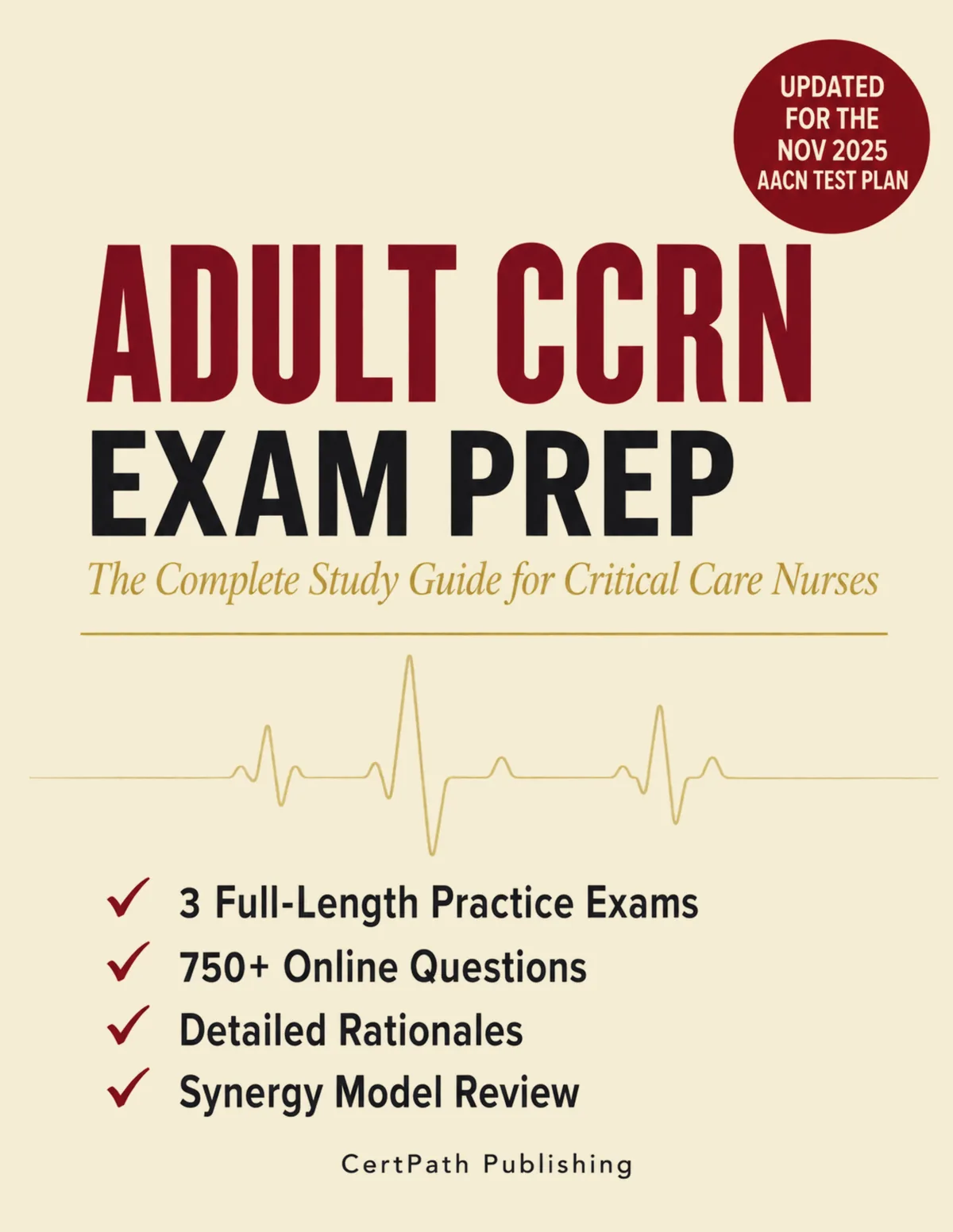
Featured book: Adult CCRN Exam Prep
CertPath Publishing's Adult CCRN Exam Prep covers both Synergy Model domains — Clinical Judgment and Professional Caring and Ethical Practice — across 750 scenario-based practice questions in five full-length tests, written in the same cluster-of-findings style as the real exam.
Buy on Amazon →4 practice questions, worked step by step
These four come from CertPath's free 25-question Adult CCRN sample set and are quoted exactly as written there.
Question 1 — Cardiovascular: cardiogenic shock despite an adequate pressure
Two days after an anterior myocardial infarction a patient is on a norepinephrine infusion. Mean arterial pressure is now 74 mmHg, yet the skin stays cool and mottled and urine output is 12 mL/hr. Pulmonary artery catheter values are: cardiac index 1.6 L/min/m2, pulmonary artery occlusion pressure 28 mmHg, systemic vascular resistance 2150 dyn·s/cm^5, mixed venous oxygen saturation 46 percent, lactate rising from 2.8 to 4.1 mmol/L. Which therapy should the nurse anticipate?
- A. Adding an inotrope to raise cardiac index and oxygen delivery
- B. An intravenous beta-blocker to lower myocardial oxygen demand
- C. A rapid 500 mL crystalloid bolus to improve ventricular filling
- D. Increasing the norepinephrine to raise the perfusion pressure further
Answer: A. Perfusion pressure is already at target, so pressure is not the deficit; the low cardiac index, low venous saturation and rising lactate with a high filling pressure and very high resistance show the pump cannot deliver flow, which calls for inotropic support alongside the vasopressor. Escalating norepinephrine is the tempting move, since it is the first-line vasopressor when pressure is inadequate, but more vasoconstriction at an adequate pressure raises afterload and lowers output further.
Skill tested and common trap: this checks whether you can tell a pressure problem from a flow problem when both a vasopressor and bad perfusion numbers are on screen at once. The trap is treating "there's already a pressor running, the numbers look bad, so push it higher" as the obvious move, when the hemodynamics show the pressure target is already met and the real deficit is cardiac output.
Question 2 — Respiratory: when a ventilator setting is the injury, not the fix
A patient with ARDS whose predicted body weight is 70 kg is ventilated on volume assist-control with a tidal volume of 560 mL, PEEP 12 cm H2O and FiO2 0.80. Arterial blood gas: pH 7.36, PaCO2 44 mmHg, PaO2 68 mmHg. The plateau pressure measures 34 cm H2O. Which ventilator change should the nurse anticipate?
- A. Reducing the tidal volume to 6 mL/kg of predicted body weight
- B. Raising the PEEP to 18 cm H2O to recruit collapsed alveoli
- C. Changing to pressure support ventilation to improve comfort
- D. Raising the FiO2 to 1.0 to correct the oxygenation deficit
Answer: A. The delivered volume is 8 mL/kg predicted weight and the plateau pressure exceeds the protective limit of about 30 cm H2O, so the lung is being overdistended. Lowering the tidal volume is the change that protects the lung. Adding PEEP is tempting because the oxygenation ratio is poor, but it drives the plateau pressure higher still; more oxygen treats the number, not the injury.
Skill tested and common trap: this is a lung-protective ventilation calculation disguised as an oxygenation question. The trap is chasing the low PaO2 with more PEEP or more FiO2 when the plateau pressure already signals volutrauma — fixing the oxygen number first would make the underlying lung injury worse.
Question 3 — Endocrine: a mixed hyperglycemic crisis with no urine output
An older adult is admitted obtunded after several days of a urinary tract infection and poor oral intake. Glucose is 968 mg/dL, sodium 149 mEq/L, chloride 103 mEq/L, potassium 5.4 mEq/L, urea nitrogen 42 mg/dL, serum osmolality 366 mOsm/kg, pH 7.24, bicarbonate 14 mEq/L, and beta-hydroxybutyrate is clearly raised. Heart rate is 124/min, blood pressure 86/50 mmHg, and no urine has been passed for eight hours. Which intervention is the priority?
- A. Give intravenous sodium bicarbonate to correct the metabolic acidosis
- B. Begin rapid isotonic crystalloid resuscitation before insulin is started
- C. Add potassium to the first litre of fluid before the insulin is started
- D. Start the insulin infusion now, since ketoacidosis is the greater threat
Answer: B. The raised ketones, anion gap of 32 and bicarbonate of 14 mEq/L mark true ketoacidosis, while the osmolality of 366 mOsm/kg marks a hyperosmolar state, so this is a mixed crisis; both components begin the same way, because the patient is litres behind and hypotensive. Starting insulin first is the tempting response to the acidosis and shifts water and potassium into cells, deepening the shock. Potassium is high with no urine output, and bicarbonate is not indicated at this pH.
Skill tested and common trap: this checks whether you know the sequence of a hyperglycemic crisis, not just its name. The trap is reaching for insulin first because "ketoacidosis" is in the stem — but starting insulin before volume is restored in a hypotensive patient can drop potassium and intravascular volume further at the worst possible moment.
Question 4 — Neurological: a blood pressure number that's correct in one situation and wrong in another
A patient arrives 95 minutes after the sudden onset of right-sided weakness and aphasia. Computed tomography shows no haemorrhage and the patient otherwise meets criteria for intravenous thrombolysis. Blood pressure is 198/112 mmHg on two readings five minutes apart and the point-of-care glucose is 122 mg/dL. Which action should the nurse anticipate?
- A. Cancelling thrombolysis because this pressure is an absolute contraindication
- B. Giving a rapid-acting oral antihypertensive and rechecking within the hour
- C. Allowing permissive hypertension and withholding all antihypertensive therapy
- D. Giving the ordered intravenous antihypertensive to reach the treatment threshold
Answer: D. Before thrombolysis the pressure must be brought below 185/110 mmHg, and a titratable intravenous agent does this safely within the treatment window. Permissive hypertension is the strong distractor because it is genuinely correct for a stroke patient who is not receiving thrombolysis; applying it here forfeits the clot-lysing window. The oral route is too slow and unpredictable to meet the deadline.
Skill tested and common trap: this question tests whether you can apply the right rule to the right patient, since "permissive hypertension in stroke" is a real and commonly taught principle. The trap is applying it here without noticing the stem already says the patient is a thrombolysis candidate, which puts a hard blood-pressure ceiling in front of that general rule.
Eligibility: how many clinical hours you actually need
The Adult CCRN exam has three eligibility pathways; the most common is Direct Care. To sit for it, you need a current RN or APRN license plus one of two hour requirements, per AACN's own CCRN (Adult) eligibility policy:
- Two-year option: 1,750 hours of direct bedside care of acutely or critically ill adult patients within the last 2 years, with at least 875 of those hours in the most recent year.
- Five-year option: 2,000 hours of direct bedside care within the last 5 years, with at least 144 of those hours in the most recent year.
A Knowledge Professional pathway and a Tele-Critical Care pathway also exist for nurses whose role doesn't fit the Direct Care model, each with its own hour requirements — check AACN's handbook for your pathway before you apply.
What happens if you don't pass on the first try
AACN allows up to 4 attempts at the same certification exam within a rolling 12-month period, counted from the date your eligibility application is approved. If you haven't passed after 12 months, you'll need to submit a new statement of honor to keep trying. A discounted retest fee is available to candidates who haven't yet passed, which is worth confirming against current pricing directly on AACN's site rather than an older guide, since certification fees are reviewed periodically.
Try 25 tough Adult CCRN questions free
No email, no signup. Full explanations after every answer.
FAQ
Where can I find free CCRN practice questions?
CertPath Publishing has 25 free Adult CCRN practice questions at certpathpublishing.store/sample?book=ccrn. No email or signup is required, and you get a full explanation after every answer.
How many questions are on the Adult CCRN exam and how long do I get?
The Adult CCRN exam has 150 multiple-choice items: 125 are scored and 25 are unscored items AACN uses to evaluate questions for future exams, though you are not told which is which. You get 3 hours to complete it.
Is there a fixed passing score on the CCRN exam?
No single published percentage applies to every exam form. AACN sets the passing point using a criterion-referenced method (a modified Angoff process) in which subject-matter experts rate the difficulty of each item; the resulting cut score is a raw number of correct items that can change between exam versions, not a fixed percentage.
How many times can I retake the CCRN exam if I don't pass?
AACN allows up to 4 attempts at the same certification exam within a rolling 12-month period from when your eligibility application is approved. After 12 months without passing, you must submit a new statement of honor to continue. A discounted retest fee applies to candidates who haven't yet passed.
What are the eligibility hour requirements for the Direct Care CCRN pathway?
You need a current RN or APRN license plus either 1,750 hours of direct bedside care of acutely or critically ill adult patients within the last 2 years (with at least 875 of those hours in the most recent year), or 2,000 hours within the last 5 years (with at least 144 hours in the most recent year).
CertPath Publishing is an independent publisher and is not affiliated with or endorsed by the American Association of Critical-Care Nurses (AACN). See the CCRN exam page for the full study guide, or buy Adult CCRN Exam Prep on Amazon. If you're prepping for a different exam, CertPath has free practice for other exams here.
— The CertPath Publishing Team