How Hard Is the CAP Exam? What IAAP's Outline Tests
The Certified Administrative Professional (CAP) credential comes from the International Association of Administrative Professionals (IAAP), and it's built differently than most certification exams — six content domains that run from leadership judgment calls to office software basics, scored across 200 questions in three hours. Whether you're deciding whether to pursue it or you've already registered, start with 25 free CAP practice questions — no email required — then read on for what the real content outline actually weighs.
CertPath Publishing's CAP Exam Study Guide is built around this six-domain outline, with practice questions written in the same scenario-judgment style IAAP uses throughout the real exam. Before buying anything, try the free sample below and see how that style feels under a clock.
What the CAP exam actually tests: six domains, not one skill
IAAP's own CAP Certification page and its Certification Handbook (updated June 2024) lay out six content domains. Each carries a published weight, and together they add up to the 200 questions IAAP scores on every exam:
- Organizational Culture and Leadership — 20% (about 40 questions). Reading team and organizational dynamics, exercising judgment in ambiguous situations, and leading without formal authority.
- Meeting, Event and Project Management — 19% (about 38 questions). Planning logistics, tracking project tasks and budgets, and managing the moving parts of in-person and hybrid meetings.
- Operational Functions — 19% (about 38 questions). Day-to-day office operations: scheduling, travel coordination, vendor and facilities management, and problem-solving under time pressure.
- Office and Records Management — 17% (about 33 questions). Records retention, information governance, and organizing physical and digital files so they can actually be retrieved.
- Business Communication and Deliverables — 16% (about 31 questions). Writing, editing and formatting memos, reports and correspondence for a specific audience and constraint.
- Software, Data and the Internet — 10% (about 20 questions). Working with common office software, basic data handling, and online research and security practices.
Two domains neither of them narrowly technical carry more than a third of the exam between them: Organizational Culture and Leadership (20%) and the combined logistics-heavy domains of Meeting/Event/Project Management and Operational Functions (19% each). That's a different shape than exams built mostly around one body of knowledge — CAP leans heavily on judgment and process management, with the lightest domain (Software, Data and the Internet, 10%) being the one most study guides spend the least time warning you about.
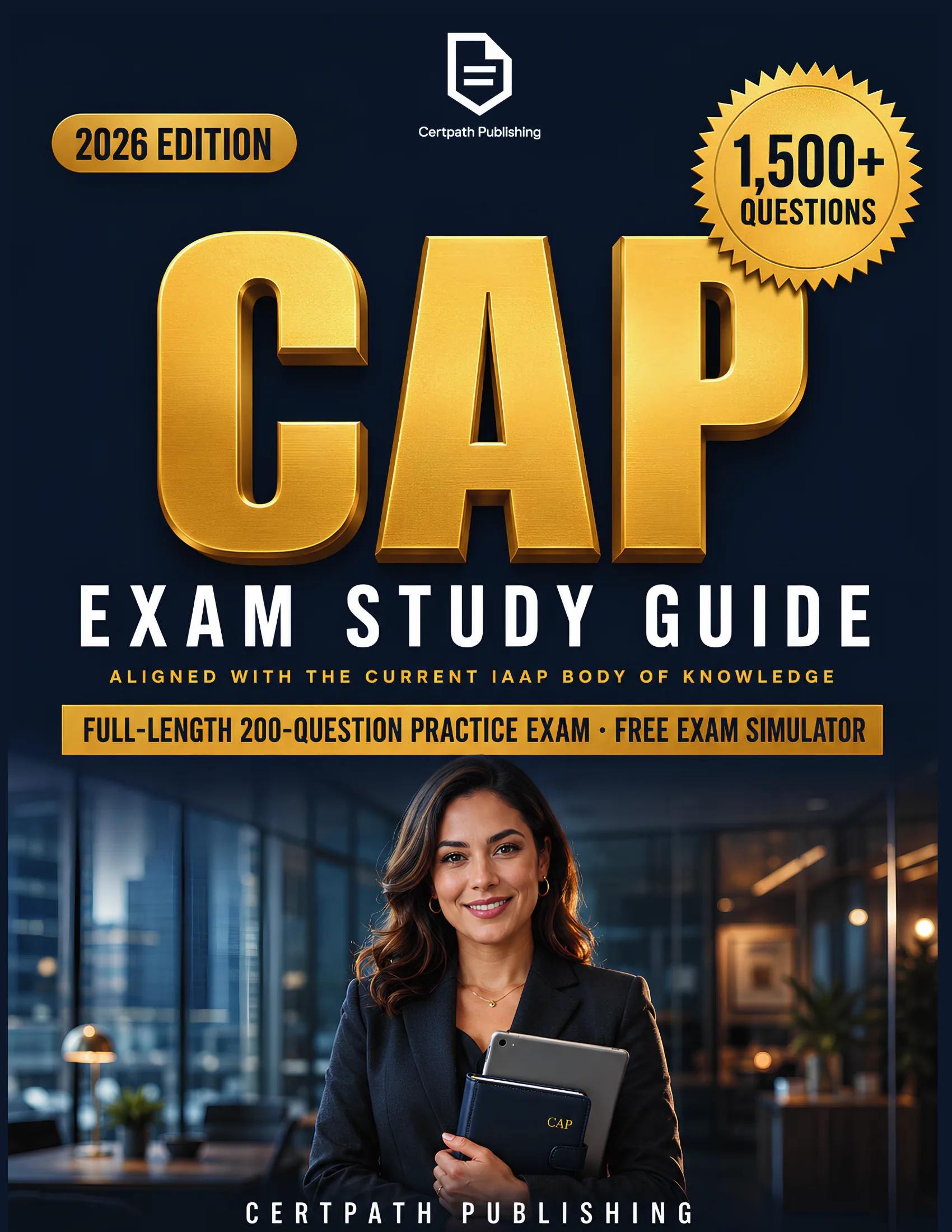
Featured book: CAP Exam Study Guide
CertPath Publishing's CAP Exam Study Guide covers all six current domains, with practice questions written to match the scenario-judgment style of the real exam.
Buy on Amazon →Exam format: what you'll actually sit down to take
Across every sitting, IAAP delivers 200 scored questions used to calculate your six domain scores, plus a small number of additional unscored pretest items mixed in to field-test future exam content — bringing the total delivered to somewhere between 200 and 225 questions. You won't be told which items are scored and which are pretest, so every question deserves full attention. You get three hours to complete the entire computer-based, multiple-choice exam.
Who can actually sit for it
IAAP qualifies candidates through one of three education-and-experience combinations, all built around the same underlying standard — relevant work experience earned within the past 10 years:
- Four-year degree: two years working at least 34 hours a week, or 3,536 hours total, of relevant experience.
- Two-year degree: three years at least 34 hours a week, or 5,304 hours total.
- No degree: four years at least 34 hours a week, or 7,072 hours total.
"Relevant" experience has to include the majority of: organizational communication (verbal and written), business writing including proofreading and editing, office functions and record keeping, and planning meetings, events and travel. Work-study placements and internships don't count toward the hours, and if you're qualifying on a degree, IAAP wants a transcript — official or unofficial — from an accredited institution.
A worked example: budgeting study time against the real weights
Because CAP has six domains of uneven size, splitting study time evenly across them under-invests in the domains that actually carry the most questions. Say you can commit 48 total hours to CAP study. Weighted to the published domain percentages, that time should split roughly like this:
- Organizational Culture and Leadership (20%): 48 × 0.20 = 9.6 hours → about 9.5 hours
- Meeting, Event and Project Management (19%): 48 × 0.19 = 9.12 hours → about 9 hours
- Operational Functions (19%): 48 × 0.19 = 9.12 hours → about 9 hours
- Office and Records Management (17%): 48 × 0.17 = 8.16 hours → about 8 hours
- Business Communication and Deliverables (16%): 48 × 0.16 = 7.68 hours → about 7.5 hours
- Software, Data and the Internet (10%): 48 × 0.10 = 4.8 hours → about 5 hours
That's roughly 9.5 + 9 + 9 + 8 + 7.5 + 5 = 48 hours, matching the domain weights instead of handing every topic an equal sixth of your time. If you only have 6 hours a week, that same split stretches across about 8 weeks.
A study plan that matches the outline
Using the same weighting, a six-week plan that front-loads the heaviest domains looks like this:
- Week 1 — Organizational Culture and Leadership (20%): Judgment-call scenarios: reading team dynamics, leading peers without formal authority, and handling conflicting priorities from different stakeholders.
- Week 2 — Meeting, Event and Project Management (19%): Logistics planning, project tracking basics, and running hybrid meetings where remote participants risk getting crowded out.
- Week 3 — Operational Functions (19%): Scheduling, travel coordination, vendor and facilities management, and time-pressured problem-solving.
- Week 4 — Office and Records Management (17%): Records retention schedules, information governance basics, and organizing files so they're actually retrievable later.
- Week 5 — Business Communication and Deliverables (16%): Writing and editing memos, reports and correspondence that fit a specific audience, length limit and purpose.
- Week 6 — Software, Data and the Internet (10%) plus a full-length review: Common office software, basic data handling, online research and security habits, then at least one full timed run to build stamina for the three-hour sitting.
What it costs, and what happens if you fail
As of this writing, IAAP members pay $375 for the CAP exam and non-members pay $575. If you fail, you can retake the exam as soon as the next testing period, often at a discounted retake fee; miss that window and a later retake carries the same fee as a first attempt. Fail twice, and IAAP requires a full year's wait before a third attempt. Candidates retaking within two years of their last attempt don't need to resubmit education and work documentation. Confirm current fees and testing windows directly on IAAP's official CAP Certification page before you apply, since both are reviewed periodically.
Try 25 tough CAP questions free
No email, no signup. Full explanations after every answer.
FAQ
Where can I find free CAP practice questions?
CertPath Publishing has 25 free CAP practice questions at certpathpublishing.store/sample?book=cap. No email or signup is required, and you get a full explanation after every answer.
How many questions are on the CAP exam and how long do I get?
The CAP exam delivers 200 scored multiple-choice questions used to calculate your six domain scores, plus unscored pretest items IAAP uses to field-test future content, for a total of 200 to 225 questions. You get three hours to complete the computer-based exam.
What are the IAAP CAP eligibility requirements?
You qualify through one of three education-and-experience combinations: a four-year degree plus two years (or 3,536 hours) of relevant work experience; a two-year degree plus three years (or 5,304 hours); or no degree plus four years (or 7,072 hours). All experience must be earned within the past 10 years, and internships or work-study do not count.
What does the CAP exam cost?
IAAP members pay $375 for the CAP exam and non-members pay $575, with IAAP annual membership priced separately. Confirm current fees on IAAP's own CAP Certification page before you apply, since pricing is reviewed periodically.
What happens if I fail the CAP exam?
You can retake the exam as soon as the next testing period, often at a discounted retake fee. If you fail twice, IAAP requires a full year's wait before a third attempt, and candidates retaking after two years must resubmit education and work documentation.
CertPath Publishing is an independent publisher and is not affiliated with or endorsed by the International Association of Administrative Professionals (IAAP). See the CAP exam page for the full study guide, or buy the CAP Exam Study Guide on Amazon. If you're prepping for a different exam, CertPath has free practice for other exams here.
— The CertPath Publishing Team