Free Digital SAT Math Practice Test: 4 Questions Explained
The Digital SAT Math section doesn't just test whether you remember a formula — it tests whether you can pull the right method out of a word problem in about a minute and a half, with an embedded calculator sitting right there the whole time. Try 25 free Digital SAT Math practice questions — no email required — then come back here for four of them worked all the way through, with the trap in each one called out explicitly.
CertPath Publishing's Digital SAT Math Prep guide is written in this same style — a realistic stem, four plausible answers, one that's actually correct — across 1,540 practice questions in 35 full-length tests. Before buying anything, try the free sample below and see how that style feels under a clock.
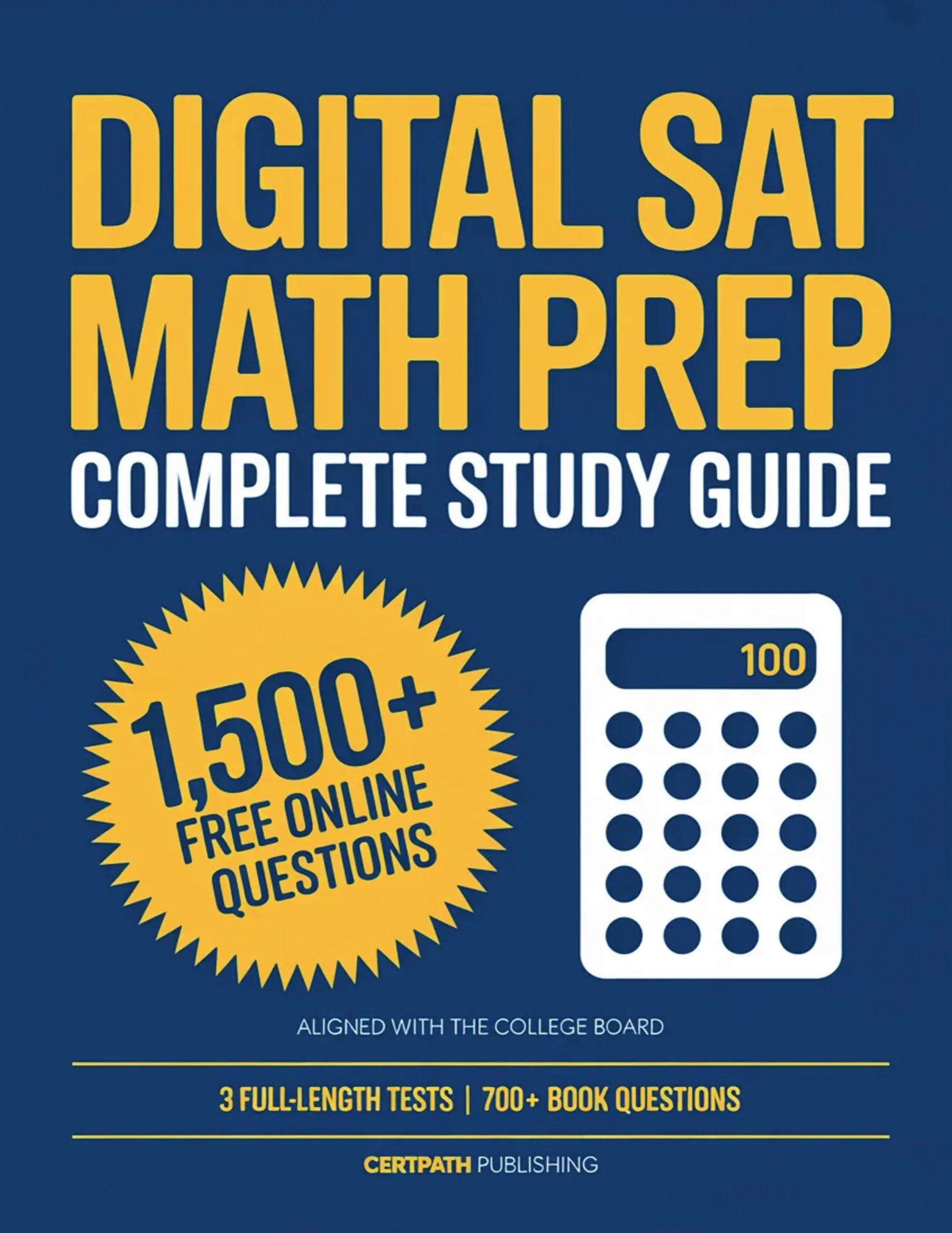
Featured book: Digital SAT Math Prep
CertPath Publishing's Digital SAT Math Prep covers all four current content domains — Algebra, Advanced Math, Problem-Solving and Data Analysis, and Geometry and Trigonometry — across 1,540 practice questions in 35 full-length tests, written in the same word-problem style as the real exam.
Buy on Amazon →4 Digital SAT Math questions, worked step by step
These four come from CertPath's free 25-question Digital SAT Math sample set and are quoted exactly as written there, one from each of the four content domains.
Question 1 — Algebra: a linear depreciation model
A delivery van bought for $24,600 loses value at a constant rate, so its value in dollars t years after purchase is V = 24,600 - 1,845t. After how long is the van worth 60% of its purchase price?
- A. 5 years 3 months
- B. 13 years 4 months
- C. 8 years 0 months
- D. 5 years 4 months
Answer: D. Sixty percent of $24,600 is $14,760, so the van must lose $9,840 in value. Dividing, 9,840 / 1,845 = 5 1/3 years, and one third of a year is 4 months.
Skill tested and common trap: this checks whether you can set up and solve a linear model from a word problem instead of just plugging in. The trap is choice C, 8 years 0 months, which comes from dividing the target value $14,760 by $1,845 — that finds how long it takes to lose 60% of the price, not how long until only 60% remains.
Question 2 — Advanced Math: exponential decay written as a rate per period
A bacterial colony contains 4,800 cells, and the number of cells decreases by 12% every 5 days. Which expression gives the number of cells remaining d days after the count of 4,800?
- A. 4,800(0.88)^(d/5)
- B. 4,800(0.12)^(d/5)
- C. 4,800(1.12)^(-d/5)
- D. 4,800(0.88)^(5d)
Answer: A. A 12% decrease multiplies the population by 0.88 once per 5-day period, and d days contain d/5 periods, so the count is 4,800(0.88)^(d/5). At d = 5 this gives 4,224, which is 12% less than 4,800.
Skill tested and common trap: this checks whether you know that "decreases by 12%" means multiply by the 88% that remains, not by 0.12. Choice B is the classic error — multiplying by the percent lost rather than the percent remaining would wipe out 88% of the colony every 5 days, which isn't what "decreases by 12%" means at all.
Question 3 — Problem-Solving and Data Analysis: a two-way table with a conditional probability
A transit agency surveyed 180 commuters. Of those surveyed, 108 own a bicycle, and 45 of the bicycle owners also hold a monthly transit pass. Altogether, 96 of the commuters surveyed hold a monthly transit pass. If one of the surveyed commuters who does not own a bicycle is selected at random, what is the probability that the commuter holds a monthly transit pass?
- A. 17/60
- B. 5/12
- C. 17/32
- D. 17/24
Answer: D. There are 180 - 108 = 72 commuters without a bicycle, and 96 - 45 = 51 of the pass holders do not own a bicycle. The probability is 51/72 = 17/24.
Skill tested and common trap: this tests whether you can build the right denominator for a conditional probability from a two-way table described only in words. Choice C, 17/32, answers a different question — it comes from 51/96, the probability that a randomly chosen pass holder owns no bicycle, which divides by the pass holders instead of by the non-owners the question actually asked about.
Question 4 — Geometry and Trigonometry: completing the square to find a sector's area
In the xy-plane, the equation x² + y² - 10x + 6y = 15 defines a circle. A sector of this circle has a central angle of 90°. What is the area of the sector?
- A. 12.25π
- B. 3.75π
- C. 24.5π
- D. 49π
Answer: A. Completing the square gives (x - 5)² + (y + 3)² = 15 + 25 + 9 = 49, so the radius is 7 and the circle's area is 49π. A 90° sector is one quarter of the circle, so its area is 49π / 4 = 12.25π.
Skill tested and common trap: this checks whether you complete the square correctly before reading off the radius. Choice B, 3.75π, comes from reading r² as 15 straight off the right side of the original equation — forgetting that completing the square adds 25 and 9 to both sides before the radius can be found.
What's actually on the Digital SAT Math section
Per College Board's own "How the SAT Is Structured" page, the Math section has 44 questions split into two modules of 22 questions each, with 35 minutes per module for 70 minutes total — about a minute and a half per question. Of the 44, 40 are scored (operational) and 4 are unscored pretest questions College Board uses to evaluate future content; there's no way to tell which is which, so every question deserves full attention. The section is adaptive at the module level: how you perform on Module 1 determines whether Module 2 draws from an easier or harder question pool, which is also documented on that same page.
A graphing calculator (a built-in Desmos tool) is available on the testing application for the entire Math section, and you're also allowed to bring your own approved handheld calculator if you prefer it.
What's tested, and how much of the section each domain gets
College Board's Math Specifications describe four content domains, with Algebra and Advanced Math jointly carrying about 70% of the section:
- Algebra — about 35% (13-15 of the 40 scored questions). Linear equations and inequalities, systems of equations, and linear functions in context — like the depreciation model in Question 1 above.
- Advanced Math — about 35% (13-15 questions). Quadratics, exponential growth and decay, polynomials, and nonlinear functions — like the bacterial-decay expression in Question 2.
- Problem-Solving and Data Analysis — about 15% (5-7 questions). Ratios, rates, percentages, probability, and interpreting data from tables and scatterplots — like the two-way table in Question 3.
- Geometry and Trigonometry — about 15% (5-7 questions). Area, volume, circle equations, right-triangle trigonometry, and lines and angles — like the sector problem in Question 4.
That weighting is worth planning around directly: Algebra and Advanced Math alone make up roughly seven in ten scored Math questions, so a study plan that treats all four domains as equally important is spending time in the wrong place.
How Digital SAT Math scoring actually works
Per College Board's "How Are Scores Calculated?" page, Math is reported on a 200-800 scale, and Reading and Writing is reported the same way, so the two combine for a total score of 400-1600. Scoring accounts for both how many questions you got right and the difficulty of the module you were routed into — and there's no penalty for a wrong answer, so leaving a question blank can only cost you, never protect you.
Registering, test dates and what it costs
Standard SAT registration is $68, per College Board's own SAT Test Fees page, with separate fees for late registration, a test-center change, or cancellation; fee waivers are available for eligible students. The SAT Suite Test Dates and Deadlines page lists confirmed U.S. test dates — for 2026, these run from August through December, with more added for 2027 — giving students several sittings a year to work around college application deadlines or a retake. Through Score Choice, you decide which test date's scores to send to each college; you can't mix a Math score from one sitting with a Reading and Writing score from another, since scores are sent by test date as a complete set.
Try 25 tough Digital SAT Math questions free
No email, no signup. Full explanations after every answer.
FAQ
Where can I find free Digital SAT Math practice questions?
CertPath Publishing has 25 free Digital SAT Math practice questions at certpathpublishing.store/sample?book=sat-math. No email or signup is required, and you get a full explanation after every answer.
How many questions are on the Digital SAT Math section and how long do I get?
The Math section has 44 questions split into two 22-question modules, with 70 minutes total (35 minutes per module). Of the 44, 40 are scored and 4 are unscored pretest questions College Board uses to test future content; you are not told which is which.
What topics are covered on the Digital SAT Math section?
Four content domains: Algebra and Advanced Math each make up about 35% of the section, while Problem-Solving and Data Analysis and Geometry and Trigonometry each make up about 15%.
Can I use a calculator on the entire Digital SAT Math section?
Yes. A graphing calculator (Desmos) is built into the testing application and available for the whole Math section, and you may also bring your own approved handheld calculator.
How is the Digital SAT Math section scored?
Math is scored on a 200-800 scale, combined with a 200-800 Reading and Writing score for a total of 400-1600. There is no penalty for a wrong answer, so every question should get an answer.
CertPath Publishing is an independent publisher and is not affiliated with or endorsed by the College Board. See the Digital SAT Math exam page for the full prep guide, or buy Digital SAT Math Prep on Amazon. If you're prepping for a different exam, CertPath has free practice for other exams here.
— The CertPath Publishing Team