How Hard Is the CMSRN Exam? What MSNCB's Blueprint Tests
The Certified Medical-Surgical Registered Nurse (CMSRN®) credential, administered by the Medical-Surgical Nursing Certification Board (MSNCB), tests med-surg nurses across five weighted practice domains rather than one tidy body-systems checklist — and more than half the exam sits on just two of them. Before you dig into the breakdown, try 25 free CMSRN practice questions — no email required — then come back here for what MSNCB's own blueprint actually weighs.
CertPath Publishing's CMSRN Exam Practice Questions guide is written around this same five-domain blueprint, with scenario-based questions in the same style the real exam uses. Before buying anything, try the free sample below and see how that style feels under a clock.
What the CMSRN exam actually tests: five domains, not an even split
MSNCB's CMSRN Certification page and the current 2023 CMSRN Exam Blueprint lay out five content domains. Each carries a published weight and a fixed number of scored items, and together they add up to the 125 scored questions on every exam:
- Patient/Care Management — 32% (40 items). Patient safety, chronic and acute pain management across both pharmacological and non-pharmacological approaches (repositioning, heat/cold, complementary therapies like acupuncture or aromatherapy), and patient advocacy.
- Nursing Teamwork and Collaboration — 21% (26 items). Delegation and supervision — the judgment calls a med-surg nurse makes about what to hand off, to whom, and how closely to follow up.
- Elements of Interprofessional Care — 17% (21 items). The nurse's role within the interdisciplinary team, including the communication and teamwork skills that role depends on.
- Holistic Patient Care — 15% (19 items). Patient-centered care (active listening, communication preferences, family involvement, individual health goals), handling patient satisfaction issues like grievances and service recovery, and the nursing process from assessment through evaluation.
- Professional Concepts — 15% (19 items). The broader professional-practice knowledge a certified med-surg nurse is expected to carry, separate from any single patient encounter.
Patient/Care Management alone is worth nearly a third of the exam, and together with Nursing Teamwork and Collaboration it covers more than half the scored questions. That's a different shape than most people expect walking in — a lot of candidates over-prepare on physiological body-systems content and under-prepare on delegation and team-based judgment calls, which together carry more weight than any single disease process.
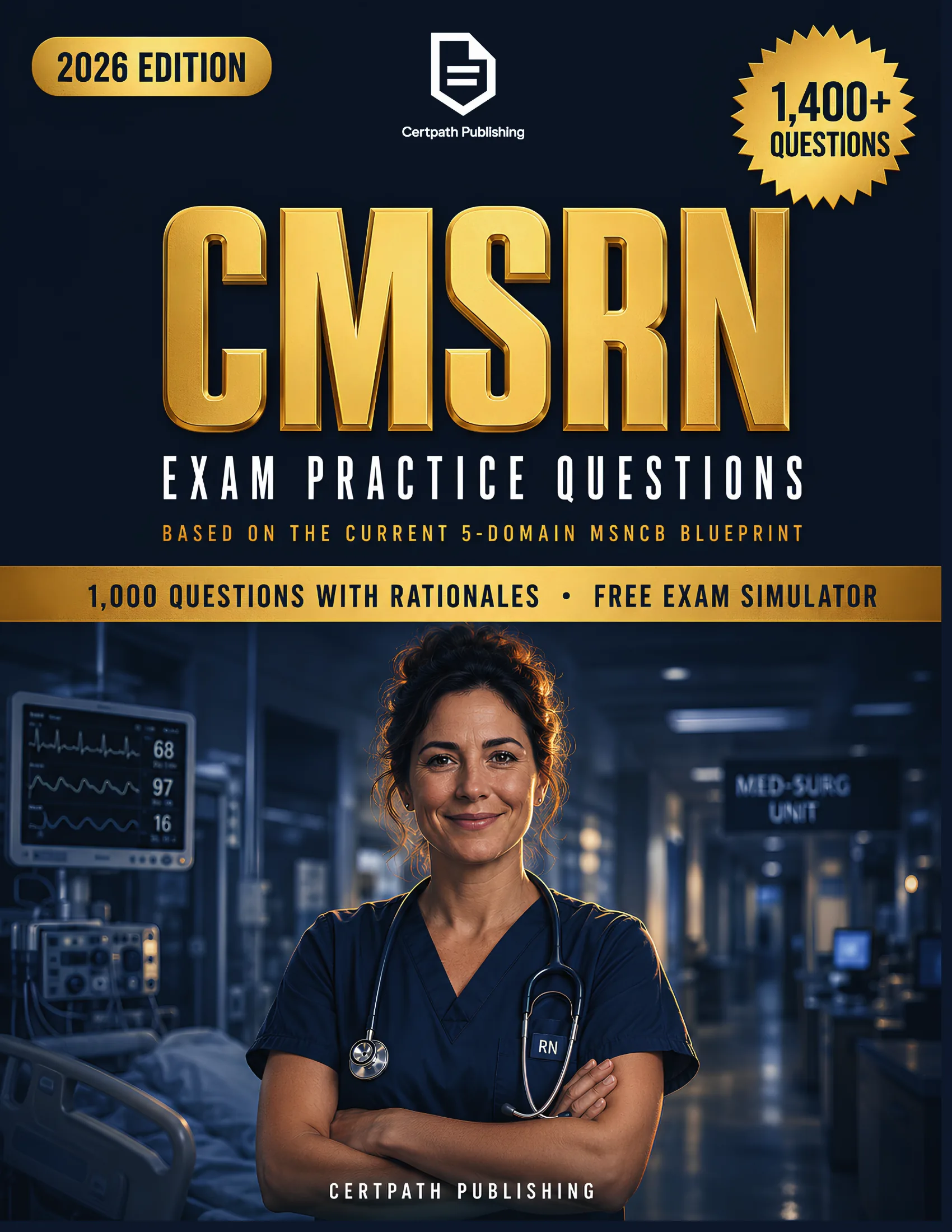
Featured book: CMSRN Exam Practice Questions
CertPath Publishing's CMSRN Exam Practice Questions guide is built around the current five-domain blueprint, with scenario-based "which action should the nurse take first" questions written in the same style the real exam uses.
Buy on Amazon →Exam format: what you'll actually sit down to take
MSNCB delivers 150 multiple-choice questions on every CMSRN exam, but only 125 of them count toward your score — the other 25 are unscored pretest items MSNCB uses to gather statistics for future exam forms, mixed in without telling you which is which. You get 3 hours to complete the full 150-question sitting. A passing result requires a standard score of 95, which is a scaled score built from your 125 scored answers rather than a raw percentage — it isn't the same thing as counting how many of the 125 you answered correctly.
Who can actually sit for it
Per MSNCB's eligibility rules, you need both of the following before you can apply:
- A current, unencumbered Registered Nurse license issued in the United States, its territories, or Canada.
- 2,000 hours of practice in a medical-surgical setting completed within the three years before you apply — clinical, management, or education roles all count toward those hours. MSNCB recommends, but does not strictly require, at least two full years of qualifying experience on top of the hours requirement.
Those requirements have to be met both when you apply and throughout your full 90-day testing window, so don't apply the moment you hit 2,000 hours if your eligibility period would lapse before you can schedule a seat.
A worked example: budgeting study time against the real weights
Because Patient/Care Management and Nursing Teamwork and Collaboration together carry 53% of the exam, splitting study time evenly across all five domains shorts the two heaviest ones. Say you can commit 30 total hours to CMSRN review. Weighted to the published domain percentages, that time should split like this:
- Patient/Care Management (32%): 30 × 0.32 = 9.6 hours → about 9.5 hours
- Nursing Teamwork and Collaboration (21%): 30 × 0.21 = 6.3 hours → about 6.5 hours
- Elements of Interprofessional Care (17%): 30 × 0.17 = 5.1 hours → about 5 hours
- Holistic Patient Care (15%): 30 × 0.15 = 4.5 hours
- Professional Concepts (15%): 30 × 0.15 = 4.5 hours
That's roughly 9.5 + 6.5 + 5 + 4.5 + 4.5 = 30 hours, matching the blueprint instead of giving each of the five domains an equal fifth. At 5 hours a week, that same split stretches across 6 weeks.
A study plan that matches the blueprint
Using the same weighting, a six-week plan that front-loads the two heaviest domains looks like this:
- Weeks 1–2 — Patient/Care Management (32%): Patient safety priorities, pharmacological and non-pharmacological pain management, and patient advocacy scenarios — the domain where the most scored questions live.
- Week 3 — Nursing Teamwork and Collaboration (21%): Delegation and supervision judgment calls — what you can hand off, to whom, and what still needs your own follow-up.
- Week 4 — Elements of Interprofessional Care (17%): The nurse's role on the interdisciplinary team and the communication patterns that role depends on.
- Week 5 — Holistic Patient Care (15%) and Professional Concepts (15%): Patient-centered care, the nursing process end to end, and the broader professional-practice knowledge the exam expects beyond any single patient scenario.
- Week 6 — Full-length review: At least one complete timed run to build stamina for the 3-hour sitting, plus a pass over whichever domain felt weakest in the first five weeks.
What it costs, and what happens if you don't pass
As of this writing, MSNCB's standard initial exam fee is $394 ($267 for AMSN members), and every application — pass or fail — also carries a separate, non-refundable $90 processing fee. If you don't pass, a first-time retake costs $315 standard or $189 for AMSN members, on top of the $90 processing fee for the new application. MSNCB also offers CertAssure, an optional add-on purchased before you test that covers the cost of a second attempt if you don't pass the first time, for $100 (AMSN members) or $200 (non-members). Confirm current pricing on MSNCB's own Test Taker FAQs page before you apply, since fees are reviewed periodically.
Try 25 tough CMSRN questions free
No email, no signup. Full explanations after every answer.
FAQ
Where can I find free CMSRN practice questions?
CertPath Publishing has 25 free CMSRN practice questions at certpathpublishing.store/sample?book=cmsrn. No email or signup is required, and you get a full explanation after every answer.
How many questions are on the CMSRN exam and how long do I get?
The CMSRN exam has 150 multiple-choice questions, 125 of which are scored (the other 25 are unscored pretest items), and you get 3 hours to complete it.
What are the eligibility requirements for the CMSRN exam?
You need a current, unencumbered RN license issued in the United States, its territories, or Canada, plus 2,000 hours of practice in a medical-surgical setting within the three years before you apply. MSNCB recommends, but does not strictly require, at least two full years of medical-surgical experience.
What does the CMSRN exam cost?
MSNCB's standard initial exam fee is $394 ($267 for AMSN members), plus a separate non-refundable $90 processing fee on every application. A first-time retake costs $315 standard or $189 for AMSN members. Confirm current pricing on MSNCB's own fee page before you apply.
What is a passing score on the CMSRN exam?
You need a standard score of 95. That's a scaled score built from the 125 scored questions, not a raw percentage, so it isn't the same as answering 95 questions correctly.
CertPath Publishing is an independent publisher and is not affiliated with or endorsed by the Medical-Surgical Nursing Certification Board (MSNCB) or the Academy of Medical-Surgical Nurses (AMSN). See the CMSRN exam page for the full practice-question guide, or buy CMSRN Exam Practice Questions on Amazon. If you're prepping for a different exam, CertPath has free practice for other exams here.
— The CertPath Publishing Team