How Hard Is the CHST Exam? What BCSP's Blueprint Tests
The Construction Health and Safety Technician (CHST) is the Board of Certified Safety Professionals' (BCSP) credential for safety staff working specifically in construction, and it's built differently than BCSP's generalist exams — four domains instead of seven, no degree requirement, and a strong tilt toward one domain that covers more than a third of the test. Whether you're deciding if now's the time or you've already applied, start with 25 free CHST practice questions — no email required — then read on for what the current blueprint actually weighs.
CertPath Publishing's CHST Exam Study Guide is built around this same four-domain blueprint, with practice questions written in the applied, scenario-based style BCSP uses throughout the real exam. Before buying anything, try the free sample below and see how that style feels under a clock.
What the CHST exam actually tests: four domains, one of them dominant
BCSP's own CHST credential page and its published CHST5 Examination Blueprint, which took effect August 1, 2024, lay out four content domains. Each carries a published weight, and together they add up to the 200 questions on every exam:
- Hazard and Risk Identification and Control — 36.6%. Recognizing and controlling construction-site hazards: fall protection, excavations and trenching, scaffolding, electrical hazards, struck-by and caught-in-between hazards, and the hierarchy of controls applied to each.
- Safety Program Development, Implementation, and Sustainment — 22.5%. Building and running a site safety program: written programs, job hazard analyses, inspections and audits, and tracking whether a program is actually working over time.
- Leadership, Communication, and Training — 21.0%. Training needs assessment and delivery, toolbox talks and other site communication, and the people-management side of getting a crew to actually follow a safety program.
- Emergency Preparedness, Fire Prevention, and Response — 19.9%. Emergency action plans, fire prevention and protection systems, and incident response on an active construction site.
One domain alone, Hazard and Risk Identification and Control, carries more than a third of the exam — more than the bottom two domains combined. That's a meaningfully different shape than BCSP's broader CSP exam, which spreads its top weight across two domains instead of one. On CHST, under-studying hazard recognition and control puts over a third of your score at risk on its own, so it deserves proportionally more of your prep time than the other three domains, not just a slightly bigger share.
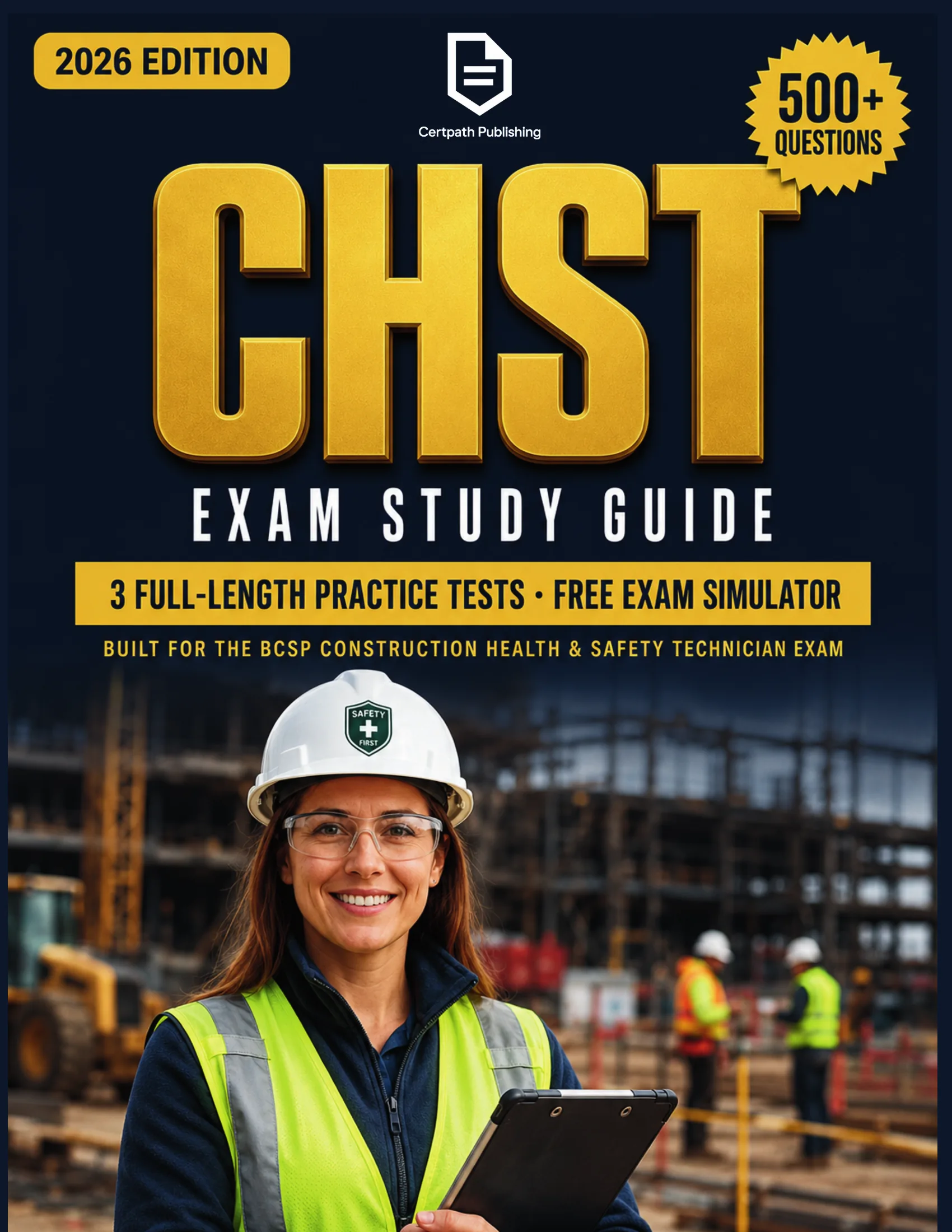
Featured book: CHST Exam Study Guide
CertPath Publishing's CHST Exam Study Guide covers all four current CHST5 domains, with practice questions written to match the applied, construction-scenario style of the real exam.
Buy on Amazon →Exam format: what you'll actually sit down to take
BCSP delivers 200 multiple-choice questions on every CHST sitting, and you get 4 hours to complete them at a computer-based testing center. That's shorter than BCSP's CSP exam (5.5 hours) and CAP-style generalist credentials, which fits a scope that's narrower by design: everything on the CHST blueprint is scoped specifically to construction, not general industry.
Who can actually sit for it
Per BCSP's CHST eligibility page, you need:
- At least three years of construction safety, health and environmental (SH&E) experience.
- At least 35% of your job duties involving technical SH&E knowledge and skill — not just a safety-adjacent title, but work that actually requires that expertise.
- No published degree, college-credit or training-hours requirement. Unlike CSP, which requires a bachelor's degree plus a qualifying credential before you can even apply, CHST is reachable directly from qualifying work experience.
That last point is the biggest practical difference from BCSP's generalist exams: CHST is designed as a direct path for experienced construction-safety staff, not a credential layered on top of another one. A job title alone won't establish eligibility, though — be ready to document your actual duties, dates and references when you apply.
A worked example: budgeting study time against the real weights
Because one domain carries more than a third of the exam and the smallest domain carries barely a fifth, splitting study time evenly across all four domains shorts the domain that matters most. Say you can commit 40 total hours to CHST study. Weighted to the published domain percentages, that time should split like this:
- Hazard and Risk Identification and Control (36.6%): 40 × 0.366 ≈ 14.5 hours
- Safety Program Development, Implementation, and Sustainment (22.5%): 40 × 0.225 = 9 hours
- Leadership, Communication, and Training (21.0%): 40 × 0.21 = 8.4 hours → about 8.5 hours
- Emergency Preparedness, Fire Prevention, and Response (19.9%): 40 × 0.199 ≈ 8 hours
That's 14.5 + 9 + 8.5 + 8 = 40 hours, weighted toward hazard recognition and control instead of giving all four domains an equal quarter. At 7 hours a week, that same split stretches across roughly 6 weeks.
A study plan that matches the blueprint
Using the same weighting, a six-week plan that front-loads the largest domain looks like this:
- Weeks 1–2 — Hazard and Risk Identification and Control (36.6%): Fall protection systems, excavation and trenching requirements, scaffolding, electrical hazards, and applying the hierarchy of controls to each.
- Week 3 — Safety Program Development, Implementation, and Sustainment (22.5%): Writing and running a site safety program, job hazard analyses, and inspection and audit routines.
- Week 4 — Leadership, Communication, and Training (21.0%): Training needs assessment, toolbox talks, and the communication skills behind getting a crew to actually follow the program.
- Week 5 — Emergency Preparedness, Fire Prevention, and Response (19.9%): Emergency action plans, fire prevention and protection systems, and incident response procedures.
- Week 6 — Full-length review: At least one complete timed run across all four domains to build stamina for the 4-hour sitting, plus a pass over your weakest domain from the first five weeks.
CHST vs. CSP: which construction-safety credential fits you
Both are BCSP credentials, and both show up in construction-safety job postings, but they're built for different points in a career. CSP is BCSP's senior generalist exam: it requires a bachelor's degree and a qualifying credential (ASP, GSP, TSP or an approved equivalent) before you can even apply, spreads 200 questions across seven domains, and runs 5.5 hours. CHST skips the degree and prior-credential requirements entirely — three years of construction-specific SH&E experience with at least 35% technical duty share is enough to apply — and its 200 questions are scoped tightly to construction over four domains in 4 hours. If your work is specifically on job sites rather than across general industry, and you don't already hold a BCSP-qualifying credential, CHST is usually the more direct target. Some safety professionals go on to pursue CSP later once they've built the broader generalist experience and credential base it requires.
Keeping the credential current
Earning CHST isn't a one-time event. BCSP requires certified professionals to recertify periodically by documenting continuing education and professional activity, and it charges an annual maintenance fee to keep the credential active. The exact point total, cycle length and current fee are set by BCSP and reviewed from time to time, so check BCSP's own renewal and maintenance guidance well before your first renewal comes due, rather than assuming the rules that applied when you first certified still apply years later.
What it costs, and what happens if you fail
As of this writing, BCSP's own CHST page lists a $300 exam fee. Fees are reviewed periodically and BCSP also publishes separate application and eligibility-extension charges, so confirm current totals on BCSP's own CHST page before you apply. If you don't pass, BCSP requires a minimum six-week wait before you can retake, and the retake has to fall within your original eligibility window. See the full retesting rules on BCSP's own retesting policy page.
Try 25 tough CHST questions free
No email, no signup. Full explanations after every answer.
FAQ
Where can I find free CHST practice questions?
CertPath Publishing has 25 free CHST practice questions at certpathpublishing.store/sample?book=chst. No email or signup is required, and you get a full explanation after every answer.
How many questions are on the CHST exam and how long do I get?
The CHST exam delivers 200 multiple-choice questions and you get 4 hours to complete it, under BCSP's current CHST5 blueprint.
What are the BCSP CHST eligibility requirements?
BCSP requires at least three years of construction safety, health and environmental (SH&E) experience, with a minimum of 35% of your job duties involving technical SH&E knowledge and skill. BCSP does not publish a degree requirement for CHST.
What does the CHST exam cost?
BCSP's own CHST page lists a $300 exam fee. Confirm the current application fee and any bundle pricing on BCSP's own CHST page before you apply, since fees are reviewed periodically.
What happens if I fail the CHST exam?
BCSP requires a minimum six-week wait before you can retake the CHST exam, and the retake must happen within your original eligibility window. Check BCSP's retesting policy page for current retake fees and requirements.
CertPath Publishing is an independent publisher and is not affiliated with or endorsed by the Board of Certified Safety Professionals (BCSP). See the CHST exam page for the full study guide, or buy the CHST Exam Study Guide on Amazon. If you're prepping for a different exam, CertPath has free practice for other exams here.
— The CertPath Publishing Team