Free CNOR Practice Test: 4 Exam-Style Questions Explained
The CNOR exam doesn't just ask whether you know perioperative nursing — it asks whether you'll choose the safe action in the middle of a case, under pressure, when a faster-looking shortcut is sitting right in front of you. Try 25 free CNOR practice questions — no email required — then walk through four questions below, straight from CertPath Publishing's CNOR Exam Study Guide, with full explanations and the trap built into each wrong answer.
CertPath's CNOR Exam Study Guide is organized around CCI's own eight content-outline domains rather than a generic nursing-review topic list, so the proportions in the book match the proportions on the real test. Before buying anything, try the free sample below and see how the question style feels under a clock.
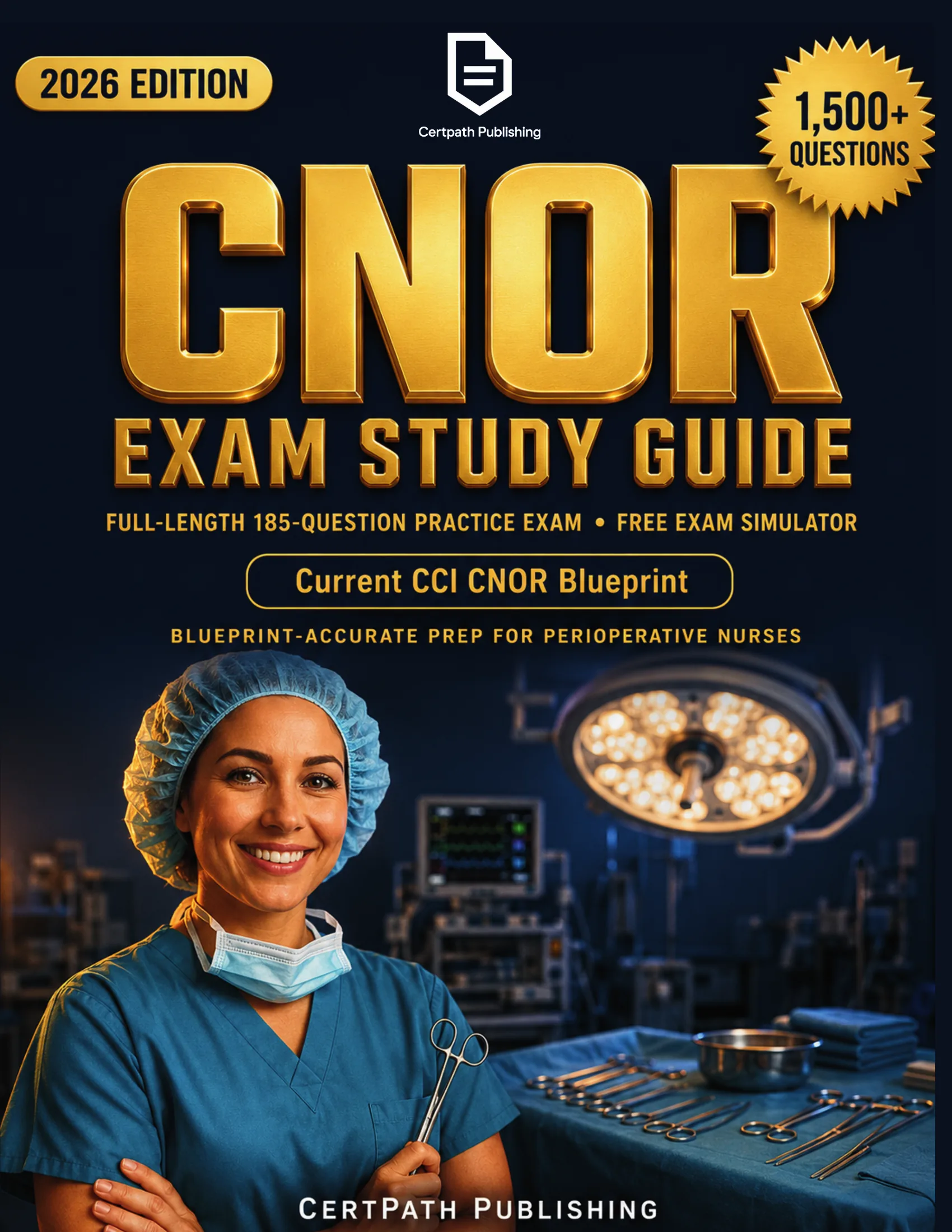
Featured book: CNOR Exam Study Guide
CertPath Publishing's CNOR Exam Study Guide walks through Patient Care and Safety, Infection Prevention, Pre/Postoperative Assessment, Emergency Situations, Communication and Documentation, and the other CCI domains in roughly the weights CCI itself assigns them, with scenario-style questions built the way the real exam asks them.
Buy on Amazon →The real format: 200 questions, 3 hours 45 minutes, pass/no pass
Per the Competency & Credentialing Institute's (CCI) own CNOR exam page, the test is 200 multiple-choice questions administered by computer, with a 3 hour 45 minute time limit. There's no scaled score reported back to you — CCI scores the exam pass or no pass. That works out to a little over a minute per question on average, though some scenario questions (like the ones below) take longer to read than a straight recall question would.
What's actually weighted: eight domains, not an even split
CCI's content outline doesn't spread questions evenly across topics. Per CCI's own breakdown, the eight domains are weighted like this:
- Patient Care and Safety — 25%. By far the largest domain, covering positioning, counts, retained-item prevention, specimen handling, fire risk, electrosurgery, tourniquets, medications on the sterile field, and blood product administration.
- Infection Prevention and Control of Environment, Instrumentation and Supplies — 16%. Sterile technique, immediate-use steam sterilization, and sterilization monitoring.
- Pre/Postoperative Patient Assessment & Diagnosis — 15%. Assessment before and after the procedure.
- Communication and Documentation — 11%. Time-out procedures, hand-offs, and implant documentation.
- Emergency Situations — 10%. Malignant hyperthermia, local anesthetic systemic toxicity, surgical fire, and cardiac arrest in non-standard positions.
- Management of Personnel, Services and Materials — 9%. Includes working with industry representatives in the OR.
- Individualized Plan of Care Development and Expected Outcome Identification — 8%.
- Professional Accountability — 6%.
Notice that Patient Care and Safety and Infection Prevention together make up 41% of the exam — more than any other pairing. That's exactly where CCI's own weighting says to spend the most study time, and it's also where the four questions below are drawn from.
CCI's page also notes that starting in 2027, the CNOR exam will move from these seven to six consolidated competency areas. CCI hasn't published the new weights yet, so current candidates should still prep against the eight-domain outline above.
Four CNOR practice questions, worked in full
These four questions are taken verbatim from CertPath's free 25-question CNOR sample. Each one is followed by the correct answer, the official explanation, and a short note on what skill it's really testing.
Question 1 — Surgical counts
At the start of fascial closure the closing sponge count is off by one. The surgeon says the count must be wrong because nothing has been placed in the wound and wants to complete the closure. A search of the field, drapes, floor and trash has not found the sponge. Which action is correct?
- A. Pause closure for a repeat count and search, then image if still unresolved
- B. Record the count as incorrect and allow the closure to continue as planned
- C. Arrange for a radiograph to be taken in the recovery area after the case
- D. Repeat the count after the drapes are removed and the patient is moved
Correct answer: A. An unresolved count discrepancy is treated as a possible retained item: closure pauses, the count and a systematic search are repeated, and if the item is still not found an intraoperative radiograph is obtained before final closure when the patient's condition permits. Deferring the film to recovery is the tempting compromise that keeps the case moving, and it means closing over a possible retained sponge and a second procedure to retrieve it.
Skill tested and the trap: This is a Patient Care and Safety question, the single largest domain on the exam. The trap is social pressure — a confident surgeon telling you the count is wrong — layered on top of a time-pressure incentive to keep moving. The correct answer requires holding the line on protocol even when a senior team member pushes back.
Question 2 — Surgical fire risk
A patient having a facial lesion excised under sedation is receiving oxygen at 6 L/min by open nasal cannula under the drapes. The surgeon asks for the electrosurgical pencil to be used at the wound edge. Which action best reduces the risk of fire?
- A. Stop the open oxygen if feasible, or reduce it below 30 percent and vent the drapes
- B. Change to a bipolar instrument so the oxygen concentration no longer matters
- C. Ask for the alcohol-based prep to be reapplied just before the incision
- D. Moisten the drapes around the site and continue at the present oxygen flow
Correct answer: A. Open oxygen under drapes near the face creates an oxygen-enriched atmosphere and the electrosurgical pencil supplies ignition. Before activation the team stops open supplemental oxygen if the patient tolerates it, or reduces the concentration below 30 percent, lets accumulated oxygen dissipate and vents the drapes; a secured airway is considered if oxygenation cannot be maintained safely. Moist towels are the tempting adjunct but do not disperse the enriched pocket, and bipolar energy does not make it safe.
Skill tested and the trap: Surgical fire risk sits inside Patient Care and Safety, and the fire triangle — oxidizer, ignition source, fuel — is a recurring CNOR theme. The trap is reaching for a plausible-sounding partial fix (moist towels, switching energy devices) instead of addressing the oxidizer itself, which is the one element the team can actually control in this scenario.
Question 3 — Sterile technique
Midway through a case the scrub person notices that an area of the drape over the instrument table has become soaked where a basin overflowed, and the fluid has reached the unsterile table surface beneath. Instruments are still being passed across that area. Which action is correct?
- A. Place an additional cloth towel over the wet area and continue the case
- B. Treat the wet area as contaminated and re-drape it before continuing
- C. Blot the area dry with a sterile towel and continue with the procedure
- D. Mark the wet area and keep instruments away from that part of the table
Correct answer: B. Moisture that passes through a drape carries microorganisms from the unsterile surface into the sterile field, so the area is contaminated and must be covered with impervious sterile material or re-draped. Adding a cloth towel is the tempting quick fix, but cloth is permeable and wicks fluid, so contamination continues. Blotting does not restore a barrier once strike-through has occurred.
Skill tested and the trap: This is straight from Infection Prevention and Control, the second-largest domain. The trap is confusing "looks dry now" with "is sterile" — blotting and adding a towel both address the visible moisture without addressing the underlying principle that strike-through is a one-way event.
Question 4 — Emergency: malignant hyperthermia
The end-tidal carbon dioxide has climbed from 36 to 64 mmHg despite increased minute ventilation, the jaw is rigid and the heart rate is 142/min. The volatile agent has been stopped and the patient is on high-flow oxygen. The anaesthesia professional asks the circulating nurse to fetch the cooling blanket. Which action should the nurse take first?
- A. Call for the malignant hyperthermia cart and extra help and prepare dantrolene
- B. Fetch the cooling blanket as the anaesthesia professional has requested
- C. Send an arterial blood gas to confirm the diagnosis before treating
- D. Begin active cooling with iced saline lavage of the open abdomen
Correct answer: A. Dantrolene is the only therapy that stops the underlying process, it takes several people and several minutes to reconstitute, and survival falls with every minute of delay. Cooling matters and comes next, which is why fetching the blanket is tempting, particularly as it was asked for directly; one nurse leaving for equipment before help and drug are summoned costs the critical interval. Treatment does not wait on a blood gas.
Skill tested and the trap: Emergency Situations questions on the CNOR exam reward recognizing the single highest-priority action, not just a correct action. The trap is following a direct instruction from a team member (the cooling blanket request) when a different, more time-critical step — mobilizing the MH cart and dantrolene — has to happen first.
Try 25 tough CNOR questions free
No email, no signup. Full explanations after every answer.
FAQ
Where can I find free CNOR practice questions?
CertPath Publishing has 25 free CNOR practice questions at certpathpublishing.store/sample?book=cnor. No email or signup is required, and you get a full explanation after every answer.
How many questions are on the CNOR exam, and how long do I get?
Per CCI's own CNOR exam page, the test has 200 multiple-choice questions with a 3 hour 45 minute time limit. It is computer-based and scored pass or no pass.
What domains does the CNOR exam cover?
CCI's content outline weights eight domains: Patient Care and Safety (25%), Infection Prevention and Control of Environment, Instrumentation and Supplies (16%), Pre/Postoperative Patient Assessment & Diagnosis (15%), Emergency Situations (10%), Communication and Documentation (11%), Management of Personnel, Services and Materials (9%), Individualized Plan of Care Development and Expected Outcome Identification (8%), and Professional Accountability (6%).
Am I eligible to sit for the CNOR exam?
Per CCI's own eligibility requirements, you need a current, unrestricted RN license and at least 2 years and 2,400 hours of perioperative nursing experience, including at least 1,200 intraoperative hours. RNs who hold the CFPN, CST, TS-C, or a qualifying military equivalent can qualify instead with 18 months and 2,400 hours as a perioperative RN.
What does the CNOR exam cost?
Per CCI's own CNOR exam page, the application fee is $475, which includes your first exam attempt. A retake costs $175.
CertPath Publishing is an independent publisher and is not affiliated with or endorsed by the Competency & Credentialing Institute. See the CNOR exam page for the full prep lineup, or buy the CNOR Exam Study Guide on Amazon. If you're prepping for a different exam, CertPath has free practice for other exams here.
— The CertPath Publishing Team