Free TABE Level D Math Practice Test: 4 Questions Explained
TABE Level D math isn't arithmetic drilling — it's percent, rate and geometry problems wrapped in real-world context, with at least one plausible wrong answer built into every question. Try 25 free TABE Level D math practice questions — no email required — then walk through four questions below, straight from CertPath Publishing's TABE 11 & 12 Math Workbook Level D, with full explanations and the trap built into each wrong answer.
TABE — the Test of Adult Basic Education — is published by Data Recognition Corporation (DRC) and used by adult-education programs, workforce boards and some employers to measure reading, language and math skills. It isn't one single test: candidates are placed into one of several levels first, and Level D sits in the middle of the math ladder, one step below the high-school-equivalent Level A. CertPath's Level D workbook follows that same level's blueprint lesson by lesson, so the practice matches the actual question style rather than a generic middle-school review.
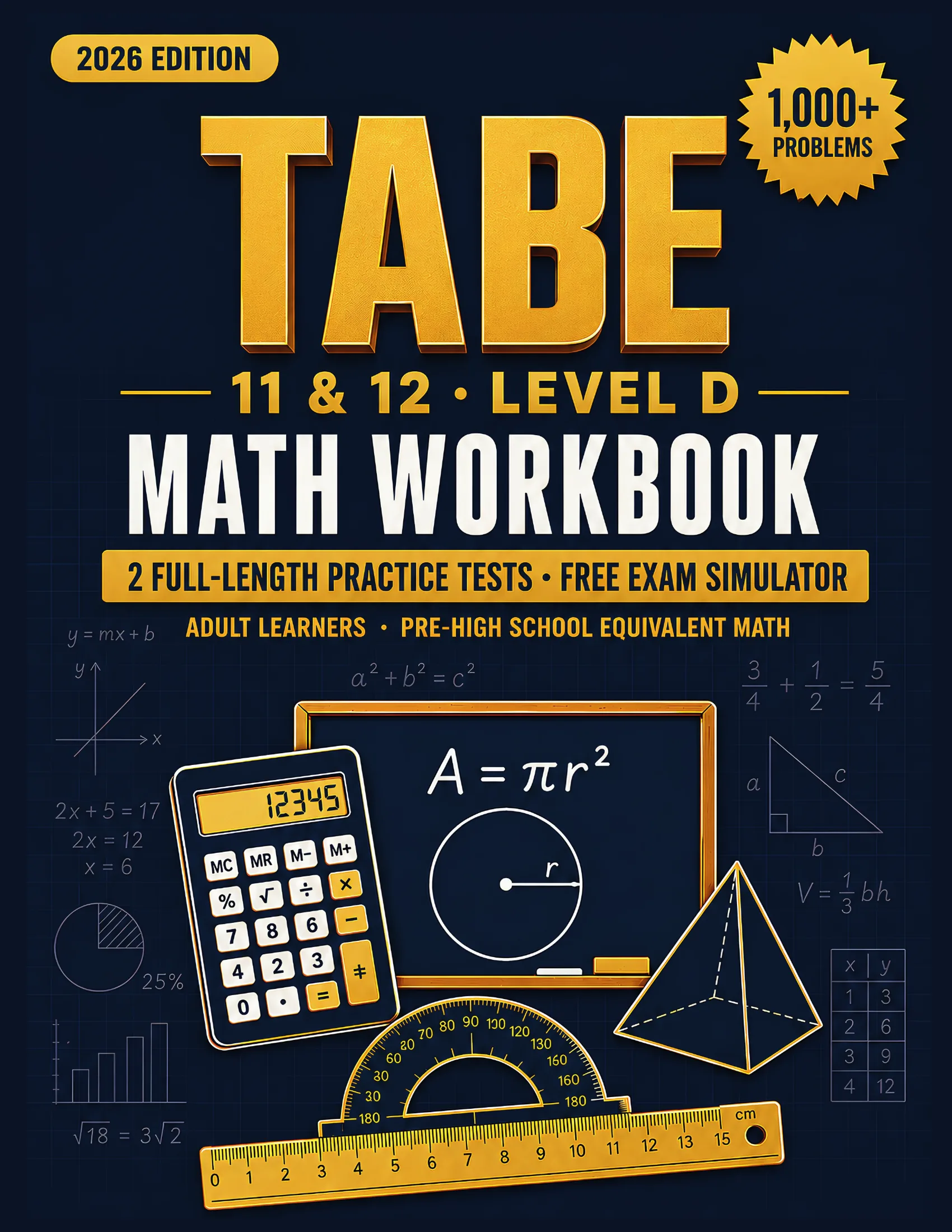
Featured book: TABE 11 & 12 Math Workbook Level D
CertPath Publishing's Level D workbook teaches signed numbers, ratios and percent, expressions and equations, functions, geometry and statistics and probability from the ground up, in plain language, with hundreds of practice problems and full-length timed tests built the way the real Level D questions are asked.
Buy on Amazon →You don't choose your level — a locator test does
Before a candidate sits the full TABE math test, most programs give a short locator (placement) test first. The locator score determines which level — E (foundational), M (upper-elementary), D (pre-high-school), or A (high-school-equivalent) — the candidate actually takes. That matters for anyone searching for "TABE practice test" in general: practicing the wrong level wastes time, because the content and difficulty genuinely differ from one level to the next. If your program has already told you which level you're taking, start there. If not, ask your program coordinator before you start studying.
What Level D math actually tests
Level D questions are built around six content areas, and the four questions below were picked to cover most of them:
- Ratios and proportional relationships — unit rates, scaling recipes or proportions, and multi-step percent problems (discounts, tax, tips, markups).
- The number system — signed numbers, rational numbers, and operations with roots and fractions.
- Expressions and equations — multi-step equations and inequalities written out of a word problem, scientific notation, and order of operations.
- Functions — building, reading and comparing linear relationships.
- Geometry — area, surface area, angle relationships, and the Pythagorean theorem, usually applied to a real object or job.
- Statistics and probability — measures of center, compound probability, and reasoning from samples.
Nothing here requires calculus or advanced algebra — the skills themselves are middle-school level. What makes Level D hard is that almost every question nests two or three steps together and attaches a plausible-looking wrong answer to each shortcut a rushed test-taker might take.
Four Level D math questions, worked in full
These four questions are taken verbatim from CertPath's free 25-question TABE Level D sample. Each one is followed by the correct answer, the official explanation, and a short note on what skill it's really testing.
Question 1 — Multi-step percent
A power tool is marked $186.00 before tax. A store coupon takes 15 percent off the marked price, and sales tax of 8 percent is then charged on the amount the customer actually pays for the tool. What is the final total, to the nearest cent?
- A. $172.98
- B. $158.10
- C. $170.75
- D. $200.88
Correct answer: C. The coupon leaves 85 percent of the price: 186.00 × 0.85 = $158.10. Tax adds 8 percent of that: 158.10 × 1.08 = $170.748, or $170.75. The tempting $172.98 comes from combining the percents additively as 186 × (1 − 0.15 + 0.08) = 186 × 0.93, which wrongly figures the 8 percent tax on the full $186 instead of on the discounted price.
Skill tested and the trap: Two percent operations have to happen in the right order — discount first, then tax on the discounted amount, never on the original sticker price. The trap rewards a test-taker who tries to shortcut two percent changes into one combined percentage, which only works for addition and subtraction, not for successive percent changes.
Question 2 — Equation from a word problem
A landscaping invoice lists an $85.00 trip charge, then mulch at $32.50 per cubic yard, then 8 percent sales tax charged on the mulch only, not on the trip charge. The invoice total is $506.20. How many cubic yards of mulch were delivered?
- A. 14.4 cubic yards
- B. 13.0 cubic yards
- C. 12.0 cubic yards
- D. 11.8 cubic yards
Correct answer: C. Tax applies only to the mulch, so each cubic yard bills at 32.50 × 1.08 = $35.10. The trip charge is untaxed, so 85.00 + 35.10y = 506.20, giving 35.10y = 421.20 and y = 12.0 cubic yards. The tempting 13.0 comes from dividing the $421.20 mulch portion by the untaxed $32.50, and 11.8 comes from taxing the whole invoice, including the trip charge, before dividing.
Skill tested and the trap: This is a one-variable equation built from a real invoice, which is exactly how Level D presents algebra — not as "solve for y" but as a billing problem you have to translate first. The trap is applying the tax rate to the wrong part of the bill, or to the wrong price per unit, before setting up the equation.
Question 3 — Surface area
A closed wooden shipping crate measures 4 feet long, 3 feet wide, and 2.5 feet high. Every outside face, including the top and the bottom, gets two coats of sealer. One quart of sealer covers 40 square feet, and sealer is sold only by the whole quart. How many quarts must be bought?
- A. 4 quarts
- B. 3 quarts
- C. 2 quarts
- D. 6 quarts
Correct answer: B. The surface area is 2(4 × 3) + 2(4 × 2.5) + 2(3 × 2.5) = 24 + 20 + 15 = 59 square feet. Two coats cover 118 square feet, and 118 ÷ 40 = 2.95, so 3 whole quarts are needed. The tempting 2 quarts figures only one coat, and 4 quarts comes from rounding each coat up separately to 2 quarts before doubling.
Skill tested and the trap: This is the surface-area formula for a rectangular solid, applied to a job-site object instead of an abstract box. The trap is a rounding-order mistake — round after you combine both coats, not before, or you overbuy supplies. Forgetting that "closed crate" means six faces, not four, is the other common miss.
Question 4 — Compound probability
A supervisor puts 10 slips in a bowl to assign overtime: 4 say morning and 6 say evening. Two workers each draw one slip, one after the other, and a slip that is drawn is not put back. What is the probability that both workers draw an evening slip?
- A. 9/25
- B. 5/9
- C. 1/3
- D. 3/5
Correct answer: C. The first worker draws an evening slip with probability 6/10. Because that slip is not replaced, only 9 slips remain and 5 of them say evening, so the second draw has probability 5/9. Multiply: 6/10 × 5/9 = 30/90 = 1/3. The tempting 9/25 is (6/10)², which would be right only if the first slip were put back before the second draw.
Skill tested and the trap: This is dependent, "without replacement" probability, which behaves differently from independent events. The trap is squaring the first probability, a shortcut that only works when the first item goes back in the bowl — it doesn't here, and Level D questions test whether you notice that.
Try 25 tough TABE Level D questions free
No email, no signup. Full explanations after every answer.
FAQ
Where can I find free TABE Level D practice questions?
CertPath Publishing has 25 free TABE Level D math practice questions at certpathpublishing.store/sample?book=tabe-d. No email or signup is required, and you get a full explanation after every answer.
How is my TABE level (E, M, D or A) decided?
You do not pick your level yourself. Adult-education and workforce programs typically give a short locator or placement test first, and your score on that locator determines which level — E, M, D or A — you sit for next.
What math topics does TABE Level D cover?
Level D math spans ratios and proportional relationships (unit rates, percent), the number system (signed numbers, rational numbers, roots), expressions and equations, functions, geometry, and statistics and probability — roughly middle-school-level content, one step below the high-school-equivalent Level A.
Is TABE 11 & 12 or TABE 13 & 14 the current test?
Per the test publisher Data Recognition Corporation's own TABE site, TABE 13 & 14 is now the current operational version, and it kept the same four levels — E, M, D and A — used in the older TABE 11 & 12 forms. Ask your own program which forms it is currently administering.
Does a higher TABE score help me skip remedial classes?
Many adult-education and workforce programs use TABE scores, in part, to decide whether a learner needs remedial coursework before moving into credential or job-training programs. Exact cutoffs are set by each program, not by the test publisher, so check with your own program for its specific requirements.
CertPath Publishing is an independent publisher and is not affiliated with or endorsed by Data Recognition Corporation. See the TABE exam page for the full prep lineup across all four levels, or buy the TABE 11 & 12 Math Workbook Level D on Amazon. If you're prepping for a different exam, CertPath has free practice for other exams here.
— The CertPath Publishing Team