Free PMP Practice Test: 4 Exam-Style Questions Explained
The PMP exam doesn't ask you to define earned value management or recite the stages of team development. It hands you a paragraph of project context and expects you to apply the right technique, under time pressure, with three convincing wrong answers sitting right next to the correct one. Here are four exam-style practice questions, worked step by step, so you can see exactly what that looks like before test day.
These questions are drawn from the same style tested in CertPath Publishing's PMP Exam Prep guide, which also unlocks a free set of 25 tough PMP practice questions online at certpathpublishing.store/sample?book=pmp — no email or signup required, with a full explanation after every answer. Below, we'll walk through four of them across three exam domains, then cover what the current exam actually looks like.
What's actually on the PMP exam right now
The PMP is administered by the Project Management Institute (PMI). CertPath Publishing is an independent publisher and is not affiliated with or endorsed by PMI.
PMI updated its PMP Examination Content Outline effective July 9, 2026, aligning the exam to the newly released PMBOK Guide, 8th edition. Under that outline, the exam is 180 questions total — 170 scored and 10 unscored pretest questions mixed in and indistinguishable from the rest — with a 240-minute time limit split by two optional 10-minute breaks. The three exam domains and current weights are:
- Process — 41% (the largest domain: initiating, planning, executing, monitoring, controlling and closing project work)
- People — 33% (leading, coaching and managing the project team and stakeholders)
- Business Environment — 26% (compliance, benefits realization and organizational strategy — a much larger share than before the July 2026 update)
That Business Environment jump is the biggest change from the prior outline, so if you studied from older material, confirm the current weights on PMI's own content outline before building a study plan around them.
Question 1: Process — forecasting cost at completion
A plant-automation project has a budget at completion of 4,800,000, and the plan says work worth 2,250,000 should be finished at the month-15 review. Actual cost to date is 2,400,000. Three work packages have progressed: one budgeted at 1,200,000 is complete, one budgeted at 900,000 is 60 percent complete, and one budgeted at 700,000 is 60 percent complete; no other package has started. The overrun comes entirely from a renegotiated labour rate that applies to every remaining hour. Which forecast of cost at completion should the project manager present?
- A. 5,040,000, because the variance is a one-off event and remaining work will run at the planned rate
- B. 5,455,556, because both the cost and the schedule efficiency indexes should be applied to remaining work
- C. 5,000,000, because the schedule efficiency index is the better predictor of the final cost of the project
- D. 5,333,333, because the cost efficiency experienced so far will continue across the remaining work
Correct answer: D.
Explanation: Earned value is 1,200,000 + 540,000 + 420,000 = 2,160,000, so the cost performance index is 2,160,000 ÷ 2,400,000 = 0.90 and the forecast is 4,800,000 ÷ 0.90 = 5,333,333. A rate rise applying to every remaining hour makes the variance typical. The tempting 5,040,000 adds actual cost to the remaining budgeted work, the formula for a variance that will not recur, which the stated root cause rules out.
Skill tested: picking the right earned value forecasting formula based on whether a cost variance is a one-off event or a condition that will keep affecting remaining work.
The trap: the question states why costs are running over — a rate change applying to every remaining hour — and answer A ignores that detail to use the formula for an atypical variance instead.
Question 2: Process — reading a network diagram correctly
A substation project has six remaining activities. Site survey takes 5 days and starts the work. Foundation forms (8 days) and utility trench (6 days) both follow the survey. Rebar placement (4 days) follows foundation forms. Conduit pull (9 days) follows utility trench. Slab pour (3 days) can start only when both rebar placement and conduit pull are finished. All links are finish-to-start with no lead or lag, and the crews for each activity are independent. Which statement about this network is correct?
- A. The longest path runs through foundation forms and rebar placement, and the remaining work will take twenty days
- B. Foundation forms and rebar placement each have three days of free float, so either may slip three days independently
- C. Foundation forms has three days of total float and no free float, while rebar placement has three days of both
- D. Rebar placement has no float, because the slab pour cannot begin until both feeding activities have been completed
Correct answer: C.
Explanation: The survey, trench, conduit and pour path is 5+6+9+3 = 23 days and is critical; the forms and rebar path is 5+8+4+3 = 20 days, so both share three days of total float. Foundation forms finishes on day 13 and rebar placement starts on day 13, so delaying the forms delays its successor: no free float. Claiming three days of free float for both confuses total float, which is shared along the path, with free float.
Skill tested: distinguishing total float, which is shared across an entire non-critical path, from free float, which belongs to a single activity and depends only on when its immediate successor can start.
The trap: assuming that because a path has three days of slack, every activity on it individually owns three days of free float — that only holds for the last activity before the paths merge.
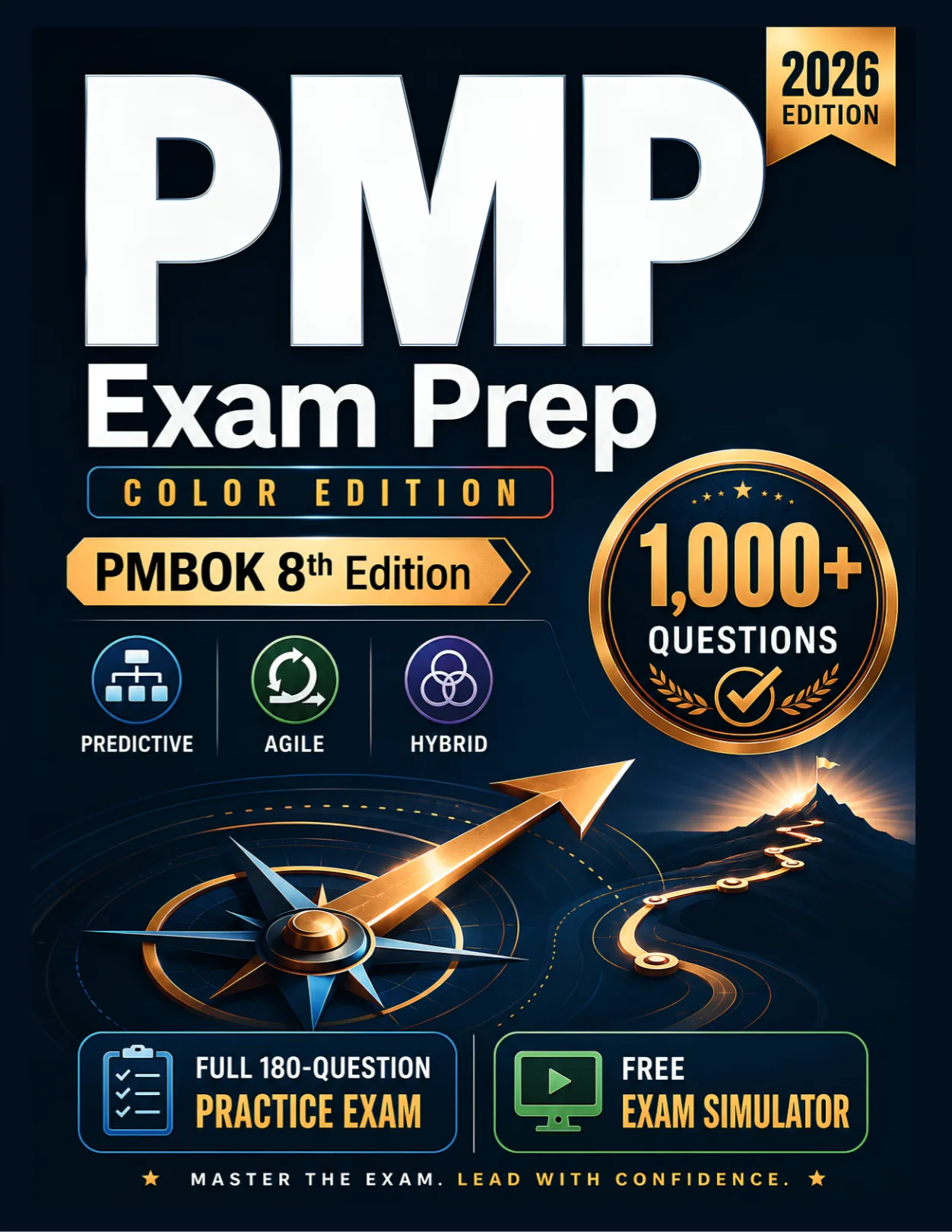
Featured book: PMP Exam Prep
CertPath Publishing's PMP Exam Prep is organized around the current Examination Content Outline, with 4 full-length practice exams (720 questions total), instant feedback, and a step-by-step explanation for every question.
Buy on Amazon →Question 3: People — communication channels after a team change
A hybrid product-launch project has run with a nine-person core team communicating informally. To hit a regulatory date the sponsor adds three vendor leads and two compliance specialists, all working remotely, and at the same time two of the original nine roll off to another programme. In the first week after the change, two duplicate decisions are made and a test environment is rebuilt twice. At the steering meeting the project manager is asked what changed and what will be done. What is the best response?
- A. Channels rose from 36 to 66, so the communications plan will be reworked around who needs which information and when
- B. Channels rose from 36 to 66, so the five joiners will be added to every existing distribution list and status call
- C. Channels rose from 36 to 91, so the communications plan will be reworked around who needs which information and when
- D. Channels rose from 45 to 78, so one daily all-hands call will be held until the regulatory launch date has passed
Correct answer: A.
Explanation: Channels equal n(n-1)/2. The team moves from nine people to twelve, not fourteen, because two members rolled off, so channels rise from 36 to 66 and the plan is reworked around information needs. The 91 figure is the strongest trap: it uses the right formula on the wrong headcount by ignoring the leavers. The 45 and 78 figures come from n(n+1)/2, which wrongly counts each person communicating with themselves.
Skill tested: applying the communication channels formula to the correct net headcount, and recognizing that a bigger channel count calls for a redesigned plan, not just adding people to what already exists.
The trap: forgetting to subtract the two people who left before adding the five who joined — a small arithmetic slip that inflates the channel count and points you at answer C instead.
Question 4: Business Environment — honest status reporting under pressure
At a monthly review the sponsor asks the project manager to report the status as green. Testing has found a defect that delays the release by three weeks. The project manager has a recovery plan that would restore the committed date, but it needs funding the steering committee has not yet approved. The sponsor argues that an amber status would trigger a funding freeze making the delay far worse, and that the recovery plan makes green a fair forecast. What should the project manager do?
- A. Ask the project management office to rule on the reporting treatment before the monthly review meeting takes place
- B. Tell the sponsor first, then report the delay with the unapproved recovery plan so the committee can decide on funding
- C. Report amber without informing the sponsor in advance, since the reporting obligation outweighs courtesy to the sponsor
- D. Report green on the basis of the recovery plan, since status reflects the forecast finish date rather than a temporary slip
Correct answer: B.
Explanation: A forecast that depends on unapproved funding is not a status, so the honest report shows the slip and the recovery plan together and puts the funding decision in front of the people who can make it. Reporting green on the forecast is the strongest trap, because forecast-based reporting is legitimate and the plan is real, yet it presents a contingent outcome as fact and buries the decision. Reporting amber unannounced is accurate but needlessly damaging.
Skill tested: recognizing that a recovery plan is only a valid basis for a status color once its funding or resources are actually approved, not merely proposed.
The trap: the sponsor's reasoning sounds responsible — "the plan restores the date, so report it" — but PMP questions in this style test whether you'll let a stakeholder's pressure turn an unapproved plan into a reported fact.
Who these questions are really testing
Look at what each wrong answer does: it applies a real, correct formula or principle to the wrong input — the wrong headcount, the wrong root cause, an unapproved plan treated as approved. PMP question writers rarely test whether you've memorized a formula; they test whether you can tell which formula fits the facts in front of you, and whether you'll hold the line when a stakeholder pushes for a shortcut. That pattern holds across all three domains, not just Process.
Two of these four questions expect a clean calculation — earned value, float, or a channel count — while the other two are pure judgment calls with no numbers at all. The real exam mixes both in similar proportion, so a study plan that only drills formulas, or only drills scenarios, leaves a gap.
The remaining 21 questions in the free set cover more of the current outline's domains, worked the same way with a full explanation after each one. Head to the free PMP sample to try them.
Eligibility, in brief
To sit the PMP exam, PMI requires one of two paths, both measured within your most recent 8 years: a four-year degree plus 36 months leading and directing projects, or a secondary diploma or associate degree plus 60 months of that experience. Either path also requires 35 hours of project management education or training, which an active CAPM certification satisfies. If you're not sure your experience or training qualifies, PMI's own PMP certification page is the authoritative source to confirm the current wording before you apply.
If you don't pass on your first attempt, PMI allows up to three attempts within your one-year eligibility window. Retake fees and the required waiting period between attempts can change, so confirm the current numbers on PMI's official PMP handbook rather than relying on a number you saw elsewhere.
Try 25 tough PMP questions free
No email, no signup. Full explanations after every answer.
FAQ
Where can I find free PMP practice questions?
CertPath Publishing has 25 free PMP practice questions at certpathpublishing.store/sample?book=pmp. No email or signup is required, and you get a full explanation after every answer.
How many questions are on the PMP exam and how long do I have?
The current PMP exam has 180 questions — 170 scored plus 10 unscored pretest questions mixed in and indistinguishable from the rest — with a 240-minute time limit and two optional 10-minute breaks.
What changed in the July 2026 PMP exam update?
PMI updated the PMP Examination Content Outline effective July 9, 2026, aligned to the PMBOK Guide, 8th edition. Domain weightings shifted to People 33%, Process 41% and Business Environment 26%, up from Business Environment's earlier 8% share.
What are the eligibility requirements for the PMP exam?
You need either a four-year degree plus 36 months leading and directing projects within the past 8 years, or a secondary diploma/associate degree plus 60 months of that experience within the past 8 years. Both paths also require 35 hours of project management education or training, which a CAPM certification satisfies.
Can I retake the PMP exam if I don't pass?
Yes. You can take the PMP exam up to three times within your one-year eligibility window. Retake fees and the required waiting period between attempts can change, so confirm the current numbers on PMI's official PMP handbook before you schedule one.
For the full study guide with 4 timed practice exams, see the PMP exam page — which also has a free full-length practice exam (email required) — or buy PMP Exam Prep on Amazon. And if PMP isn't the exam you're studying for, CertPath has free practice for other exams here.
— The CertPath Publishing Team