Complete Prep
PMP Complete Prep — $19.99.
Every task on the 2026 exam, taught in depth with scenario labs, formulas and full question walkthroughs, plus 4 timed online practice exams to prove you are ready.
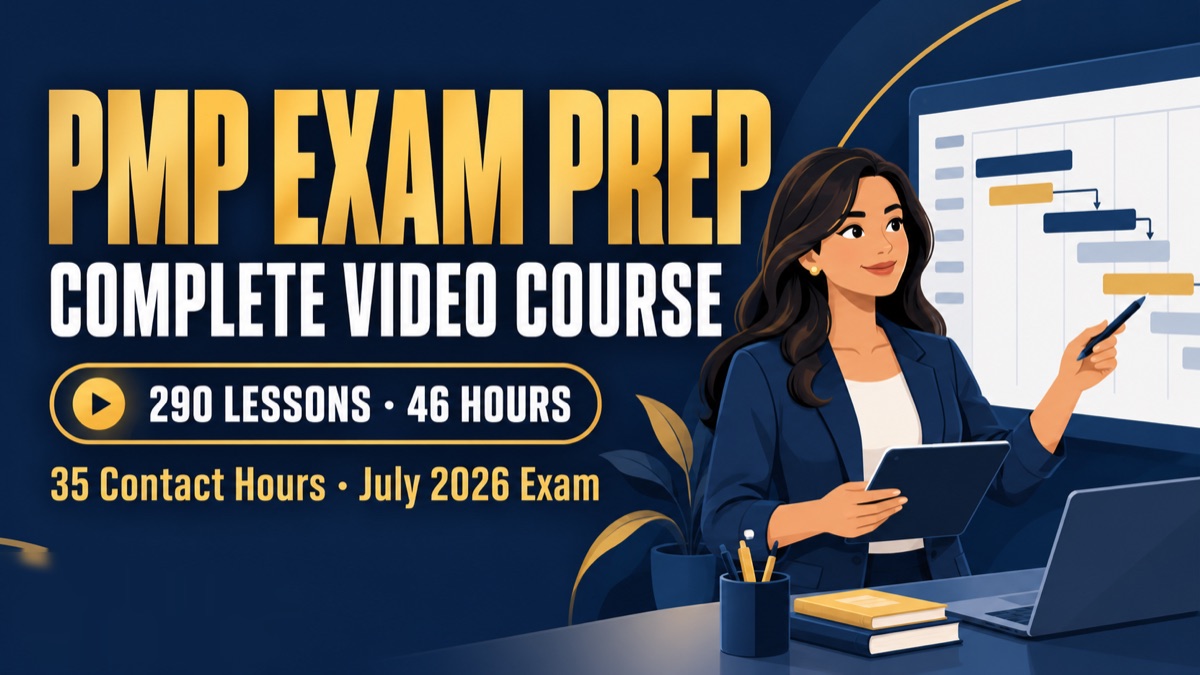 ▶ 290 lessons + 4 practice exams
290lessons
46.1 hof video
28sections
PMP Complete Prep — Video Course + Practice Exams
Every task of the July 2026 Exam Content Outline, taught in depth, with worked exam scenarios throughout.
- 4 timed online practice exams (720 questions), every answer explained
- 290 lessons across 28 sections — orientation, all three domains, agile & hybrid, formulas and final revision
- Every ECO task broken into focused 8–12 minute lessons you can finish on a lunch break
- Situational question walk-throughs: how to pick the answer PMI is looking for
- Built on PMBOK® 8 and the Agile Practice Guide, matched to the 2026 exam
- Progress tracking, speed control and auto-play — pick up exactly where you left off
$19.99One-time payment
No subscription. 12 months of access from the day you enter your access code — stream on phone, tablet or computer.
Get Complete Prep — $19.99
Already bought? Start watching →Own the book? It's free with your code
🔒 Secure checkout by Payhip💳 Card & PayPal🎓 CertPath Publishing
See the full curriculum — 290 lessons in 28 sections
Orientation, the 2026 Exam and Foundations11 lessons
- 001Course Orientation and the PMP Mindset
- 002The July 2026 PMP Exam Format
- 003Eligibility and the 35 Education Hours
- 004Reading the Approach — Question Mix
- 005Exam Mindset I — Servant Leadership and Root Cause
- 006Exam Mindset II — What Should the PM Do Next
- 007PMBOK 8 — The Six Principles
- 008PMBOK 8 — Domains and Focus Areas
- 009Life Cycles and Development Approaches
- 010Agile Foundations — Scrum and Kanban
- 011AI and Sustainability
Domain I — People · Develop a common vision9 lessons
- 012Develop a Common Vision (Task Overview)
- 013Building a Shared Vision
- 014Vision in Agile Teams
- 015Promoting the Vision
- 016Keeping the Vision Current
- 017Root Cause of a Misunderstood Vision
- 018Vision in Hybrid Programs
- 019Scenario Lab — Common Vision Questions
- 020Scenario Lab — Vision Case Study
Domain I — People · Manage conflicts11 lessons
- 021Manage Conflicts (Task Overview)
- 022Project Conflict Sources
- 023Analyzing Conflict Context
- 024Conflict Resolution Modes
- 025Collaborative Resolution
- 026Agile Team Agreements
- 027Ground-Rule Violations
- 028Escalation vs Resolution
- 029Agile Team Conflicts
- 030PMP Conflict Scenario Lab
- 031Hybrid Team Conflicts
Domain I — People · Lead the project team12 lessons
- 032Lead the Project Team (Task Overview)
- 033Setting Team Expectations
- 034Lesson 34 Empowering Teams
- 035Leadership Styles
- 036Tuckman's Stages & EI
- 037Problem Solving with the Team
- 038Voice of Team & Diversity
- 039Roles & RACI Charts
- 040Motivation & Virtual Teams
- 041Servant Leadership in Practice
- 042Leading Hybrid Teams
- 043PMP Scenario Lab
Domain I — People · Engage stakeholders11 lessons
- 044Engage Stakeholders (Task Overview)
- 045Identify Stakeholders
- 046Stakeholder Analysis
- 047Engagement Matrix
- 048Tailoring Communication
- 049Execute Engagement Plan
- 050Agile Stakeholders
- 051Trust Without Authority
- 052Hybrid Program Engagement
- 053PMP Stakeholder Scenarios
- 054Resistant Stakeholder Case
Domain I — People · Align stakeholder expectations10 lessons
- 055Align Stakeholder Expectations (Task Overview)
- 056Categorizing Stakeholders
- 057Needs & Expectations
- 058Facilitating Alignment
- 059PMP Agile Expectations
- 060Predictive Alignment
- 061PMP ECO Task 5
- 062Managing Expectations Early
- 063Aligning Hybrid Projects
- 064PMP Alignment Questions
Domain I — People · Manage stakeholder expectations10 lessons
- 065Manage Stakeholder Expectations (Task Overview)
- 066PMP Customer Types
- 067Align Outcomes & Expectations
- 068Measuring Satisfaction
- 069Continuous Customer Feedback
- 070Expectation Drift
- 071Handling Unhappy Customers
- 072Hybrid Acceptance
- 073PMP Stakeholder Lab
- 074Scenario Lab Case Study
Domain I — People · Help ensure knowledge transfer10 lessons
- 075Help Ensure Knowledge Transfer (Task Overview)
- 076Explicit & Tacit Knowledge
- 077Identify Critical Knowledge
- 078Gathering Knowledge
- 079Knowledge-Sharing Culture
- 080Agile Knowledge Transfer
- 081PMP Knowledge Transfer
- 082AI Knowledge Management
- 083Master Knowledge Transfer
- 084Key-Person Departure Case
Domain I — People · Plan and manage communication12 lessons
- 085Plan and Manage Communication (Task Overview)
- 086Comm Strategy & Plan
- 087Communication Complexity
- 088Comm Methods & Models
- 089PMP Mastery Transparency
- 090PMP Enabler P8.3
- 091Reporting Requirements
- 092Project Governance
- 093Agile Communication
- 094Hybrid Team Communication
- 095Cracking PMP Scenarios
- 096PMP People Domain Lab
Domain II — Process · Develop an integrated project management plan and plan delivery13 lessons
- 097Develop an Integrated Project Management Plan and Plan Delivery (Task Overview)
- 098Assess Project Needs
- 099Choosing & Tailoring Approach
- 100Critical Info Requirements
- 101PMP 101 Execution Strategy
- 102Integrated Project Plan
- 103PMP Prep Estimating
- 104Integrating Plans for PMP
- 105PMP 105 Plan & Data
- 106Hybrid Planning Concepts
- 107Tailoring Hybrid Life Cycles
- 108Adaptive Planning Levels
- 109PMP Exam Planning Scenarios
Domain II — Process · Develop and manage project scope10 lessons
- 110Develop and Manage Project Scope (Task Overview)
- 111Defining Project Scope
- 112PMP 112 Traceability
- 113Agreeing on Scope
- 114Demystifying Scope Breakdown
- 115Lesson 115 Agile Scope
- 116Validate Scope vs Quality
- 117Lesson 117 Hybrid Scope
- 118Scope Scenario Lab
- 119WBS and Backlog Practice
Domain II — Process · Help ensure value-based delivery10 lessons
- 120Help Ensure Value-Based Delivery (Task Overview)
- 121Identifying Value Components
- 122Prioritizing by Value
- 123MVP, MMF and Release Planning
- 124Examine Business Value
- 125Benefits Realization
- 126Evaluating Delivery Options
- 127Value in Hybrid Projects
- 128Value Stream Mapping
- 129Scenario Lab Value Delivery
Domain II — Process · Plan and manage resources10 lessons
- 130Plan and Manage Resources (Task Overview)
- 131Resource Planning — Resource Breakdown Structure and Estimating Resources
- 132Acquiring the Team — Pre-assignment, Negotiation and Virtual Teams
- 133Leveling vs Smoothing
- 134Resources in Agile
- 135Managing Resource Conflicts
- 136Physical Resources and JIT
- 137Assessing Team and Resource Performance
- 138Capacity Planning Across Multiple Agile Teams
- 139Scenario Lab — Resource Questions Worked Step by Step
Domain II — Process · Plan and manage procurement11 lessons
- 140Plan and Manage Procurement (Task Overview)
- 141Planning Procurement — Make-or-Buy and the Procurement Strategy
- 142Contract Types I — Fixed-Price Contracts
- 143Contract Types II — Cost-Reimbursable and Time-and-Materials
- 144Procurement Documents and Source Selection
- 145Negotiation Strategy and Agreement Negotiations
- 146Agile Contracting — Capped TandM, Incremental Delivery and Collaboration
- 147Managing Suppliers, Contracts, Claims and Disputes
- 148Evaluating Vendor Performance and Closing Procurements
- 149Procurement in Hybrid Projects — Fixed Deliverables Plus Iterative Work
- 150Scenario Lab — Procurement Questions Worked Step by Step
Domain II — Process · Plan and manage finance10 lessons
- 151Plan and Manage Finance (Task Overview)
- 152Analyzing Financial Needs — Estimating Costs and Building the Budget
- 153Contingency and Management Reserves — Quantifying Risk in the Budget
- 154The Cost Baseline, Funding Limits and Spend Tracking
- 155Project Selection Finance — NPV, IRR, Payback and BCR
- 156Financial Reporting to Sponsors and Governance
- 157Finance in Agile — Budgeting by Team, Burn Rate and Value Tracking
- 158Monitoring Financial Variation and Managing Reserves
- 159Funding Adaptive Delivery — Incremental Funding and Lean Portfolio Budgets
- 160Scenario Lab — Finance Questions Worked Step by Step
Domain II — Process · Plan and optimize quality of products/deliverables10 lessons
- 161Plan and Optimize Quality of Products-Deliverables (Task Overview)
- 162Gathering Quality Requirements and Metrics
- 163Planning Quality — Quality Assurance vs Quality Control
- 164The Seven Basic Quality Tools with Worked Examples
- 165Cost of Quality — Prevention, Appraisal and Failure Costs, Plus Sustainability
- 166Regulatory Compliance for Deliverables
- 167Quality in Agile — Definition of Done, Testing and Built-in Quality
- 168Quality Reviews, Audits and Continuous Improvement
- 169Hybrid Quality — Stage-Gate Acceptance and Continuous Testing Together
- 170Scenario Lab — Quality Questions Worked Step by Step
Domain II — Process · Plan and manage schedule12 lessons
- 171Plan and Manage Schedule (Task Overview)
- 172Defining Activities, Sequencing and Dependency Types
- 173Estimating Durations — Analogous, Parametric, Three-Point and Story Points
- 174The Critical Path Method with a Worked Network Diagram
- 175Float, Leads, Lags and Schedule Baselines
- 176Analyzing Schedule Variation and Compression — Crashing vs Fast-Tracking
- 177Adaptive Scheduling — Timeboxes, Release Plans and Velocity
- 178Coordinating with Other Projects and Operations, Benchmarks and History
- 179Kanban Scheduling — Cycle Time, Throughput and Service-Level Expectations
- 180Hybrid Schedules — Integrating Sprint Cadence with a Milestone Plan
- 181Scenario Lab — Schedule Questions Worked Step by Step
- 182Scenario Lab — Network Diagram Practicum
Domain II — Process · Evaluate project status12 lessons
- 183Evaluate Project Status (Task Overview)
- 184Metrics and Artifacts — Choosing and Tailoring What to Track
- 185Artifact Management — Created, Reviewed, Updated and Accessible
- 186Earned Value I — PV, EV, AC, Variances and Indices
- 187Earned Value II — Forecasting with EAC, ETC, VAC and TCPI
- 188Earned Value III — Reading Combined Indicators and Status Scenarios
- 189Adaptive Status — Burndown, Burnup, Velocity and Cumulative Flow
- 190Communicating and Reconciling Status
- 191Hybrid Status Reporting — Combining EVM with Agile Metrics
- 192Data-Driven Status — Dashboards, Throughput Forecasts and AI-Assisted Analytics
- 193Scenario Lab — Status and EVM Questions Worked Step by Step
- 194Scenario Lab — EVM Practicum with Data Tables
Domain II — Process · Manage project closure9 lessons
- 195Manage Project Closure (Task Overview)
- 196Closure Criteria and Final Acceptance
- 197Transition Readiness — Handover to Operations or the Next Phase
- 198Closing Activities — Lessons Learned, Procurement, Finance and Resources
- 199Closing Cancelled or Early-Terminated Projects
- 200Transition in Agile — Releases, Operational Readiness and Handover
- 201Closing Iterations and Releases vs Closing the Project
- 202Scenario Lab — Closure Questions Worked Step by Step
- 203Scenario Lab — Process Domain Mixed Review
Domain III — Business Environment · Define and establish project governance9 lessons
- 204Define and Establish Project Governance (Task Overview)
- 205Governance Structures, OPAs and Enterprise Environmental Factors
- 206Organizational Structures and the PMO — Functional, Matrix and Projectized
- 207Ethics and the PMI Code of Ethics and Professional Conduct
- 208Defining Success Metrics
- 209Escalation Paths and Tolerance Thresholds
- 210Governance in Agile and Hybrid Environments
- 211Lean and Adaptive Governance — Guardrails and Decentralized Decision-Making
- 212Scenario Lab — Governance and Ethics Questions Worked Step by Step
Domain III — Business Environment · Plan and manage project compliance8 lessons
- 213Plan and Manage Project Compliance (Task Overview)
- 214Confirming and Classifying Compliance Requirements
- 215Threats to Compliance and Methods to Support It
- 216Security, Health and Safety and Data Privacy on Projects
- 217Sustainability and ESG Compliance
- 218Consequences of Non-compliance and Measuring Compliance
- 219Compliance in Agile Delivery — Building Compliance into the Definition of Done
- 220Scenario Lab — Compliance Questions Worked Step by Step
Domain III — Business Environment · Manage and control changes9 lessons
- 221Manage and Control Changes (Task Overview)
- 222The Integrated Change Control Process Step by Step
- 223The Change Control Board, Change Requests and the Change Log
- 224Managing Change in Adaptive Delivery — Product Backlog, Product Ownership and Lightweight
- 225Communicating the Status of Proposed Changes
- 226Implementing Approved Changes and Updating Documentation
- 227Change in Hybrid Projects — When the Backlog and the Change Control Board Work Together
- 228Scenario Lab — Change Control Questions Worked Step by Step
- 229Scenario Lab — Change Request Sequencing Drag-and-Drop
Domain III — Business Environment · Remove impediments and manage issues7 lessons
- 230Remove Impediments and Manage Issues (Task Overview)
- 231Evaluating and Prioritizing Impediments
- 232Removing Blockers — Intervention Strategies and Continual Reassessment
- 233When a Risk Becomes an Issue — The Issue Log and Workarounds
- 234Collaborating with Stakeholders to Resolve Issues
- 235Impediments at Scale — Escalating Blockers Across Multiple Agile Teams
- 236Scenario Lab — Impediments and Issues Questions Worked Step by Step
Domain III — Business Environment · Plan and manage risk13 lessons
- 237Plan and Manage Risk (Task Overview)
- 238The Risk Management Plan — Appetite, Thresholds and Categories
- 239Identifying Risks — Techniques and Writing Good Risk Statements
- 240Qualitative Risk Analysis — Probability and Impact
- 241Quantitative Risk Analysis — EMV, Decision Trees and Monte Carlo
- 242Risk Responses for Threats and Opportunities
- 243Contingency vs Management Reserves and Contingency Plans
- 244Executing, Monitoring and Communicating Risk — The Risk Register and Risk Owners
- 245Risk in Agile — Risk-Adjusted Backlog, Spikes and Short Iterations
- 246Risk in Hybrid Projects — Risk Registers Plus Iterative Risk Burndown
- 247Security, Privacy and Sustainability Risks
- 248Scenario Lab — Risk Questions Worked Step by Step
- 249Scenario Lab — Decision Tree and EMV Practicum
Domain III — Business Environment · Continuous improvement7 lessons
- 250Continuous Improvement (Task Overview)
- 251PDCA and Kaizen — The Engine of Continuous Improvement
- 252Retrospectives and Lessons Learned That Actually Work
- 253Process Tailoring and Organizational Maturity
- 254Updating Organizational Process Assets
- 255Continuous Improvement at Scale — Inspect-and-Adapt, Flow and Kaizen Events
- 256Scenario Lab — Continuous Improvement Questions Worked Step by Step
Domain III — Business Environment · Support organizational change8 lessons
- 257Support Organizational Change (Task Overview)
- 258Assessing Organizational Culture
- 259Why Organizational Change Struggles and How to Build Readiness
- 260Change Management Models — ADKAR, Kotter and the Satir Model
- 261Evaluating the Impact of Organizational Change on the Project
- 262Organizational Change Across Development Approaches, Including Agile Transformations
- 263Change Readiness for AI and Digital Transformation Projects
- 264Scenario Lab — Organizational Change Questions Worked Step by Step
Domain III — Business Environment · Evaluate external business environment changes8 lessons
- 265Evaluate External Business Environment Changes (Task Overview)
- 266Surveying and Continually Reviewing the External Environment — PESTLE and Market Scanning
- 267Assessing and Prioritizing External Impact on Scope and Backlog
- 268AI in Project Environments — Uses, Limits and Governance
- 269AI Risks — Data Privacy, Bias, Accuracy and Human Oversight
- 270Responding to Market and Technology Shifts with Adaptive Planning
- 271Scenario Lab — External Environment and AI Questions Worked Step by Step
- 272Scenario Lab — Business Environment Domain Mixed Review
Module 4 — Integration and Exam Readiness18 lessons
- 273Formulas and Calculation Practice
- 274Final Revision and Test-Day Strategy
- 275Practice Exam Debrief and Remediation
- 276Interpreting Agile and Hybrid Metrics — Worked Data Scenarios
- 277Formula Masterclass II — Schedule, Communication, Risk and Finance Formulas
- 278Commonly Confused Terms — The Pairs That Trap Candidates
- 279Case-Scenario and Graphic-Based Items
- 280Practicum and Data-Driven Items
- 281Multiple Response, Enhanced Matching, Point-and-Click, Matching and Pull-Down Items
- 282Full Walkthrough I — People Domain Question Set
- 283Full Walkthrough II — Process Domain Question Set (Predictive Focus)
- 284Full Walkthrough III — Process Domain Question Set (Agile and Hybrid Focus)
- 285Full Walkthrough IV — Business Environment Question Set
- 286Full Walkthrough V — Mixed Hard Questions and the Traps Behind Them
- 287Final Review — People Domain in One Session
- 288Final Review — Process Domain in One Session
- 289Final Review — Business Environment Domain in One Session
- 290The Last 48 Hours — Exam-Day Plan, Timing and Mindset