CAPM vs. PMP: Which PMI Certification Do You Need?
Both certifications come from the Project Management Institute, both show up in job postings, and both get lumped together in search results as if they're interchangeable. They aren't. One requires zero work experience and tests foundational concepts; the other requires years of documented project leadership and tests judgment under realistic pressure. Here's exactly how they differ, so you don't spend months preparing for the wrong exam.
CertPath Publishing's CAPM Exam Prep guide is built around the current CAPM Examination Content Outline, and its free practice questions are a good way to see whether CAPM-style questions feel manageable before you commit — try 25 of them at certpathpublishing.store/sample?book=capm, no email or signup required. Below, we'll walk through eligibility, format, domains, cost and — most importantly — which one actually fits where you are right now.
The one-sentence version
CAPM is an entry-level credential open to almost anyone willing to complete 23 hours of project management training; PMP is a mid-to-senior credential that requires PMI to verify years of actual experience leading projects before you're even allowed to sit for it. If you're weighing "which one should I study for," the honest first question is whether you currently meet PMP's experience bar — not which exam sounds more impressive.
Eligibility: the difference that actually decides this for you
This is where most people's decision gets made for them, whether they realize it or not.
CAPM requires a secondary credential — a high school diploma, GED, associate degree, or higher — plus 23 contact hours of project management education completed through a PMI Authorized Training Partner or equivalent. PMI removed CAPM's old work-experience option in 2024, so today there is no experience path at all: training hours are the only bar, and there's no minimum age requirement PMI publishes beyond needing the underlying credential.
PMP requires one of two paths, both measured within your most recent 8 years: a four-year degree plus 36 months leading and directing projects, or a secondary diploma/associate degree plus 60 months of that same experience. Both paths also require 35 hours of project management education or training — hours that an active CAPM certification satisfies, which is the one real structural link between the two credentials.
Worked example. Say a candidate has an associate degree and 30 months of experience leading small projects, earned over the last 6 years. Do they qualify for either exam?
- CAPM: yes. The associate degree satisfies the credential requirement, and only the 23 training hours are missing — no experience threshold applies at all.
- PMP: not yet. The secondary-diploma path needs 60 months of leading-and-directing experience; 30 months is half of that. They'd need another 30 months of qualifying experience (or a four-year degree, which still needs 36 months) before PMI would approve a PMP application.
That's the whole decision in miniature: if your experience doesn't clear PMP's bar yet, CAPM isn't a consolation prize — it's the correct exam for where you are, and the training hours you log for it count toward PMP later.
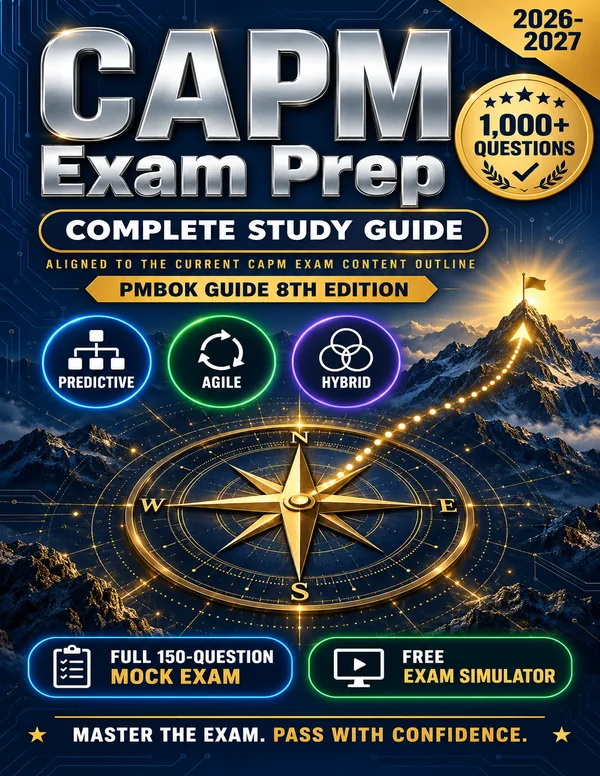
Featured book: CAPM Exam Prep
CertPath Publishing's CAPM Exam Prep is organized around the current Examination Content Outline, with 5 full-length practice exams, instant feedback, and a step-by-step explanation for every question.
Buy on Amazon →Format and domains, side by side
Both exams are administered by PMI. CertPath Publishing is an independent publisher and is not affiliated with or endorsed by PMI.
The CAPM Examination Content Outline covers four domains:
- Project Management Fundamentals and Core Concepts — 36%
- Predictive, Plan-Based Methodologies — 17%
- Agile Frameworks/Methodologies — 20%
- Business Analysis Frameworks — 27%
The exam itself is 150 questions (135 scored, 15 unscored pretest items mixed in) over 180 minutes with one 10-minute break, using multiple-choice, multiple-response, matching and point-and-click question formats.
The PMP Examination Content Outline, updated effective July 9, 2026 alongside the PMBOK Guide, 8th edition, covers three domains: Process (41%), People (33%) and Business Environment (26%). The exam is 180 questions (170 scored, 10 unscored) over 240 minutes with two optional 10-minute breaks.
Worked example: how many questions per domain should you expect?
Applying each outline's published weights to its total question count (rounding to whole questions, so the totals still add up):
- CAPM (150 questions): roughly 54 on Fundamentals, 40–41 on Business Analysis, 30 on Agile, and 25–26 on Predictive methodologies.
- PMP (180 questions): roughly 74 on Process, 59 on People, and 47 on Business Environment.
PMI doesn't guarantee an exact count per domain on any individual exam form — pretest and scored items are mixed and reshuffled — so treat these as planning estimates, not a guaranteed blueprint. The takeaway that does hold: CAPM spreads its weight across four different ways of working (plan-based, agile and business analysis, not just classic PM theory), while PMP concentrates over half its weight on Process and People — the two domains most dependent on having actually run a project.
Cost and how long it lasts
CAPM costs $225 for PMI members and $300 for non-members. PMP costs meaningfully more — $675 for non-members as of the 2026 fee schedule, with the member-rate having changed partway through 2026, so confirm the current member price directly on PMI's certification pages before you register rather than trusting a number you saw on a third-party site. Both credentials require ongoing continuing-education units to maintain once earned, and both allow up to three exam attempts within a one-year eligibility window before you'd need to reapply.
So which one should you actually take?
A few common situations, and where they point:
- You're new to project management, in school, or changing careers with no formal PM experience yet. Take CAPM. It's the only one you're eligible for today, and it builds a foundation — including hours that count toward PMP's education requirement — while you accumulate the experience PMP requires.
- You already lead or direct projects and can document 36–60 months of that experience within the last 8 years. Go straight for PMP. Passing CAPM first isn't required and won't shortcut PMP's own exam content, so it mainly makes sense if you want the credential now and the experience clock hasn't caught up yet.
- You work in a hybrid predictive/agile environment and want a credential that explicitly covers both. CAPM's content outline was rebuilt in 2023 specifically to span predictive, agile and business-analysis ways of working — arguably a broader methodology footprint than PMP's, even though PMP sits at a higher seniority level.
Try 25 tough CAPM questions free
No email, no signup. Full explanations after every answer.
FAQ
Where can I find free CAPM practice questions?
CertPath Publishing has 25 free CAPM practice questions at certpathpublishing.store/sample?book=capm. No email or signup is required, and you get a full explanation after every answer.
Is the CAPM exam easier than the PMP exam?
They test different things rather than one simply being easier. CAPM covers foundational concepts across predictive, agile and business-analysis ways of working with no work-experience requirement, while PMP tests situational judgment built on actual experience leading projects. Many candidates find PMP's scenario questions harder specifically because they assume you've lived the trade-offs, not just studied them.
Do I need to earn CAPM before I can take the PMP exam?
No. CAPM and PMP have separate, independent eligibility requirements, and you can apply for PMP directly once you meet its education-and-experience criteria. CAPM is useful as a stepping stone mainly because its training can satisfy part of the project-management-education hours PMP also requires.
How much do the CAPM and PMP exams cost?
CAPM costs $225 for PMI members and $300 for non-members. PMP costs substantially more — $675 for non-members, with the member rate having changed in 2026, so confirm the current member price on PMI's official certification pages before you register.
Can I retake the CAPM or PMP exam if I don't pass?
Yes, for both. PMI allows up to three attempts within your one-year eligibility window for either exam. If you use all three without passing, you must wait one year from your last attempt before reapplying.
See the CAPM exam page or the PMP exam page for the full study guides — both also link to a free full-length practice exam (email required) at /capm and /pmp respectively. You can also buy CAPM Exam Prep on Amazon. And if neither PMI exam is the one you're studying for, CertPath has free practice for other exams here.
— The CertPath Publishing Team