Free Mechanical Aptitude Practice Test: 4 Questions Explained
"Mechanical aptitude test" isn't one exam — it's a category of pre-employment assessments that utilities, manufacturers and trades employers use to screen apprentices, machine operators, maintenance techs and lineworkers. The three you'll run into most often ask the same kinds of questions in different packaging: read a diagram, apply a simple physics relationship, and pick the choice that survives the traps built around common mistakes. Below are 4 questions in that exact style, worked all the way through.
CertPath Publishing's Mechanical Aptitude Study Guide is where these worked examples come from in spirit — it drills the same recurring setups (levers, gears, pulleys, hydraulics, springs, friction) that show up across BMCT, WTMA and Ramsay-style tests. Before you buy anything, try 25 free mechanical aptitude practice questions at certpathpublishing.store/sample?book=mech-apt — no email or signup required, with a full explanation after every answer.
Which "mechanical aptitude test" are you actually taking?
If a recruiter told you to expect a "mechanical test" without naming it, it's almost certainly one of these three commercial assessments. CertPath Publishing is an independent publisher and isn't affiliated with any of them.
- Bennett Mechanical Comprehension Test (BMCT-II), published by Pearson TalentLens: 55 picture-based items in 25 minutes, drawn from a large item bank so no two sittings look identical.
- Wiesen Test of Mechanical Aptitude (WTMA), published by Criteria Corp: 60 questions in 30 minutes, built to reduce gender and racial adverse impact compared with older mechanical tests.
- Ramsay Mechanical Aptitude Test (MAT-5), published by Ramsay Corporation: 36 questions in 20 minutes, aimed specifically at entry-level maintenance, millwright and machine-operator roles.
All three are usually scored as a percentile against other test-takers rather than a pass/fail cutoff, so there's no single published "passing score" to chase — accuracy and pacing are what move the needle. Ask whoever scheduled your test which one it is; the topics overlap heavily, but the item count and time pressure differ enough to change how you should pace yourself.
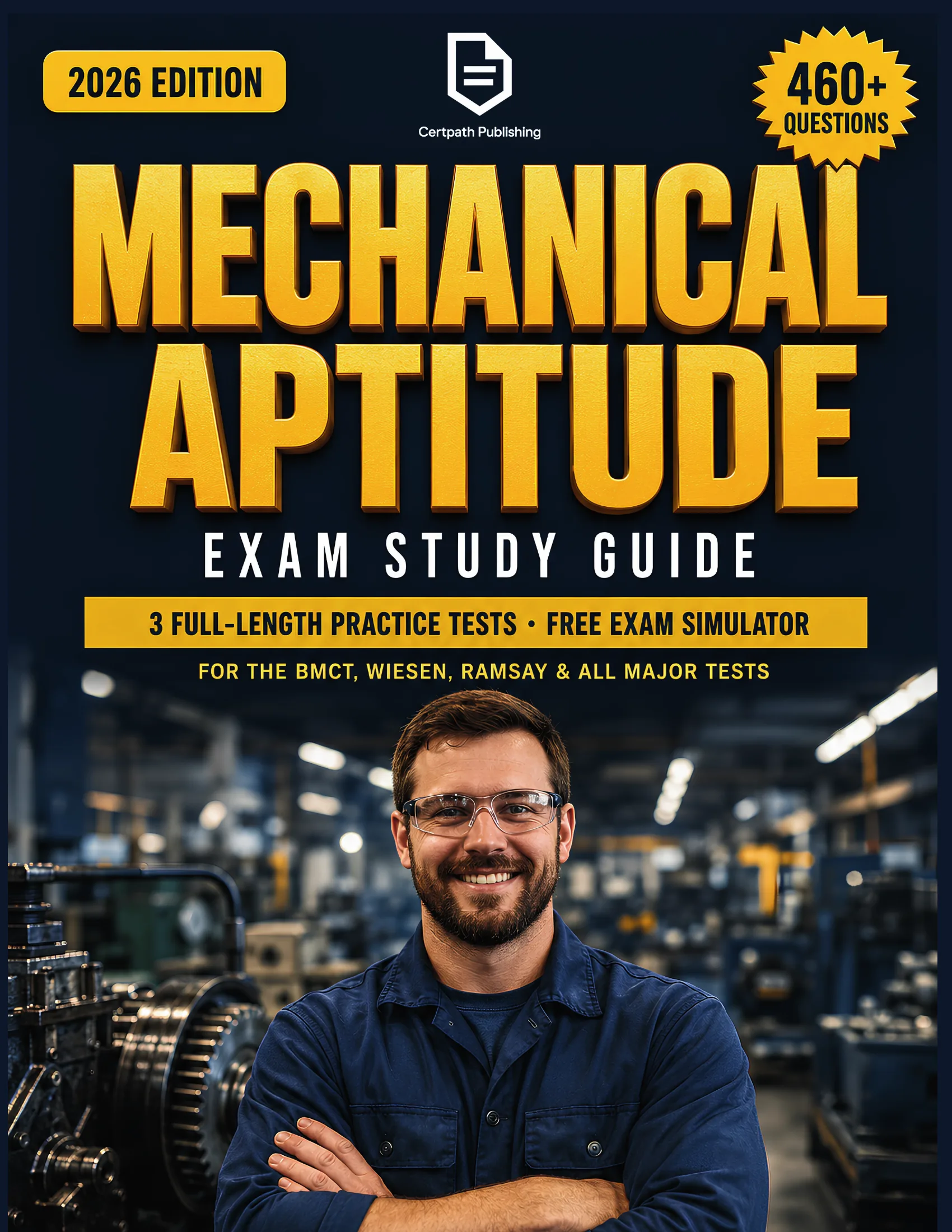
Featured book: Mechanical Aptitude Study Guide
CertPath Publishing's Mechanical Aptitude Study Guide covers levers, gears, pulleys, belts, hydraulics, pneumatics, springs, friction and basic electricity across 180 practice questions in three full-length tests, plus a free 10-lesson video course.
Buy on Amazon →4 practice questions, worked step by step
These four come from CertPath's free 25-question sample set and don't appear in the paid book. Each one is quoted exactly as written, followed by the answer and full explanation.
Question 1 — Gear trains: torque through a worm reducer
A 1.5 hp motor running at 1,750 rpm drives a worm reducer with a 25 to 1 ratio and an efficiency of 70 %. Torque in lb-ft equals horsepower × 5,252 ÷ rpm. What torque appears at the reducer's output shaft?
- A. 55.1 lb-ft
- B. 78.8 lb-ft
- C. 4.5 lb-ft
- D. 112.5 lb-ft
Answer: B — 78.8 lb-ft. Motor torque is 1.5 × 5,252 ÷ 1,750 = 4.5 lb-ft. The reduction multiplies torque by 25, giving 112.5 lb-ft ideally, and the 70% efficiency reduces that to 112.5 × 0.70 = 78.8 lb-ft. The 112.5 lb-ft answer ignores the losses, which worm gearing makes large. The 55.1 lb-ft answer applies efficiency twice, and 4.5 lb-ft stops at the motor shaft.
Skill tested and common trap: this checks whether you know efficiency losses apply once, after the ideal mechanical advantage, not twice and not never. The strongest trap is 112.5 lb-ft — it's arithmetically clean and "feels" like the answer if you forget worm gearing wastes a lot of the input power as heat and friction.
Question 2 — Pneumatics: free air drawn from a receiver
An 80 cubic foot air receiver is charged to 120 psig. Tools draw from it until the pressure falls to 90 psig. Atmospheric pressure is 14.7 psi and the air stays at the same temperature. How much free air, measured at atmospheric pressure, is drawn from the receiver?
- A. 733 cubic feet
- B. 80 cubic feet
- C. 163 cubic feet
- D. 570 cubic feet
Answer: C — 163 cubic feet. At constant temperature, free air equals tank volume × absolute pressure ÷ 14.7. The receiver holds 80 × 134.7 ÷ 14.7 = 733 cubic feet of free air at the start and 80 × 104.7 ÷ 14.7 = 570 cubic feet at the end, so 163 cubic feet are drawn. The 733 answer is everything in the tank, ignoring that the tools stop at 90 psig, and 570 is what remains.
Skill tested and common trap: this checks whether you convert gauge pressure to absolute pressure (adding atmospheric pressure) before comparing states, and whether you compute a difference rather than reporting one of the two raw totals. Reading "733" or "570" straight off your work and stopping there, without subtracting, is the trap most candidates fall into under time pressure.
Question 3 — Springs: finding load from spring rate
A coil spring shortens 0.6 in when a 90 lb load is set on it. Staying within the spring's elastic range, what load shortens it 1.5 in?
- A. 375 lb
- B. 135 lb
- C. 225 lb
- D. 36 lb
Answer: C — 225 lb. The spring rate is 90 ÷ 0.6 = 150 lb per inch, so 1.5 in needs 150 × 1.5 = 225 lb. The 135 lb answer multiplies the original 90 lb by the new deflection of 1.5, mixing a load with a length. The 375 lb answer multiplies the rate by the deflection ratio of 2.5 instead of by the deflection, and 36 lb inverts the proportion.
Skill tested and common trap: this is a straightforward proportional-reasoning question dressed up in spring terminology — the real skill is finding the constant rate first (load ÷ deflection) instead of scaling the given numbers directly against each other, which is what produces the 135 lb trap.
Question 4 — Friction: skids versus rollers
A 1,200 lb crate is dragged on skids across a floor where the coefficient of friction is 0.35. Pipe rollers placed under the crate lower the effective coefficient to 0.05. How much less force is needed to keep the crate moving once the rollers are under it?
- A. 420 lb less
- B. 480 lb less
- C. 60 lb less
- D. 360 lb less
Answer: D — 360 lb less. On skids the resistance is 0.35 × 1,200 = 420 lb; on rollers it is 0.05 × 1,200 = 60 lb. The saving is 420 − 60 = 360 lb. The 420 lb answer gives the skid force rather than the saving, and 60 lb gives the roller force, both of which answer a question the stem did not ask. The 480 lb answer adds the two coefficients instead of taking their difference.
Skill tested and common trap: the question asks for a difference, but two of the four choices are just the individual friction forces you calculate along the way. Reading the question stem carefully — "how much less" — before circling an answer is the actual skill being tested here, more than the friction formula itself.
A short prep checklist before test day
Mechanical aptitude tests reward pattern recognition more than deep engineering knowledge. A focused week looks like this:
- Day 1–2: Refresh the core relationships — moments (force × distance), gear/belt/chain speed ratios, mechanical advantage in pulleys and inclined planes, and Ohm's law basics.
- Day 3–4: Practice reading diagrams under time pressure. Most points are lost to misreading a dimension or direction arrow, not to not knowing the formula.
- Day 5: Drill unit conversions — inches to feet, gauge to absolute pressure, rpm ratios — since almost every trap answer in this article comes from a skipped or doubled conversion.
- Day 6–7: Take timed practice sets that match your actual test's pacing (roughly 27 seconds per question on the BMCT-II, 30 seconds on the WTMA, 33 seconds on the Ramsay MAT-5), and review every miss for which trap caught you.
Try 25 tough mechanical aptitude questions free
No email, no signup. Full explanations after every answer.
FAQ
Where can I find free mechanical aptitude practice questions?
CertPath Publishing has 25 free mechanical aptitude practice questions at certpathpublishing.store/sample?book=mech-apt. No email or signup is required, and you get a full explanation after every answer.
Which mechanical aptitude test will I actually take?
It depends on the employer, not on you. Utilities, manufacturers and staffing agencies pick from a handful of commercial tests — most often the Bennett Mechanical Comprehension Test (BMCT-II) from Pearson TalentLens, the Wiesen Test of Mechanical Aptitude (WTMA) from Criteria Corp, or a Ramsay Corporation Mechanical Aptitude Test (MAT-5). Ask your recruiter which one you're scheduled for so you can match your practice to its format.
Do I need to memorize physics formulas for these tests?
A short list, not a semester's worth. Moments (force times distance), gear and belt speed ratios, spring rate, friction force, and simple pressure and torque relationships cover most questions. The formulas matter less than reading a diagram carefully and tracking units as you convert them.
How long should I study for a mechanical aptitude test?
Most candidates see real improvement in one to two weeks of short, focused sessions, since these tests reward recognizing a handful of recurring setups rather than deep technical knowledge. If you can already do basic algebra and remember how levers, gears and pulleys behave, a few practice sets may be enough.
Is there a fixed passing score on a mechanical aptitude test?
Usually not a published one. These tests are typically scored as a percentile compared with other test-takers, and each employer sets its own cutoff for the role, which they don't usually publish. Focus on accuracy and pacing rather than chasing a specific number.
See the mechanical aptitude exam page for the full study guide and free video course, or buy the Mechanical Aptitude Study Guide on Amazon. If you're prepping for a different exam, CertPath has free practice for other exams here.
— The CertPath Publishing Team