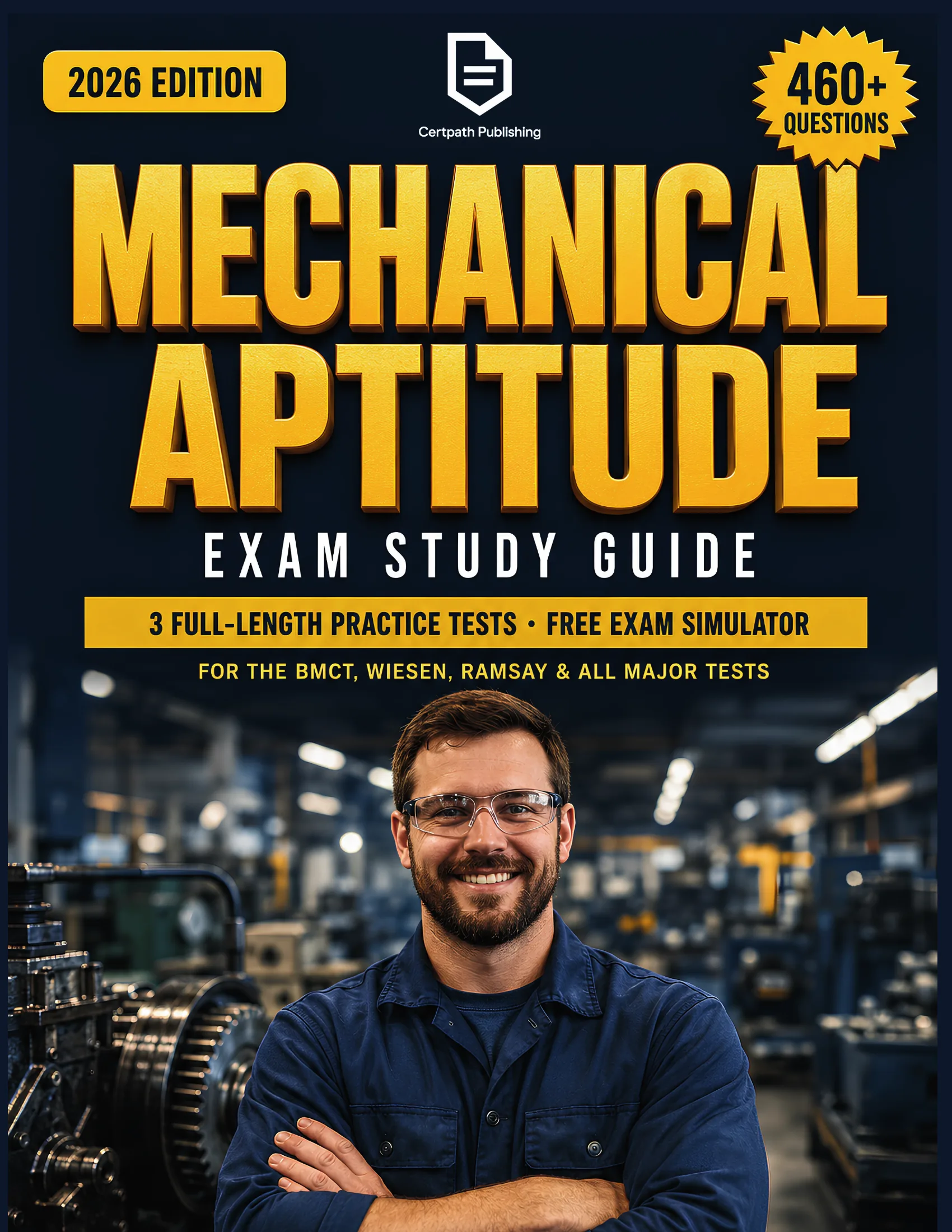
Build real intuition for the Bennett (BMCT-II), Wiesen (WTMA), Ramsay, and other mechanical aptitude tests used to screen for skilled-trade and industrial jobs. Try 10 exam-style practice questions below, free.
▶ New: Free 30-lesson Mechanical Aptitude video course on YouTube · watch here
Straight from our question bank — answer each one and see the step-by-step explanation instantly.
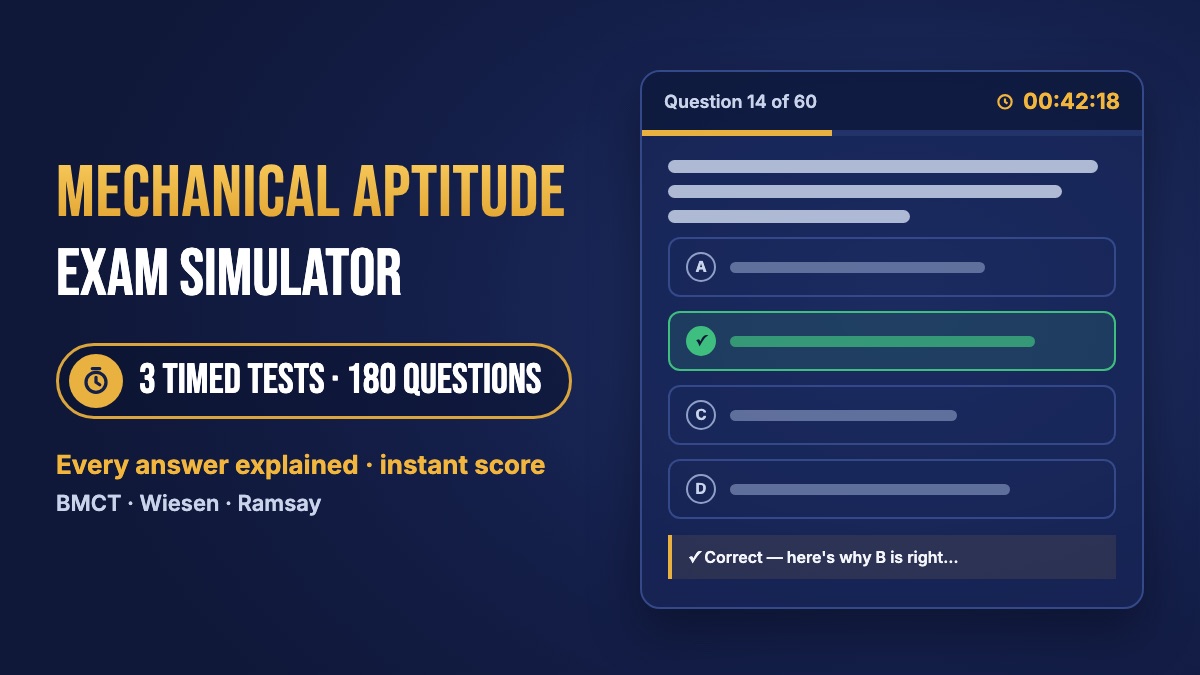
3 timed online practice tests (180 questions) that run like the real exam, score you the moment you finish and explain every answer.
⏱ 3 timed practice tests
Sit each test under exam timing, see your score straight away, then review every question with the reasoning behind the right answer.
A free companion to the exam simulator: 30 short lessons on every topic the tests cover. No sign-up needed.
Lesson 1: Mechanical Aptitude Test Explained: Bennett, Wiesen, Ramsay and Criteria (How to Prepare)Plays here from YouTube. Nothing loads from YouTube's player until you press play.
5:04
Lesson 1: Mechanical Aptitude Test Explained: Bennett, Wiesen, Ramsay and Criteria (How to Prepare)
5:43
Lesson 2: Speed vs Velocity and Distance vs Displacement
5:45
Lesson 3: Acceleration and Free Fall: Which One Lands First?
6:00
Lesson 4: Newton's Three Laws of Motion Explained Simply
5:07
Lesson 5: Friction Explained: Static vs Kinetic vs Rolling
6:26
Lesson 6: Work, Energy and Power Made Simple
5:06
Lesson 7: First-Class Levers: Solve Lever Math in Seconds
5:01
Lesson 8: Second- and Third-Class Levers: Wheelbarrows, Tweezers and the Trap
5:27
Lesson 9: Inclined Planes, Wedges and Screws Explained
5:17
Lesson 10: Fixed vs Movable Pulleys: Count the Ropes
5:14
Lesson 11: Block and Tackle and Wheel-and-Axle Explained
5:17
Lesson 12: Mechanical Advantage and Efficiency: The Formulas You Need
4:37
Lesson 13: Gear Direction and Idler Gears: Which Way Does It Turn?
5:04
Lesson 14: Gear Ratio, Speed and Torque Explained
4:42
Lesson 15: Belts, Chains and Sprockets Explained
7:34
Lesson 16: Torque and Rotational Motion Explained
8:38
Lesson 17: Pressure and Pascal's Principle Explained
8:58
Lesson 18: Hydraulic and Pneumatic Systems: Hydraulic Lift Math
8:04
Lesson 19: Fluid Flow and Bernoulli's Principle Explained
9:13
Lesson 20: Buoyancy and Archimedes' Principle: Will It Float?
6:53
Lesson 21: Voltage, Current, Resistance and Ohm's Law
7:47
Lesson 22: Series vs Parallel Circuits Explained
8:16
Lesson 23: Electrical Power, Grounding and AC vs DC
6:46
Lesson 24: Heat, Temperature and Thermal Expansion
8:31
Lesson 25: Conduction, Convection and Radiation Explained
9:09
Lesson 26: Common Hand Tools and Their Uses
8:27
Lesson 27: Power Tools, Fasteners and Materials
7:45
Lesson 28: Spatial Reasoning: Rotation and Folding Questions
8:10
Lesson 29: Pattern Recognition and Assembly Problems
8:36
Lesson 30: Light, Sound, Centre of Gravity and StructuresLevers, pulleys, gears, fluids and forces explained with clear diagrams and 3 full-length practice tests in the book — plus an access code for 3 timed online practice tests (180 questions, each explained).
Already have the book? Open your practice tests →
It measures your understanding of basic physical and mechanical principles — forces, levers, pulleys, gears, fluids, and simple machines. Employers in manufacturing, utilities, the military, and apprenticeship programs use it to predict how well you reason about mechanical problems on the job.
The most common ones: the Bennett Mechanical Comprehension Test (BMCT-II, about 55 questions in 25 minutes), the Wiesen Test of Mechanical Aptitude (WTMA, 60 questions in 30 minutes), and the Ramsay MAT. The underlying concepts overlap heavily, so one book prepares you for all of them.
Simple machines (levers, pulleys, gears, inclined planes), forces and motion, gravity and momentum, fluids and pressure, energy, basic electricity, and everyday tool and shop knowledge.
No. Mechanical aptitude is conceptual, not computational — most questions are answered by reasoning about a picture or scenario. A calculator is usually not needed or allowed.
A full concept review, 3 full-length timed practice tests, 180+ practice questions with explanations, and free timed online practice tests via the access code printed inside.